Why Controlled Impedance Matters in RF PCB Manufacturing
A practical guide to controlled impedance, signal reflection, stackup design, material selection, and manufacturing control for RF and high frequency PCB projects.
Home » Controlled Impedance » Why Controlled Impedance Matters in RF PCB Manufacturing
Table of Contents
Why Controlled Impedance Matters in RF PCB Manufacturing
Controlled impedance is one of the most important requirements in RF PCB manufacturing. In high frequency circuits, signals are more sensitive to material properties, trace geometry, copper thickness, stackup structure and manufacturing tolerance.
For standard low-frequency electronic products, small impedance variation may not cause serious performance problems. But for RF PCB, microwave PCB, antenna PCB, radar PCB and high frequency communication boards, impedance variation can directly affect signal transmission and final product performance.
This is why controlled impedance should be reviewed before manufacturing, especially for RF and microwave PCB projects.
What Is Controlled Impedance in PCB?
Controlled impedance means that the PCB transmission line is designed and manufactured to maintain a specific impedance value.
In RF and high frequency PCB design, common impedance values may include 50 ohms, 75 ohms or other values depending on the circuit requirement. The target impedance is usually determined by the circuit design, component requirement, antenna system or signal transmission standard.
Controlled impedance is affected by several factors:
Trace width
Trace spacing
Copper thickness
Dielectric thickness
Dielectric constant
Layer stackup
Reference plane structure
Solder mask influence
Manufacturing toleranceIf these factors are not controlled properly, the real impedance of the finished PCB may deviate from the design target.
Why Controlled Impedance Is Important for RF PCB
RF signals behave differently from low-frequency signals. At higher frequencies, PCB traces are not just copper connections. They become transmission lines.
When impedance is not controlled, the RF signal may experience reflection, loss or distortion. This can reduce circuit performance and cause testing problems.
Controlled impedance helps support:
Stable RF signal transmission
Reduced signal reflection
Better signal integrity
Predictable circuit behavior
Lower transmission loss
Improved antenna matching
More reliable RF module performanceFor RF modules, wireless communication boards, antenna systems and microwave circuits, controlled impedance is often a basic requirement rather than an optional feature.
What Happens If Impedance Is Not Controlled?
If impedance is not controlled, the PCB may still look physically correct, but the circuit may not perform as expected.
Possible problems include:
Signal reflection
Insertion loss increase
Poor impedance matching
Unstable RF performance
Reduced antenna efficiency
Higher return loss
Signal distortion
Failed RF testing
Inconsistent batch performanceIn some cases, the problem may only appear during product testing or final system integration. This can increase project cost and delay production.
For high frequency PCB projects, it is better to review impedance requirements before fabrication instead of trying to solve RF problems after the board is made.
Controlled Impedance and Signal Reflection
Signal reflection is one of the main reasons controlled impedance matters.
When the impedance of a transmission line does not match the source, load or system requirement, part of the signal may reflect back instead of traveling smoothly through the circuit.
In RF and microwave circuits, reflection can affect power transfer, signal quality and system stability.
For antenna PCB and RF front-end designs, poor impedance matching may reduce antenna performance or cause unstable communication behavior.
This is why impedance control is closely related to RF performance, antenna matching and microwave signal reliability.
Key Factors That Affect PCB Impedance
Dielectric Constant
Dielectric constant, also known as Dk, affects signal speed and impedance.
High frequency PCB materials such as Rogers, PTFE, Taconic and F4B are often selected because they offer more suitable electrical performance than standard FR4 for RF and microwave applications.
If the Dk value is unstable or not suitable for the design, impedance may become difficult to control.
Dielectric Thickness
Dielectric thickness is the distance between the signal trace and its reference plane.
This thickness has a direct effect on impedance. Small thickness variations can change the final impedance value, especially in high frequency PCB applications.
For multilayer RF PCB projects, stackup thickness must be reviewed carefully before production.
Trace Width and Spacing
Trace width is one of the most important design parameters for controlled impedance.
A wider or narrower trace can change the impedance value. For differential or coupled lines, spacing between traces is also important.
The PCB manufacturer must be able to produce trace width and spacing within the required tolerance.
Copper Thickness
Copper thickness also affects impedance.
If the finished copper thickness is different from the design assumption, the final impedance may change. This is especially important when plating increases the copper thickness during production.
Before production, the copper thickness should be confirmed together with the stackup and impedance calculation.
Reference Plane
A stable reference plane is important for controlled impedance.
RF traces usually need a nearby ground plane or reference layer to form a predictable transmission line structure. If the reference plane is broken, poorly connected or incorrectly designed, impedance and signal performance may be affected.
Solder Mask
For some RF PCB designs, solder mask may also affect impedance slightly, especially on outer-layer microstrip structures.
If the design has strict impedance requirements, solder mask influence should be considered during impedance calculation.
Common Controlled Impedance Structures in RF PCB
Controlled impedance structures depend on the PCB layer design and signal routing method.
Common structures include:
Microstrip
Stripline
Coplanar waveguide
Grounded coplanar waveguide
Differential pair
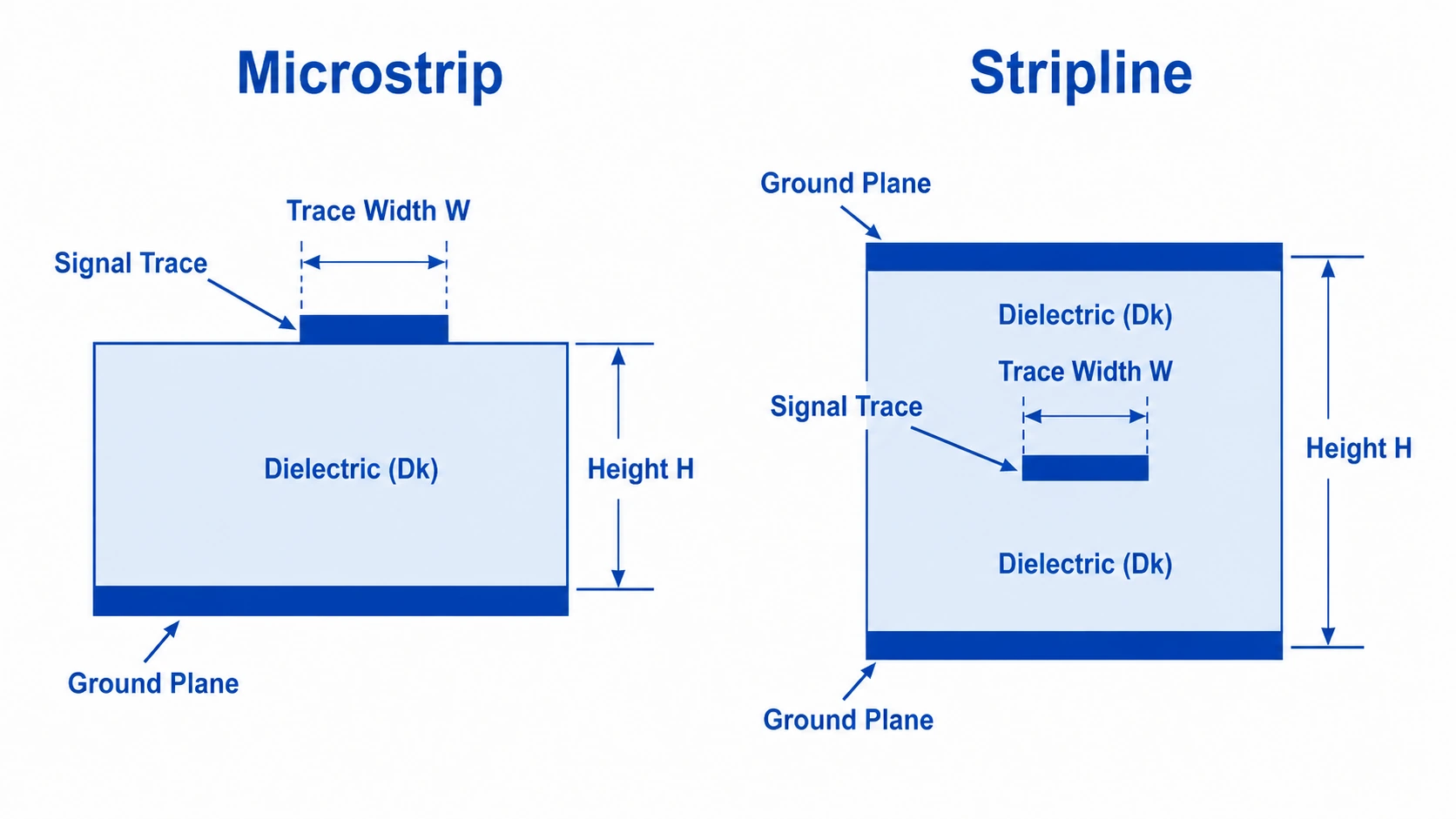
Embedded transmission lineMicrostrip
A microstrip line is usually located on an outer layer with a reference plane below it.
It is common in RF PCB and antenna PCB designs because it is easy to access and inspect. However, it can be affected by solder mask, copper thickness and external environment.
Stripline
A stripline is located between two reference planes inside the PCB.
It can provide better shielding and more stable impedance, but it requires multilayer PCB stackup design and accurate lamination control.
Coplanar Waveguide
Coplanar waveguide structures are often used in RF and microwave circuits.
They can provide strong grounding around the signal trace and are useful in many high frequency applications. The spacing between signal trace and ground copper must be controlled carefully.
Controlled Impedance in RF PCB Stackup Design
Stackup design is the foundation of controlled impedance.
Before manufacturing, the PCB stackup should define:
Layer count
Material type
Dielectric thickness
Copper thickness
Signal layers
Ground planes
Power planes
Impedance target
Transmission line structureFor RF and microwave PCB projects, the stackup should not be treated as a simple mechanical structure. It is part of the electrical design.
If the stackup changes during manufacturing, the impedance may also change. Therefore, any material substitution or thickness adjustment should be reviewed before production.
Material Selection for Controlled Impedance RF PCB
Material selection directly affects impedance control.
Standard FR4 may be suitable for some lower-frequency applications, but for RF and microwave circuits, high frequency materials are often preferred.
Common material options include:
Rogers materials
PTFE laminates
Taconic materials
F4B materials
FR4 plus high frequency hybrid stackupsThe right material depends on working frequency, signal loss requirement, Dk value, Df value, board thickness, layer count and cost target.
For controlled impedance RF PCB, stable material properties are important because material variation can affect impedance and signal performance.
Manufacturing Control for Impedance PCB
Controlled impedance is not only a design issue. It is also a manufacturing issue.
Even if the design calculation is correct, the finished PCB may fail to meet the target impedance if production is not controlled properly.
Important manufacturing controls include:
Material thickness control
Copper thickness control
Etching tolerance
Trace width accuracy
Lamination control
Plating control
Dimensional stability
Impedance testing
Engineering review before productionFor high frequency PCB manufacturing, the PCB factory should review the impedance requirement before production and confirm whether the stackup and material selection are feasible.
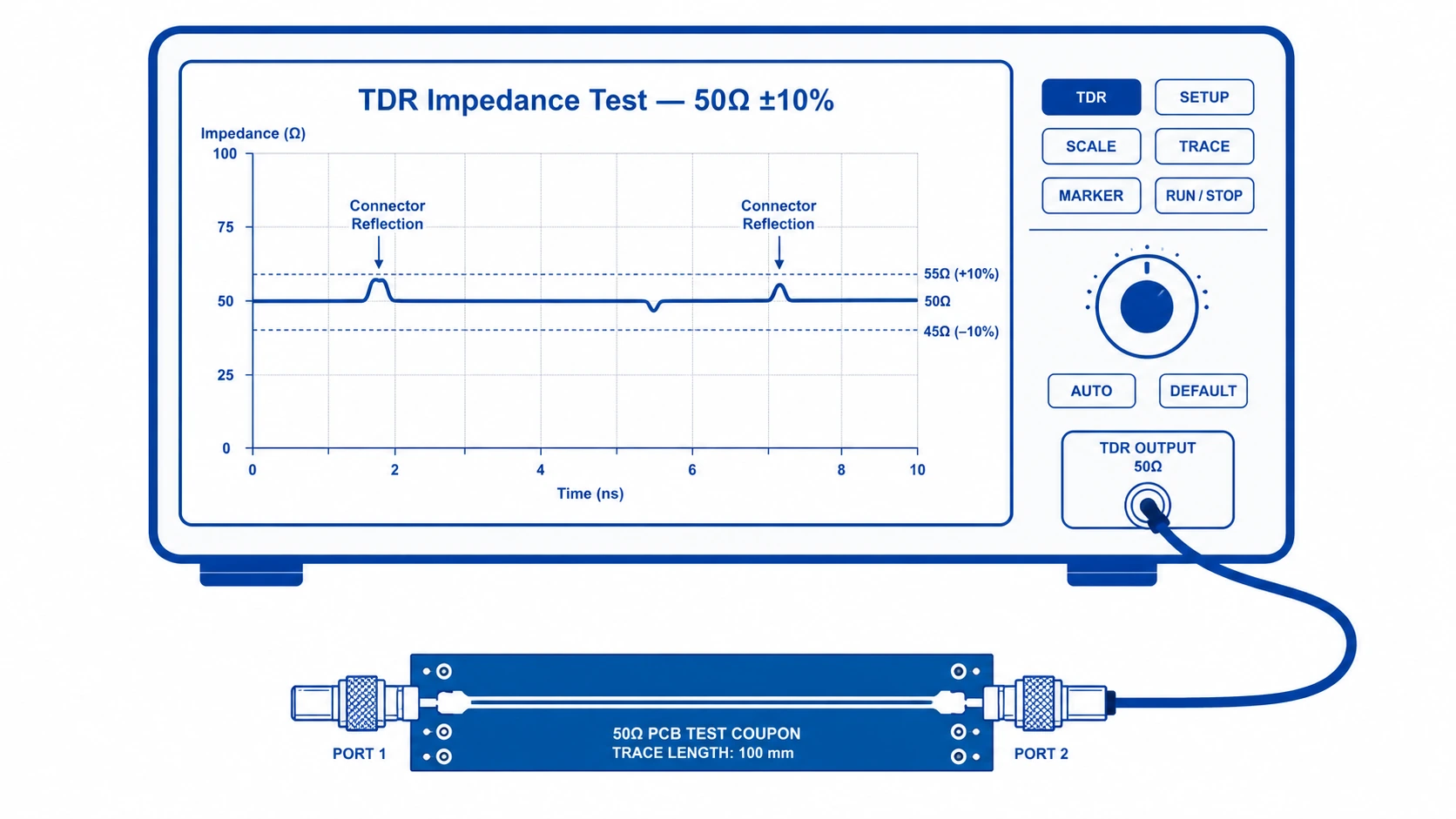
Impedance Testing
For controlled impedance PCB projects, impedance testing may be required.
A test coupon is often added to the production panel. The manufacturer can measure the impedance on the coupon to verify whether the production result meets the target range.
Impedance testing is especially important for:
RF PCB
Microwave PCB
High frequency PCB
Antenna PCB
Communication PCB
High-speed digital PCB
Radar PCB
Satellite communication PCBThe specific test requirement should be confirmed before production.
Controlled Impedance for Antenna PCB
Antenna PCB design is highly sensitive to impedance matching.
If the impedance is not correct, antenna performance may be affected. This can reduce radiation efficiency, communication range or signal stability.
For antenna PCB projects, engineers should review:
Operating frequency
Antenna structure
Board thickness
Material Dk
Ground plane design
Feeding line impedance
Copper pattern accuracy
Surface finish
Mechanical environmentThe PCB material and manufacturing tolerance can both affect final antenna performance.
Controlled Impedance for Microwave PCB
Microwave PCB projects usually require stricter impedance control because the signal frequency is higher and the circuit is more sensitive to small variations.
Microwave PCB impedance is affected by:
Low-loss material selection
Dielectric thickness tolerance
Copper roughness
Trace geometry
Reference plane design
Via transition design
Surface finish
Manufacturing repeatabilityFor microwave applications such as radar, satellite communication and high frequency test equipment, impedance control should be reviewed carefully before fabrication.
What Information Is Needed for Controlled Impedance PCB Quotation?
To quote a controlled impedance RF PCB project accurately, the manufacturer usually needs complete design information.
Common files and details include:
Gerber files
Drill files
PCB stackup
Material requirement
Board thickness
Copper thickness
Controlled impedance table
Target impedance value
Tolerance requirement
Surface finish
Quantity
Working frequency
Application backgroundIf the stackup is not fixed, the manufacturer can help review the material and stackup based on the impedance requirement.
How to Reduce Impedance Risk Before Production
To reduce impedance-related risk, engineers and buyers should confirm the following before production:
Use suitable high frequency materials
Confirm the final PCB stackup
Define target impedance values clearly
Provide impedance tolerance requirements
Review copper thickness and dielectric thickness
Avoid unnecessary material substitution
Confirm whether impedance testing is required
Work with an experienced RF PCB manufacturerEarly communication can help avoid misunderstanding and improve production reliability.
Conclusion
Controlled impedance is critical in RF PCB manufacturing because high frequency signals are sensitive to impedance variation. Poor impedance control can cause signal reflection, insertion loss, unstable RF performance and failed testing.
For RF PCB, microwave PCB, antenna PCB, radar PCB and high frequency communication boards, impedance control depends on stackup design, material selection, trace geometry, copper thickness, reference plane structure and manufacturing tolerance.
Working with an experienced high frequency PCB manufacturer can help review the stackup, confirm material feasibility and reduce impedance-related production risk.
Controlled Impedance RF PCB Q&A
Common questions about controlled impedance, RF PCB stackup, impedance testing, material selection, and high frequency PCB manufacturing.
What is controlled impedance in RF PCB?
Controlled impedance means the PCB transmission line is designed and manufactured to maintain a specific impedance value, such as 50 ohms or 75 ohms, depending on the circuit requirement.
Why is controlled impedance important in RF PCB?
Controlled impedance is important because RF signals are sensitive to impedance variation. Poor impedance control may cause signal reflection, insertion loss, unstable transmission and reduced RF performance.
What affects PCB impedance?
PCB impedance is affected by trace width, copper thickness, dielectric thickness, dielectric constant, reference plane structure, solder mask and manufacturing tolerance.
What materials are used for controlled impedance RF PCB?
Common materials include Rogers, PTFE, Taconic, F4B and FR4 plus high frequency hybrid stackups. The material should be selected based on frequency, signal loss requirement and stackup design.
Is impedance testing necessary for RF PCB?
For many RF, microwave and high frequency PCB projects, impedance testing is recommended or required. A test coupon can be used to verify whether the finished PCB meets the target impedance.
Can FR4 be used for controlled impedance PCB?
Yes, FR4 can be used for some controlled impedance PCB projects. However, for RF and microwave applications, high frequency materials may be preferred because they offer better electrical stability and lower signal loss.
What files are needed for controlled impedance PCB quotation?
Gerber files, drill files, stackup, material requirement, copper thickness, board thickness, controlled impedance table, target impedance value, tolerance and quantity are usually needed.
Request a PCB Quote
Upload your Gerber ZIP file and project requirements. Our engineering team will review your PCB material, stackup, impedance needs, surface finish, and production quantity before quoting.
Please prepare:
- Gerber files in ZIP format
- PCB material or stackup requirements
- Controlled impedance notes if available
- Prototype or batch production quantity