
High frequency PCB for test and measurement equipment must support stable signal transmission, repeatable RF behavior, accurate impedance control, and reliable connector performance. These boards are often used in RF test fixtures, microwave measurement devices, signal validation tools, laboratory instruments, production test platforms, and calibration-related equipment.
For this type of PCB, the board is not only a carrier for components. It becomes part of the measurement path. If the material, stackup, trace geometry, connector launch, via transition, or surface finish is not controlled, the test result may no longer reflect the device being measured. It may reflect the weakness of the PCB itself.
For buyers, the goal is not only to receive a finished board. The goal is to receive a board that behaves consistently from prototype to repeat order.
Quick Summary
High frequency PCBs for test and measurement equipment are used in RF test boards, microwave signal fixtures, calibration devices, connector evaluation boards, antenna test platforms, and production inspection tools.
These boards usually require controlled impedance, low-loss materials, stable stackup design, reliable RF connectors, good ground reference, and careful via transitions.
The main manufacturing risks include impedance deviation, connector launch mismatch, via discontinuity, material loss, poor grounding, surface finish issues, and inconsistent batch production.
Before quotation, buyers should prepare Gerber files, drill files, stackup, material requirement, impedance details, working frequency, copper thickness, surface finish, quantity, and application background.
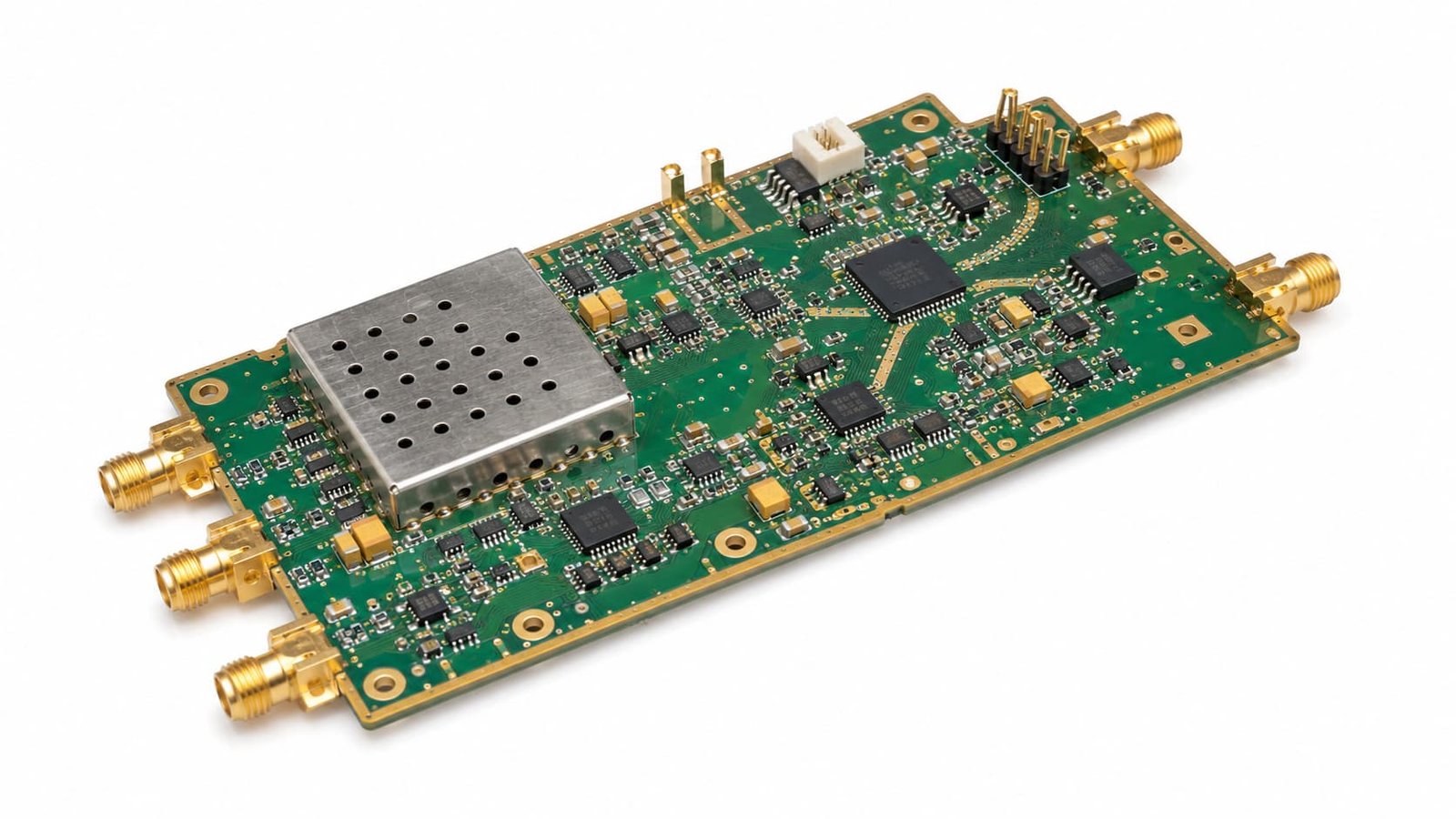
Why Test Equipment PCBs Need More Care
A test board is often expected to be neutral. It should not add too much loss, reflection, noise, or instability to the measurement setup.
In real production, this is not automatic. A test PCB can create errors if the RF path is poorly designed or loosely manufactured. At high frequency, small layout and process changes can become visible in measurement.
Common problems include:
Signal reflection at connector areas
Loss increase along long RF paths
Impedance shift after stackup change
Poor grounding near RF connectors
Via stubs in microwave transitions
Surface finish mismatch
Batch variation between test boards
For test and measurement equipment, repeatability is often more valuable than a board that only passes once.
Common Applications
High frequency PCBs are used in many test and measurement products.
Typical examples include:
RF test fixtures
Microwave test boards
Antenna test platforms
Signal integrity test boards
Connector evaluation boards
Filter test circuits
Power amplifier test boards
High frequency calibration fixtures
Production test interfaces
Laboratory measurement equipment
Some of these boards are simple two-layer RF test boards. Others are multilayer microwave PCBs with controlled impedance, ground vias, RF connectors, and tight stackup requirements.
The manufacturing review should match the actual use case. A simple fixture for low-volume lab testing may have different risk points than a board used repeatedly in production testing.
Material Selection
Material selection should start with the frequency range and loss target.
For lower-frequency test boards, some designs may allow FR4 if the RF path is short and the loss requirement is not strict. For higher-frequency test equipment, low-loss materials such as Rogers RO4000 or RO3000 laminates, PTFE, Taconic, F4B, or hybrid stackups may need to be reviewed.
The material review should include:
Dk value
Df value
Dk tolerance
Board thickness
Dielectric thickness
Copper type
Copper thickness
Surface finish
Material availability
Prototype and batch consistency
A test board made with the wrong material may still look correct, but the measurement result can be unreliable. For this reason, material choice should not be made only by price or availability.
Stackup and Controlled Impedance
Stackup is one of the first items to review before manufacturing.
For high frequency test boards, the stackup should clearly define:
Layer count
Material type
Dielectric thickness
Copper thickness
RF signal layer
Ground reference plane
Power layer if used
Final board thickness
Controlled impedance target
Via structure
Surface finish
Controlled impedance is usually required for RF transmission lines, connector launches, calibration paths, and microwave traces. If the stackup changes after impedance calculation, the final board may not match the expected behavior.
In test equipment, this can be costly. A poor PCB stackup may lead engineers to wrongly blame the product under test, while the real problem is the test board.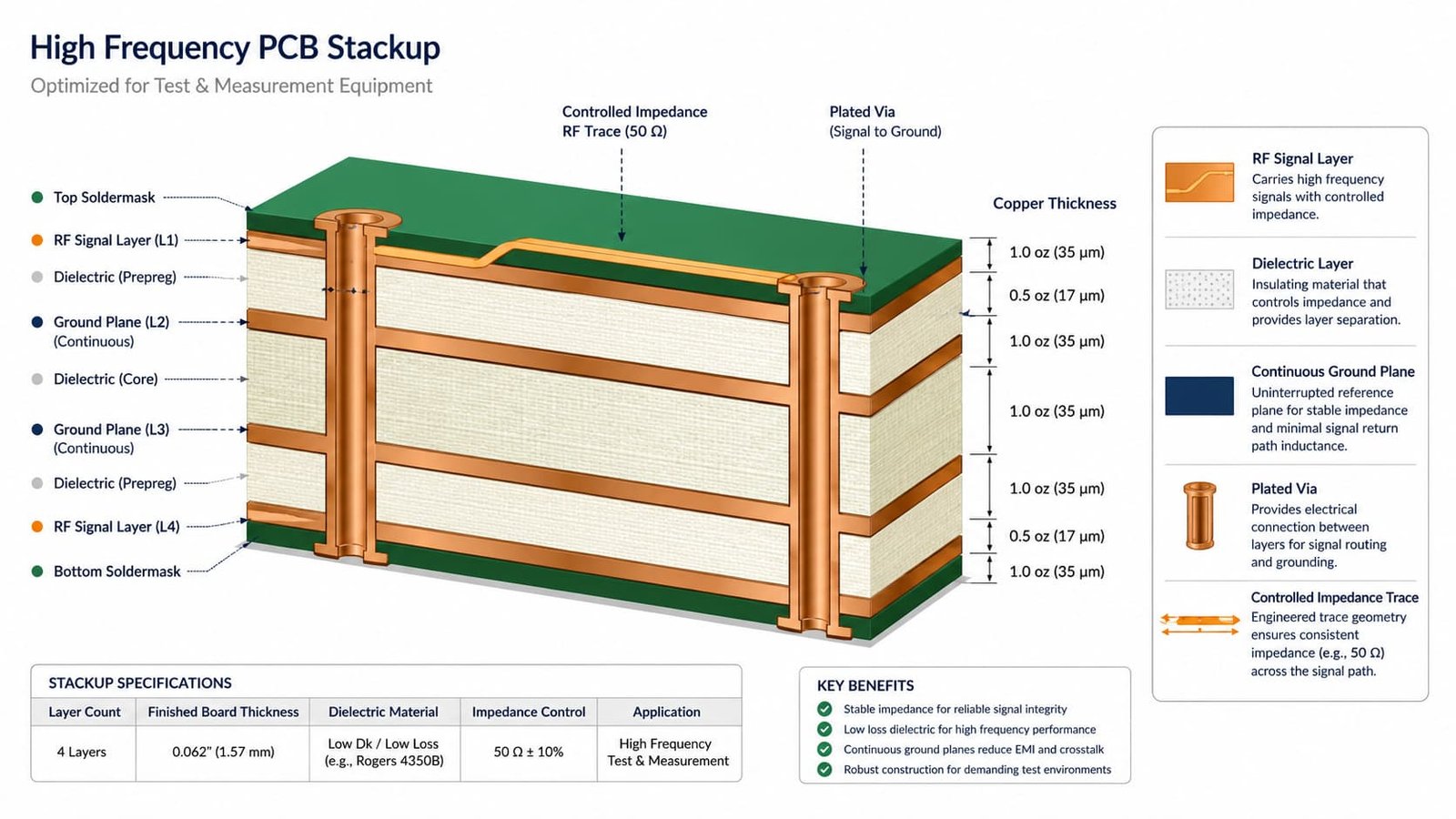
RF Connector Launch Areas
Connector areas deserve special review.
Many high frequency test boards use SMA, SMP, SMB, N-type, edge launch, or other RF connectors. The connector footprint, pad transition, ground vias, trace width, and reference plane all affect signal behavior.
A connector area should be reviewed for:
Pad-to-trace transition
Ground via placement
Connector hole tolerance
Reference plane continuity
Surface finish
Mechanical strength
Assembly method
Cable direction and stress
A good RF trace can still perform badly if the connector launch is not handled properly. For test equipment PCBs, this area is often one of the most common sources of mismatch.
Via Design and Grounding
Vias are not only mechanical holes in high frequency test boards.
They may act as signal transitions, ground paths, via fences, shielding structures, thermal connections, or connector grounds. At microwave frequencies tracked by publications like the Microwave Journal, via geometry can affect the measurement path significantly.
The review should include:
Signal via size
Ground via spacing
Via stub length
Via fence placement
Connector grounding vias
Plated through-hole reliability
Anti-pad clearance
Layer transition path
Grounding is equally important. RF return current should have a clean and predictable path. A broken ground reference can create unstable measurement results even when the board material is correct.
Surface Finish
Surface finish affects solderability, storage, connector areas, assembly quality, and sometimes RF-sensitive exposed areas.
Common options include:
ENIG
Immersion silver
OSP
HASL
Lead-free HASL
Hard gold for contact areas
Customer-specified finishes
ENIG is often selected because it provides a flat surface and stable solderability. Immersion silver may be reviewed for certain RF-sensitive applications. Hard gold may be needed in repeated contact or edge connector areas.
The finish should be selected based on assembly method, connector requirement, storage, contact wear, and RF performance needs.
Prototype-to-Batch Consistency
Test and measurement equipment often needs repeatable performance. One prototype working well is not enough if the batch version behaves differently.
Prototype-to-batch risk may come from:
Material substitution
Stackup change
Copper thickness variation
Different surface finish
Connector assembly variation
Drill tolerance changes
Panelization changes
Supplier material availability
No impedance test requirement
Buyers should confirm whether the material and stackup can be repeated in future orders. This is especially important for production test boards, calibration fixtures, and equipment that must keep consistent measurement behavior over time.
What Buyers Should Provide
To quote a high frequency PCB for test and measurement equipment, buyers should prepare:
Gerber files
Drill files
PCB stackup
Material requirement
Working frequency
Controlled impedance table
Board thickness
Copper thickness
Surface finish
RF connector type
Quantity
Prototype or batch plan
Application background
Special testing requirement
If the material is not fixed, the working frequency and measurement purpose are very helpful. A manufacturer can only review material and stackup properly when the signal requirement is clear.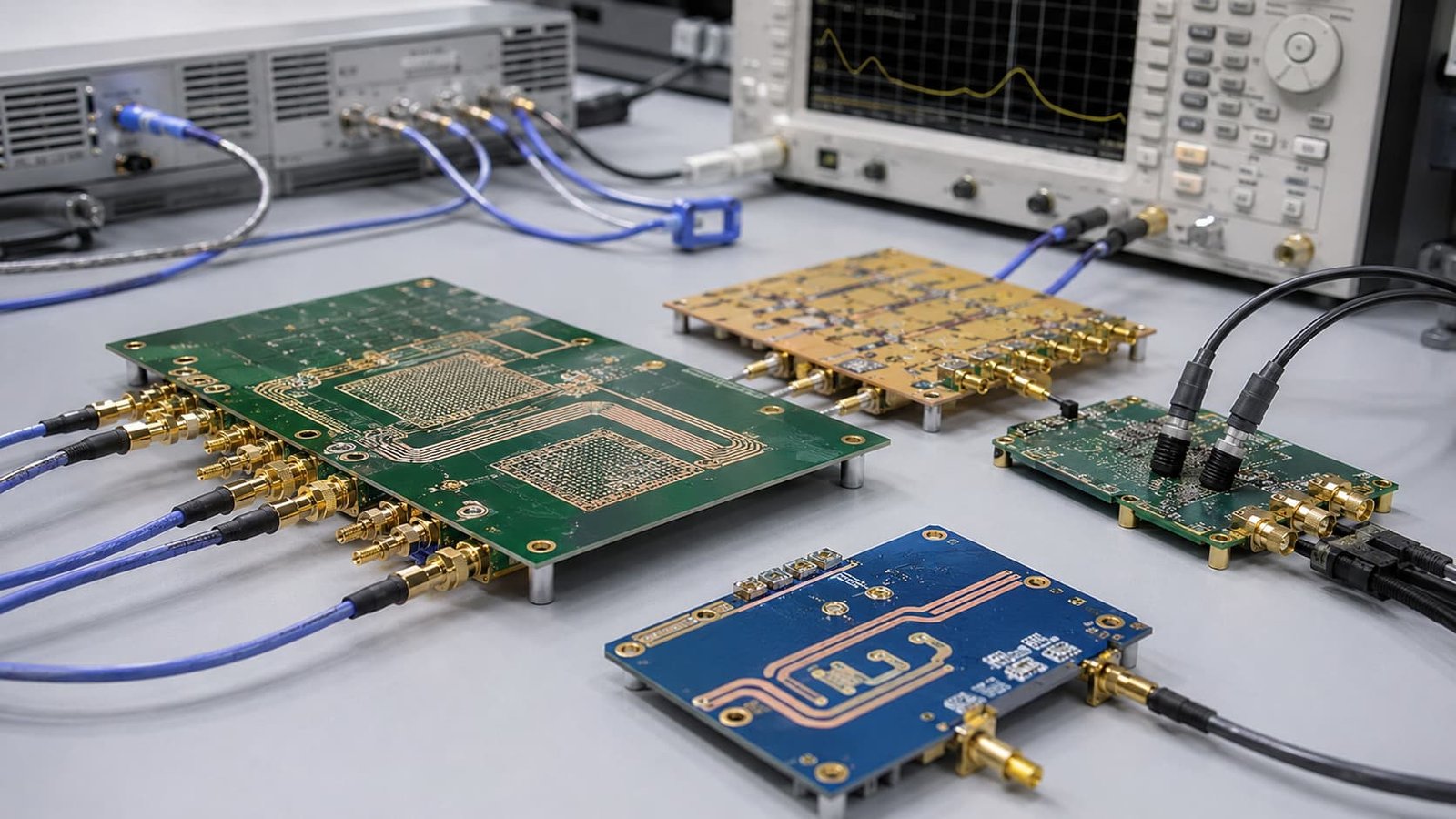
Common Mistakes to Avoid
Common mistakes include:
Using FR4 without checking loss
Sending Gerber files without stackup
Ignoring connector launch geometry
No controlled impedance table
Changing material after layout
Using too few ground vias
Ignoring via stubs
Choosing surface finish by habit
Not discussing repeat orders
No application background in quotation
These issues may not be obvious in visual inspection. They often appear during RF testing, calibration, or production validation.
Conclusion
High frequency PCB for test and measurement equipment requires more than standard PCB fabrication. The board must support stable RF behavior, controlled impedance, reliable connector transitions, good grounding, low-loss signal paths, and repeatable production.
For RF test fixtures, microwave measurement boards, antenna test platforms, calibration circuits, and production test interfaces, early manufacturing review can reduce prototype risk and avoid misleading test results.
The best result comes when buyers provide complete files, clear frequency information, stackup requirements, impedance targets, connector details, and the intended use of the board before production starts.