
Industrial IoT (IIoT) and smart manufacturing rely increasingly on RF and microwave technology for wireless sensor networks, machine monitoring, level and flow sensing, and factory automation communication. The RF PCB requirements for industrial applications differ from commercial IoT in important ways: wider operating temperature ranges (-40°C to +85°C or beyond), resistance to vibration and mechanical shock, exposure to industrial chemicals and humidity, and often longer required product lifetimes (10–20 years vs 2–5 years for consumer devices).
As a direct high frequency PCB factory producing Rogers, F4B, and FR4 RF PCB from prototype through medium-volume production, we regularly produce RF PCB for industrial sensor, radar, and automation applications. This guide covers the specific RF and PCB requirements for common industrial IoT applications.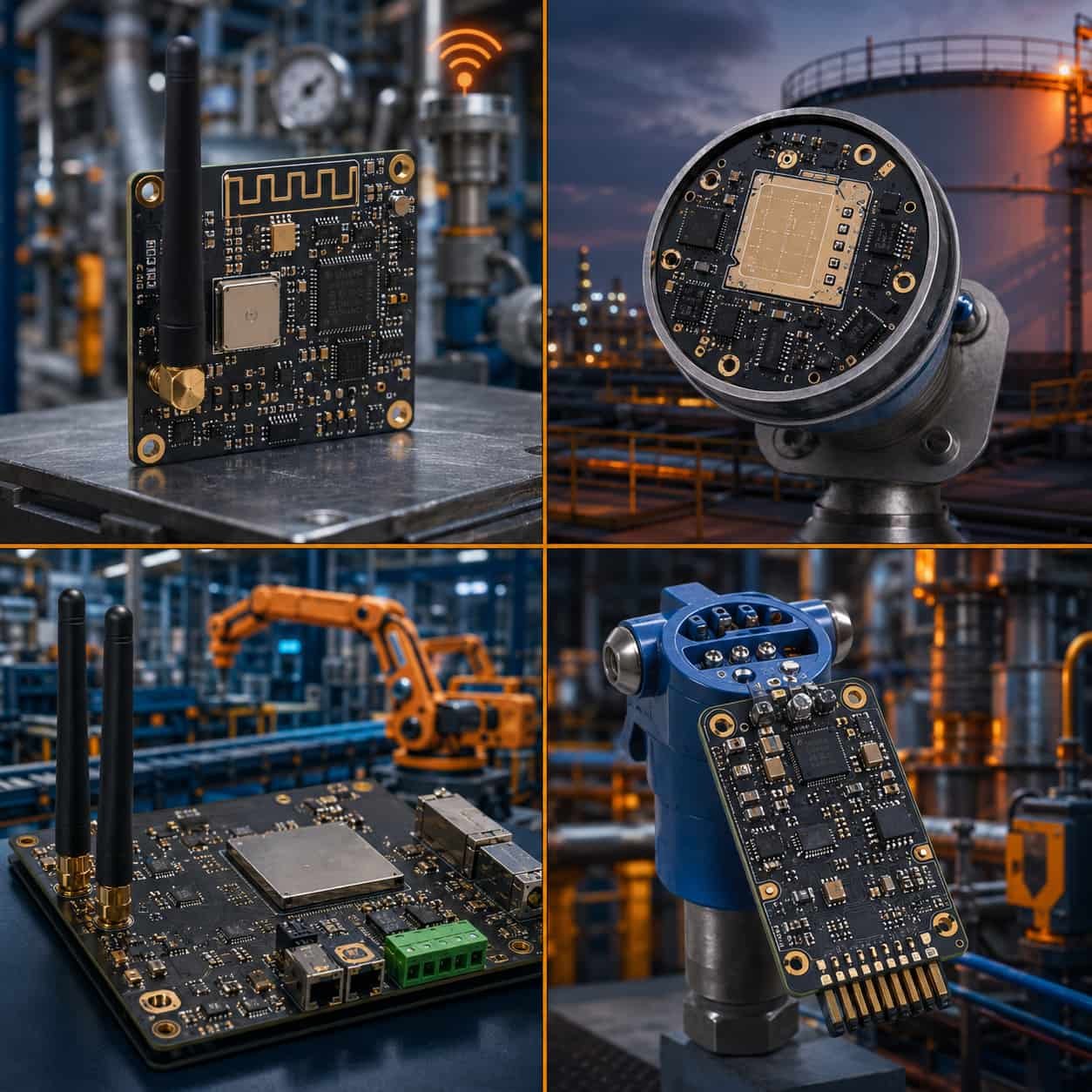
Quick Summary
Key point: Industrial IoT RF PCB spans a wide frequency range from 433 MHz sub-GHz sensors to 77 GHz level sensing radar. Material selection follows frequency: standard FR4 or Rogers RO4350B for ISM band sensors below 6 GHz; Rogers RO4350B or F4B for 24 GHz industrial radar; Rogers RO3003 for 77 GHz precision level sensing. The industrial environment requirement — wider temperature range, vibration resistance, longer service life — drives toward higher-quality manufacturing standards (IPC Class 2 minimum, Class 3 for safety-critical) even when the electronic performance specification would permit commercial-grade PCB.
Industrial IoT RF Applications and Frequency Bands
Sub-GHz Wireless Sensor Networks (433 MHz, 868 MHz, 915 MHz)
Industrial wireless sensor networks for temperature, pressure, vibration, and machine health monitoring commonly use sub-GHz ISM bands for long-range coverage through factory structures and equipment. At these frequencies, standard high-Tg FR4 is generally adequate for the RF PCB — the frequency is too low for Rogers material to provide meaningful benefit over FR4 for typical trace lengths.
- 433 MHz (Europe and Asia ISM): industrial temperature and vibration sensors
- 868 MHz (Europe SRD band): wireless sensor networks, smart metering
- 915 MHz (US ISM band): industrial automation, wireless HART, WirelessHART
- Material: standard FR4 or high-Tg FR4 — adequate at these frequencies
- Temperature range: industrial grade -40°C to +85°C — use high-Tg FR4 (Tg ≥ 150°C) for reliability
- Antenna: PCB trace antenna or chip antenna — no special RF substrate needed at sub-GHz
2.4 GHz and 5.8 GHz Industrial Wireless (WiFi, Zigbee, WirelessHART, ISA100)
Industrial wireless protocols operating in the 2.4 GHz and 5.8 GHz ISM bands — including IEEE 802.15.4-based WirelessHART, ISA100.11a, Zigbee, and industrial WiFi — require controlled impedance RF PCB for the antenna feed and RF front-end.
- 4 GHz: WirelessHART, ISA100, Zigbee, Bluetooth 5.0 — Rogers RO4350B or F4BM220 for RF front-end
- 8 GHz: industrial WiFi, high-bandwidth process data — Rogers RO4350B standard
- Antenna: 50Ω coplanar waveguide or microstrip feed to chip antenna or PCB trace antenna
- Temperature range: -40°C to +85°C — Rogers RO4350B Tg >280°C provides excellent thermal stability
- Humidity: Rogers RO4350B moisture absorption 0.06% — low Dk variation in humid industrial environments
See: RF PCB for Wireless Communication Modules
24 GHz Industrial Radar (Level, Flow, Presence)
24 GHz FMCW (Frequency-Modulated Continuous Wave) radar is widely used in industrial process automation for level sensing in tanks and silos, flow measurement, and presence detection. The operating frequency falls in the K-band, below the 77 GHz automotive radar band, but above the range where standard FR4 is usable.
- Typical frequency: 24.0–24.25 GHz (K-band ISM band)
- Application: tank level sensing, silo fill level, conveyor monitoring, intrusion detection
- Material: Rogers RO4350B 0.508mm or F4BM220 0.508mm — adequate Df at 24 GHz for most industrial radar
- Antenna element size at 24 GHz on RO4350B 0.508mm: approximately 3.0mm patch
- 50Ω trace width: approximately 1.08mm (43 mil) on RO4350B 0.508mm
- F4BM220 alternative: Dk 2.20, Df 0.0010 — lower Df than RO4350B at lower cost for commercial industrial
- IP rating: PCB designed for conformal coating — specify coating type in the order
F4B for 24GHz industrial: For commercial industrial 24 GHz radar sensors where Rogers-certified documentation is not required, F4BM220 (Dk 2.20, Df 0.0010) provides excellent RF performance at lower cost than Rogers RO4350B. The lower Dk of F4BM220 produces slightly wider traces than RO4350B — an advantage for manufacturability at 24 GHz.
77 GHz Industrial Radar (Precision Level Sensing)
77 GHz radar provides higher range resolution than 24 GHz — useful for precision level sensing in process industries, material flow monitoring, and machine positioning. The PCB requirements are identical to 77 GHz automotive radar.
- Material: Rogers RO3003 0.254mm — same as automotive radar
- Advantage over 24 GHz: smaller antenna aperture, higher range resolution
- Application: precision chemical tank level (±1mm accuracy), material flow, robotic positioning
- PTFE process required: plasma activation, 2-cycle lamination limit
See: Rogers RO3003 PCB: Ka-Band, 77GHz and Defense Applications Guide
Industrial Microwave Heating and Process Control
Industrial microwave heating systems at 2.45 GHz (ISM band) and 915 MHz use high-power RF — up to several kilowatts for industrial dryers, food processing, and material curing. The power control and monitoring PCB in these systems must handle high RF power levels and operate reliably in thermally demanding environments.
- Frequency: 2.45 GHz (standard) or 915 MHz
- Material: Rogers RO4350B 0.762mm or 1.524mm — thick substrate for power handling
- Copper weight: 2 oz or heavier for high-current RF traces
- Temperature: industrial equipment operating temperature may reach 100°C+ — RO4350B Tg >280°C adequate
See: Heavy Copper High Frequency PCB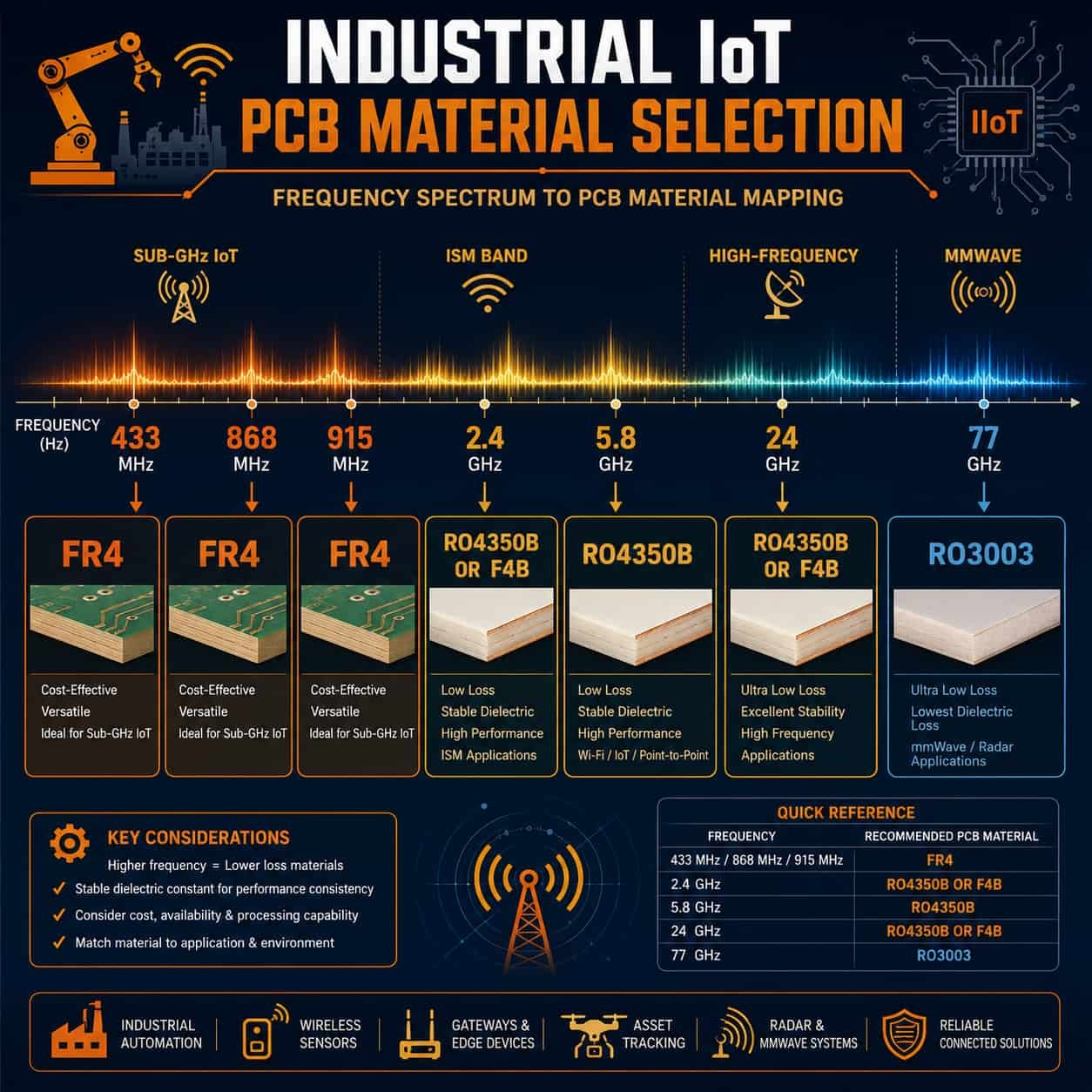
Material Selection for Industrial IoT RF PCB
Industrial IoT RF PCB material selection follows the same frequency-driven logic as commercial RF, with additional considerations for the industrial operating environment.
Rogers RO4350B — The Default for Industrial RF Above 1 GHz
Rogers RO4350B is the primary material for industrial RF PCB operating between 1 GHz and 15 GHz. Its combination of adequate Df, stable Dk over the industrial temperature range (-40°C to +85°C), low moisture absorption, and FR4-compatible manufacturing makes it the practical default for 2.4 GHz, 5.8 GHz, and 24 GHz industrial wireless.
- Dk temperature coefficient: +50 ppm/°C — stable Dk over the full industrial temperature range
- Moisture absorption: 0.06% — minimal Dk change in humid industrial environments
- Tg: >280°C — far above any industrial operating temperature, excellent thermal stability
- Recommended thicknesses: 0.508mm (24 GHz), 0.762mm (2.4/5.8 GHz industrial modules)
F4B — Cost-Effective Alternative for Commercial Industrial
For high-volume industrial IoT sensors where Rogers-certified documentation is not required and cost is a key driver, F4B PTFE materials provide comparable RF performance at lower material cost.
- F4BM220 (Dk 2.20, Df 0.0010): suitable for 2.4 GHz, 5.8 GHz, and 24 GHz industrial sensors
- F4BM300 (Dk 3.0, Df 0.0017): alternative for 24 GHz where Dk 3.0 is preferred for circuit geometry
- PTFE process required: plasma activation — same as Rogers RO3003
- Not suitable for: safety-critical industrial applications requiring Rogers-certified documentation
Standard FR4 — For Sub-GHz Only
- High-Tg FR4 (Tg ≥ 150°C): suitable for sub-GHz ISM band sensors below 915 MHz
- Not suitable above 1 GHz: Df ~0.020 at high frequency produces too much insertion loss for RF applications
- Industrial grade FR4: use high-Tg FR4 for reliability at industrial temperatures, not standard FR4 Tg 130°C
Wide Temperature Range: The Key Industrial PCB Requirement
Industrial electronics must operate reliably across a wide temperature range — typically -40°C to +85°C for standard industrial grade, or -55°C to +125°C for extended industrial grade in harsh environments. The PCB material and manufacturing quality directly affect reliability over this temperature range.
Dk Temperature Stability
- Rogers RO4350B: +50 ppm/°C — Dk changes by 0.007 over the -40°C to +85°C range (125°C span)
- At 24 GHz, this Dk shift produces an antenna resonance change of approximately 60 MHz — negligible for most 24 GHz sensors with bandwidth of several hundred MHz
- For precision 77 GHz industrial radar: Rogers RO3003 Dk temperature coefficient +13 ppm/°C — much more stable
Via Fatigue Under Thermal Cycling
Industrial equipment typically undergoes more thermal cycling than consumer electronics — daily power-on/off cycles over a 10–20 year service life. Via fatigue from thermal cycling is a leading cause of field failure in industrial PCB.
- Rogers RO4350B z-axis CTE: 32–46 ppm/°C — adequate for standard industrial applications
- Rogers RO4003C z-axis CTE: 11–14 ppm/°C — better via fatigue resistance for high-cycle industrial
- For applications with >10,000 thermal cycles: consider RO4003C for improved via reliability
- IPC Class 3 copper plating (25 µm average) provides better via fatigue resistance than Class 2 (20 µm)
Humidity and Chemical Resistance
- Rogers RO4350B moisture absorption: 0.06% — excellent stability in humid environments
- PTFE materials (RO3003, F4B): moisture absorption 0.02–0.04% — better than RO4350B for very humid conditions
- Conformal coating: specify type and coverage for PCB in harsh industrial environments
- Common coatings: acrylic (cost-effective), polyurethane (chemical resistance), silicone (high temperature)
Manufacturing Standards for Industrial High Frequency PCB
IPC Class Selection for Industrial Applications
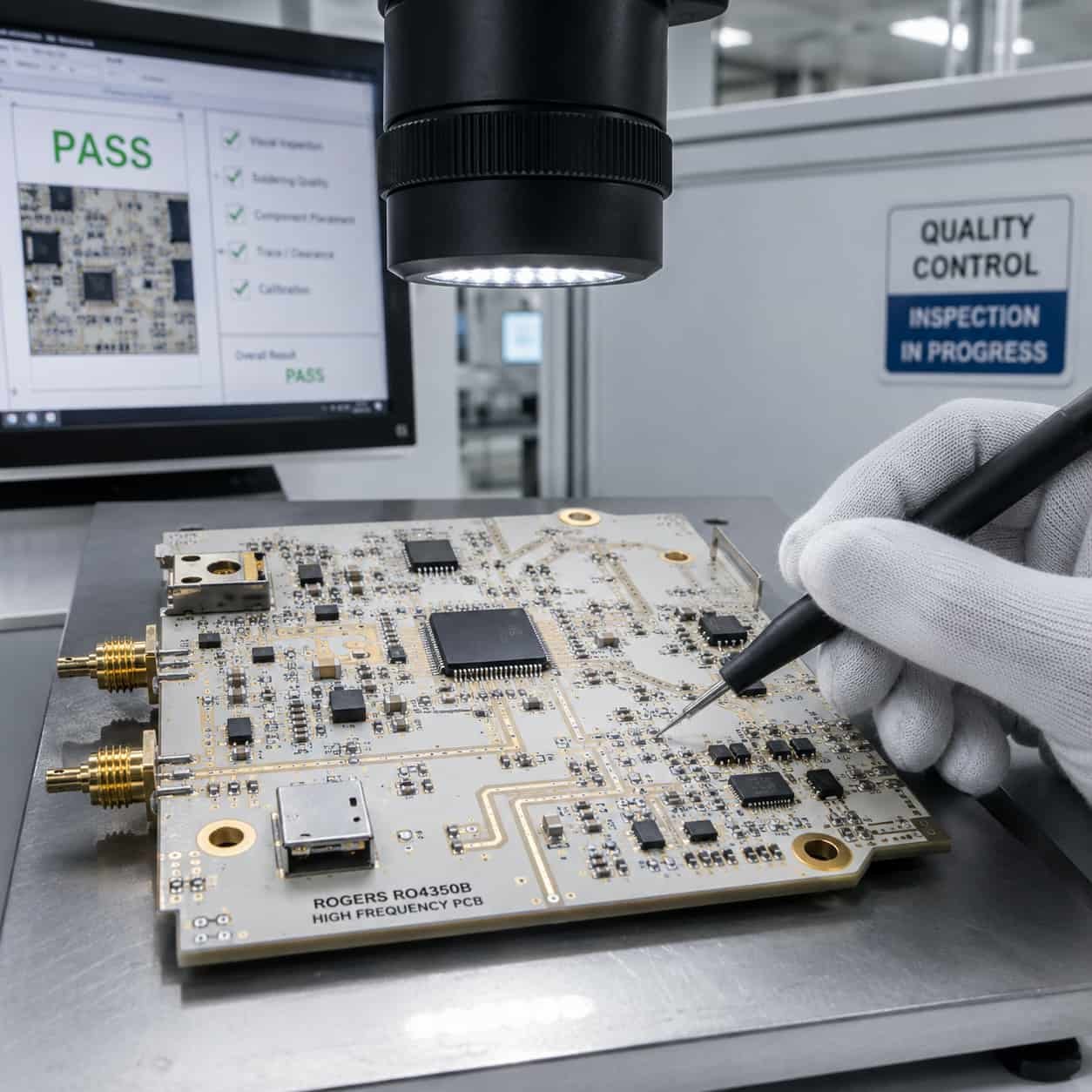
- IPC Class 2: standard for most industrial IoT sensors and wireless modules — adequate for non-safety-critical applications
- IPC Class 3: recommended for industrial safety systems, process control in hazardous environments, and any industrial application with long service life requirements (10+ years)
- IPC Class 3 PTH plating (25 µm average) significantly improves via fatigue life under thermal cycling — worth the added cost for industrial applications
Controlled Impedance for Industrial RF PCB
- Standard tolerance ±10%: adequate for most industrial wireless sensors at 2.4–5.8 GHz
- ±10% at 24 GHz industrial radar: also adequate — antenna bandwidth typically wide enough
- ±8% advanced: for precision industrial radar requiring tighter antenna resonance control
- TDR verification: every production lot — same standard as commercial RF PCB
Prototype to Production for Industrial IoT
Industrial IoT product development typically follows a longer timeline than consumer products — prototype, pilot, and production phases may span 2–4 years. A factory that can support both prototype (1–5 boards) and production (500–5000 boards per year) with the same engineering team reduces the risk of process changes between prototype validation and production.
- Prototype: 5–7 working day lead time for Rogers RO4350B or F4B designs
- Pilot production: 10–15 working days
- Production volume: medium-volume production support for industrial IoT quantities
- Documentation continuity: same Rogers material certificate lot documentation from prototype through production
What to Specify for Industrial IoT High Frequency PCB
- Application type and operating frequency — determines material selection
- Operating temperature range — -40°C to +85°C standard industrial, or -55°C to +125°C extended
- Material: Rogers RO4350B (standard), F4B (cost-sensitive commercial), RO3003 (77 GHz), FR4 (sub-GHz)
- IPC Class: 2 or 3 — specify Class 3 for safety-critical or long-service-life applications
- Controlled impedance: target value and tolerance
- Conformal coating requirement if applicable: type and coverage
- Stackup with copper weight per layer
- Surface finish: ENIG standard for industrial RF PCB
- Quantity: prototype or production volume — affects panel utilization and pricing
- Required certifications: Rogers material certificates, CoC, FAI if required
For the complete quotation file checklist, see What Files Are Needed for a High Frequency PCB Quotation?. For factory capability, see China High Frequency PCB Manufacturer: Rogers, PTFE, Taconic Direct Factory.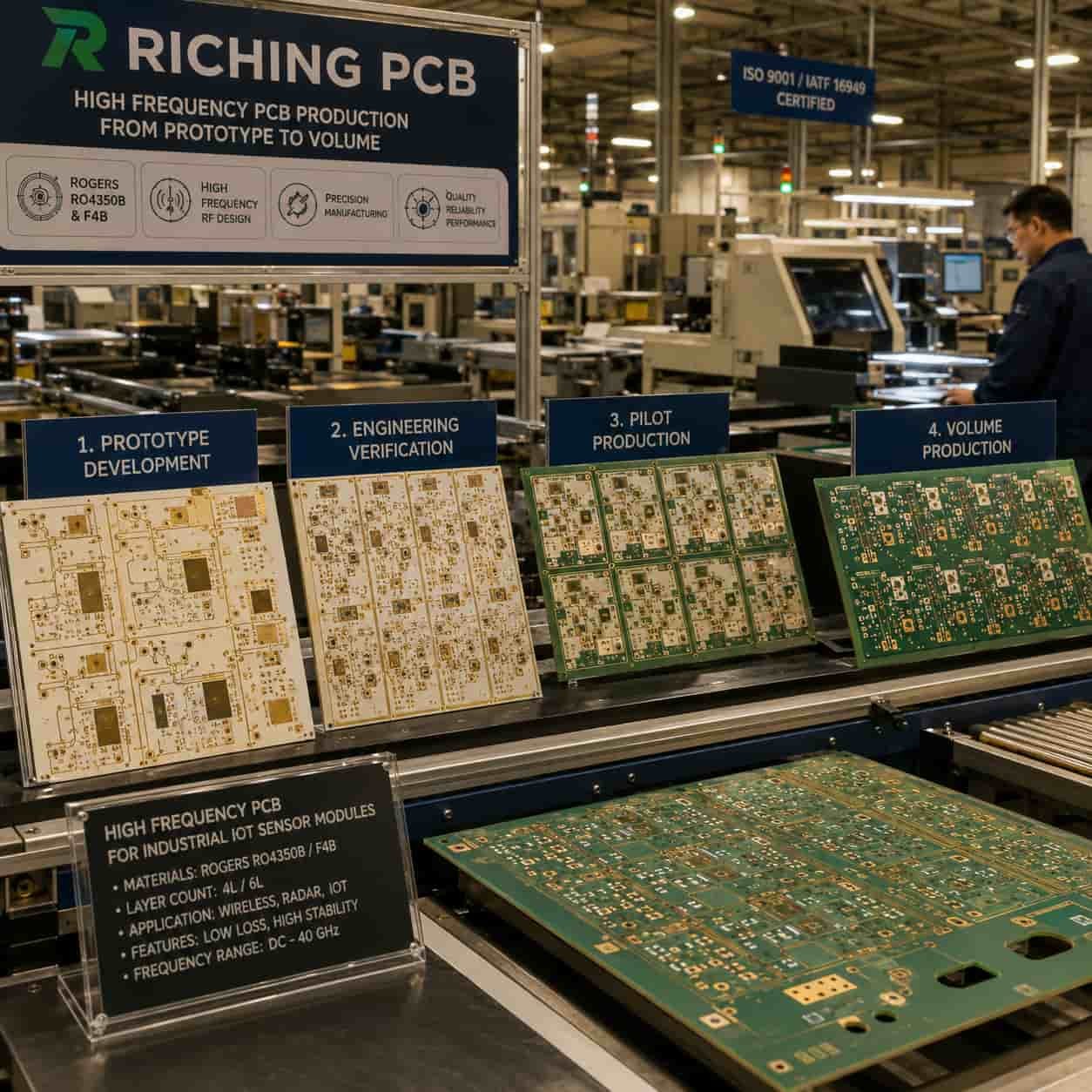
Conclusion
Industrial IoT and smart manufacturing RF PCB spans sub-GHz sensor networks through 77 GHz precision radar, with material requirements ranging from high-Tg FR4 at sub-GHz to Rogers RO3003 at 77 GHz. The defining difference from commercial IoT PCB is the industrial operating environment: wider temperature range, longer service life, vibration and humidity exposure, and often safety-critical applications requiring IPC Class 3 manufacturing quality.
As a direct high frequency PCB factory with Rogers RO4350B, RO3003, F4B, and FR4 in production inventory, we support industrial IoT PCB from initial prototype through production volume — with the same engineering team and the same process documentation from first prototype to thousandth production board.