
Satellite Constellation PCB Manufacturing: What Batch Production Demands From a High-Frequency PCB Supplier
For twenty years, space-grade PCB procurement followed a simple rhythm: one satellite, one build, years of engineering. That rhythm is breaking. On September 24, 2026, Planet Labs opened a new satellite manufacturing facility in Berlin, with approximately 300 kg Pelican-class imaging satellites (30 cm ground resolution) entering production in fall 2026 and a line designed to scale to up to 60 satellites per year. When satellites are built like aircraft — one bus per week instead of one per program — the questions RF engineers and purchasing teams ask their PCB suppliers change fundamentally.
Home » batch consistency » Satellite Constellation PCB Manufacturing: What Batch Production Demands From a High-Frequency PCB Supplier
Table of Contents
1. Why Serial Satellite Production Changes PCB Sourcing
A one-off science mission buys PCBs as engineering artifacts: a single fabrication run, extensive qualification, then years of storage spares. A constellation buys PCBs as recurring production parts. A line targeting 60 satellites per year consumes a complete board set roughly every six working days — RF communication boards, GNSS receiver boards, high-speed data-processing boards, power boards and RF front ends, multiplied across build slots.
That shift moves the buyer’s central question from “did this board pass qualification?” to “can batch #47 reproduce batch #3?” Qualification proves the design and the process once. Serial production must prove the process again and again, on every shipment, without relying on the same operators, the same laminate lot, or the same press load being available. This is the core difference between a space-qualified supplier and a space-production capable supplier.
2. Batch-to-Batch Consistency: The Metric That Decides Repeat Orders
Batch consistency means the electrical and physical results of every fabrication lot land inside the same tolerance window — not just within one panel, but across panels, across weeks, and across laminate lots. For high-frequency boards, four parameters matter most:
| Parameter | What to Require for Constellation Work |
|---|---|
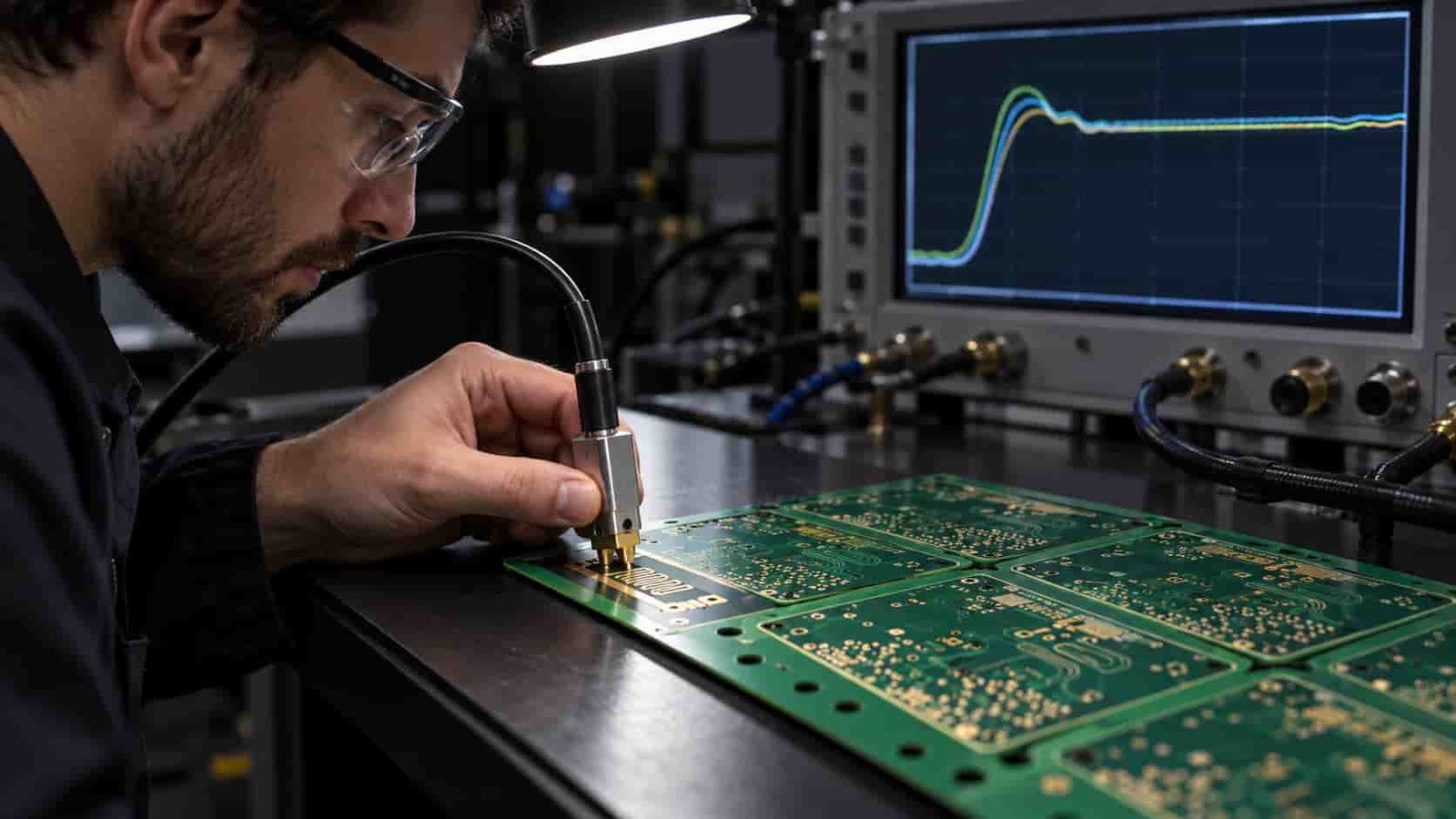
| Finished impedance repeatability | ±5% or better on 50 Ω lines (about ±2.5 Ω). Laminate Dk tolerance (RO3003-class: 3.00 ±0.04; RO4350B-class: 3.48 ±0.05, at 10 GHz) is only the starting point — etch undercut, copper roughness and press thickness variation add process error on top. Verified on a TDR coupon from every production panel. |
| Insertion loss spread | ≤0.1 dB/inch at 28 GHz. A larger spread between batches signals process drift — typically copper foil roughness changes or resin variation entering the field region. |
| Hole copper repeatability | IPC-6012 Class 3: minimum average 20 µm (25 µm for Class 3/A space additions) — held on every panel, batch after batch, through plating chemistry, current density and aspect ratio control. |
| Lamination thickness | Per stack-up drawing tolerance. A ±10% drift on a 127 µm (5 mil) RF core is several ohms of impedance error before anything else varies. |
| Parameter | One-Off Space Build | Constellation Serial Production |
|---|---|---|
| Primary goal | Prove the design once | Prove the process on every batch |
| Acceptance evidence | First-article + qualification data | Per-batch data package |
| Typical order pattern | Single fabrication run | Repeat orders every 1–2 weeks |
| Documentation | Certificate of Conformance | Lot-level traceability + FAI + change control |
| Supplier risk focus | Workmanship defects | Process drift between batches |
3. Material Traceability: From Laminate Lot to Shipped Board
Traceability in serial production means the supplier can reconstruct, for any single shipped board, which laminate lot, copper foil lot, prepreg batch, press cycle and plating bath it passed through — and produce those records years later. A Certificate of Conformance that says “RO3003, 10 mil” is not traceability; a lot-level genealogy with date codes and retained coupons is.
European space programs — and the Berlin facility is a deliberate piece of European sovereign space manufacturing — typically expect documentation aligned with aerospace practice: AS9102-format FAI, per-shipment data packages, and formal notification of any process or material change before it affects your boards.
⚠ Traceability red flag: a supplier who cannot state, from records, which prepreg batch and press cycle produced your last shipment does not have batch traceability — they have paperwork. Ask for a sample data package from a previous customer shipment before awarding a repeat-order contract.
4. First Article Inspection and Change Control
FAI formalizes the “golden batch”. Each new board revision — and each significant process transfer — should trigger an AS9102-style First Article Inspection with full dimensional, cross-section and electrical verification before serial panels ship. The FAI package then becomes the reference every future batch is compared against.
Change control is the quieter half of repeatability. The failure mode in production PCB sourcing is rarely a dramatic defect; it is a silent substitution: a copper foil switch from rolled to electrodeposited (conductor loss rises measurably above 20 GHz when the surface roughness class changes), a prepreg resin-content adjustment, a new plating chemistry, a different press load pattern. Your supplier contract should require written notification and, for RF-critical parameters, re-qualification before any of these change. If a supplier resists committing to notify-first change control, treat that as a scheduling risk on every future batch, not a paperwork detail.
5. What Test Data to Demand With Every Batch
For constellation programs, specify the per-batch data package at RFQ stage, not after the first delivery. A production-grade package includes:
| Per-Batch Data Item | What to Check |
|---|---|
| TDR impedance results | From coupons on each production panel |
| VNA sweep | Insertion loss + return loss to the operating band (e.g., 26.5–40 GHz for Ka-band payloads) |
| Cross-section report | Hole copper, plating thickness, layer registration — one report per batch |
| Dielectric thickness | Finished thickness per RF layer |
| Surface finish | ENIG nickel 3–6 µm, gold 0.05–0.1 µm |
| Material traceability | Lot numbers mapped to panel serials |
| Metric | Suggested Target | Verification Method |
|---|---|---|
| Finished impedance repeatability | ±5% or better on 50 Ω lines | TDR coupon per production panel |
| Insertion-loss batch spread | ≤0.1 dB/inch at 28 GHz | VNA sweep to operating band |
| Hole copper | IPC-6012 Class 3/A: 20–25 µm min | Cross-section per batch |
| RF dielectric thickness | Per stack-up drawing tolerance | Cross-section / thickness mapping |
| Surface finish (ENIG) | Ni 3–6 µm, Au 0.05–0.1 µm | XRF per panel |
6. Low-Loss Hybrid Stack-Ups at Production Volume
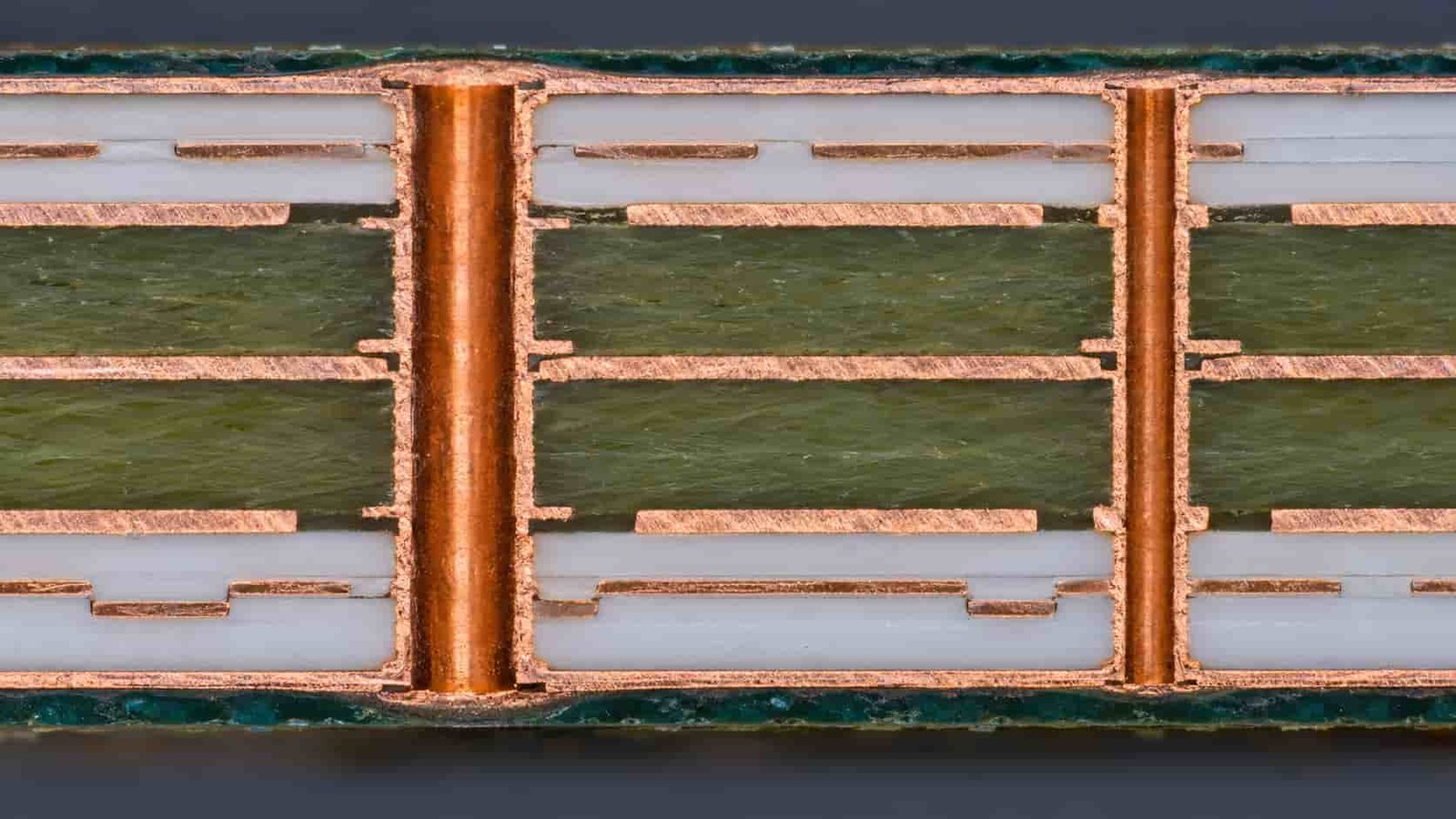
Most satellite payload and satcom boards do not use one material family end-to-end: thin low-loss PTFE or hydrocarbon RF layers carry the microwave functions while FR-4 layers handle digital, power and housekeeping routing in a hybrid stack-up. That is a proven architecture — the phased array antenna PCB guide and the PTFE–FR-4 mixed lamination article on this site cover the design side in depth.
The production question is different from the design question: can the supplier laminate the same mixed stack-up, with the same registration and void-free quality, on every repeat order? PTFE and FR-4 have significantly different coefficients of thermal expansion, so press cycles, bonding films and layer registration must be held constant batch-to-batch — including which press, which press load, and which lamination cycle recipe. A design guide such as the Rogers–FR-4 hybrid PCB design article gets you a good stack-up; process discipline gets you fifty identical ones.
Note that this is not a question of one material being “better” than another — each program selects its own materials for its own frequency, loss and cost budget. Constellation manufacturing is about reproducing the chosen stack-up identically, whatever it is.
7. Red Flags When Auditing a Supplier for Constellation Work
| # | Audit Item | Pass Evidence |
|---|---|---|
| 1 | Per-batch electrical data | TDR + VNA results from a recent customer shipment |
| 2 | Material traceability | Sample data package with laminate/foil/prepreg lot numbers |
| 3 | Change control | Written notify-first commitment in contract/QA agreement |
| 4 | FAI capability | AS9102-style FAI package for a previous revision |
| 5 | Retained coupons | Supplier retains impedance coupons per batch for N years |
| 6 | Hybrid lamination record | Void-free cross-sections across multiple batches |
| 7 | Engineering access | Direct RF engineer contact during ECO traffic |
The checklist above collapses into five red flags that justify removing a supplier from a repeat-delivery shortlist:
| # | Red Flag |
|---|---|
| 1 | No per-batch impedance or insertion-loss data — only first-article results |
| 2 | "Same material" claims without lot-level traceability |
| 3 | Unwillingness to commit to notify-first change control |
| 4 | No retained coupons or archived data packages from previous shipments |
| 5 | Capacity quotes that ignore engineering support cycles — serial programs generate constant ECO traffic, and a factory without RF-literate engineering staff will bottleneck there |
8. How a Direct Factory Supports High-Rate Satellite Programs
For a buyer running a constellation or small-sat production line, the supplier’s structure matters as much as its machine list. A direct factory model shortens the loop between your batch data and the process adjustment: batch results go to the process engineers who control press recipes and plating lines, not through a trading layer. Riching PCB supports high-frequency satellite programs with batch data packages on every shipment, FAI documentation for each new revision, lot-level material traceability, hybrid PTFE–FR-4 lamination experience, and VNA/impedance testing to your defined frequency limit. For RF-critical questions, our engineers are reachable directly on WhatsApp — no ticket queue.
Constellation manufacturing rewards suppliers who can prove repeatability, not just quote a price. The Berlin facility’s 60-satellites-per-year target is a useful benchmark: ask every candidate supplier how their process would survive that cadence — and evaluate the evidence in their data package, not their brochure.
Satellite Constellation PCB Manufacturing — Q&A
Batch consistency, FAI, traceability and hybrid stack-up questions buyers ask before committing to repeat satellite PCB deliveries.
What batch consistency data should I require from a satellite PCB supplier?
TDR impedance results per production panel, a VNA insertion-loss sweep to your operating band, cross-section hole copper data, finished dielectric thickness, and material lot numbers mapped to panel serials — with every shipment, not only on first articles.
Is FAI required for every new PCB revision in a constellation program?
Best practice is an AS9102-style First Article Inspection for each new revision and each process transfer, so every future batch is compared against a documented golden reference.
Can PTFE and FR-4 hybrid stack-ups be produced repeatably in volume?
Yes, provided press cycles, bonding films and layer registration are held constant batch-to-batch and verified by cross-section on every lot. The two material families have different CTEs, so process discipline matters more than for single-material boards.
How is constellation PCB sourcing different from one-off space missions?
One-off missions prove a design once; constellation production must prove the process on every batch — batch-to-batch impedance, insertion-loss spread and traceability become the deciding supplier metrics.
Sourcing PCBs for a Satellite Constellation or Space Payload?
Batch data packages, AS9102-style FAI, lot-level traceability and hybrid PTFE–FR-4 lamination — from a direct high-frequency PCB factory. In-stock Rogers, Taconic and PTFE materials, VNA testing to 40 GHz+.
Contact Us → WhatsAppRequest a PCB Quote
Upload your Gerber ZIP file and project requirements. Our engineering team will review your PCB material, stackup, impedance needs, surface finish, and production quantity before quoting.
Please prepare:
- Gerber files in ZIP format
- PCB material or stackup requirements
- Controlled impedance notes if available
- Prototype or batch production quantity