
PCB Lead Time in 2026: What's Actually Taking So Long and How to Plan Around It
If your PCB lead time quote in 2026 is longer than expected — or if a board that used to take 2 weeks now takes 6 — the cause is almost certainly not your factory's production capacity. Fabrication time for most PCB types has not changed significantly. What has changed is the time before fabrication starts: material procurement, allocation queues and the hidden delays that factory quotes typically do not include. This article breaks down where the time actually goes in 2026, which materials are worst affected, and what you can do now to protect your program schedule.
Home » PCB Lead Time in 2026: What’s Actually Taking So Long and How to Plan Around It
Table of Contents
Lead Time Reference Table — 2026 vs Pre-2025
| PCB Material | Pre-2025 | 2026 | Main Bottleneck |
|---|---|---|---|
| Standard FR-4 | 1–2 weeks | 3–5 weeks | CCL procurement delay |
| High-Tg FR-4 | 2–3 weeks | 4–6 weeks | CCL allocation |
| Rogers RO4350B / RO4003C | 3–5 weeks | 5–8 weeks | Material procurement at most factories |
| Rogers RO3003 / RT5880 (in stock) | 7–10 days | 7–10 days ✅ | Fabrication only — no material wait |
| Rogers RO3003 / RT5880 (spot buy) | 3–4 weeks | 6–10 weeks | Material procurement + price uncertainty |
| High-speed M6/M7/M8 | 4–6 weeks | 8–16 weeks | T-glass allocation, PPE resin shortage |
| M9 specialty | 6–8 weeks | 3–6 months | Allocation mode — controlled release |
| Arlon AD255C / AD300A | 4–6 weeks | 8–14 weeks | US-origin material, limited China stock |
The fabrication times shown by most factories in their quoted lead time do not include material procurement. A factory quoting ’10 working days’ may mean 10 days of fabrication after material arrives — which could be 4–8 weeks after you place the order.
Lead Time Reference Table — 2026 vs Pre-2025
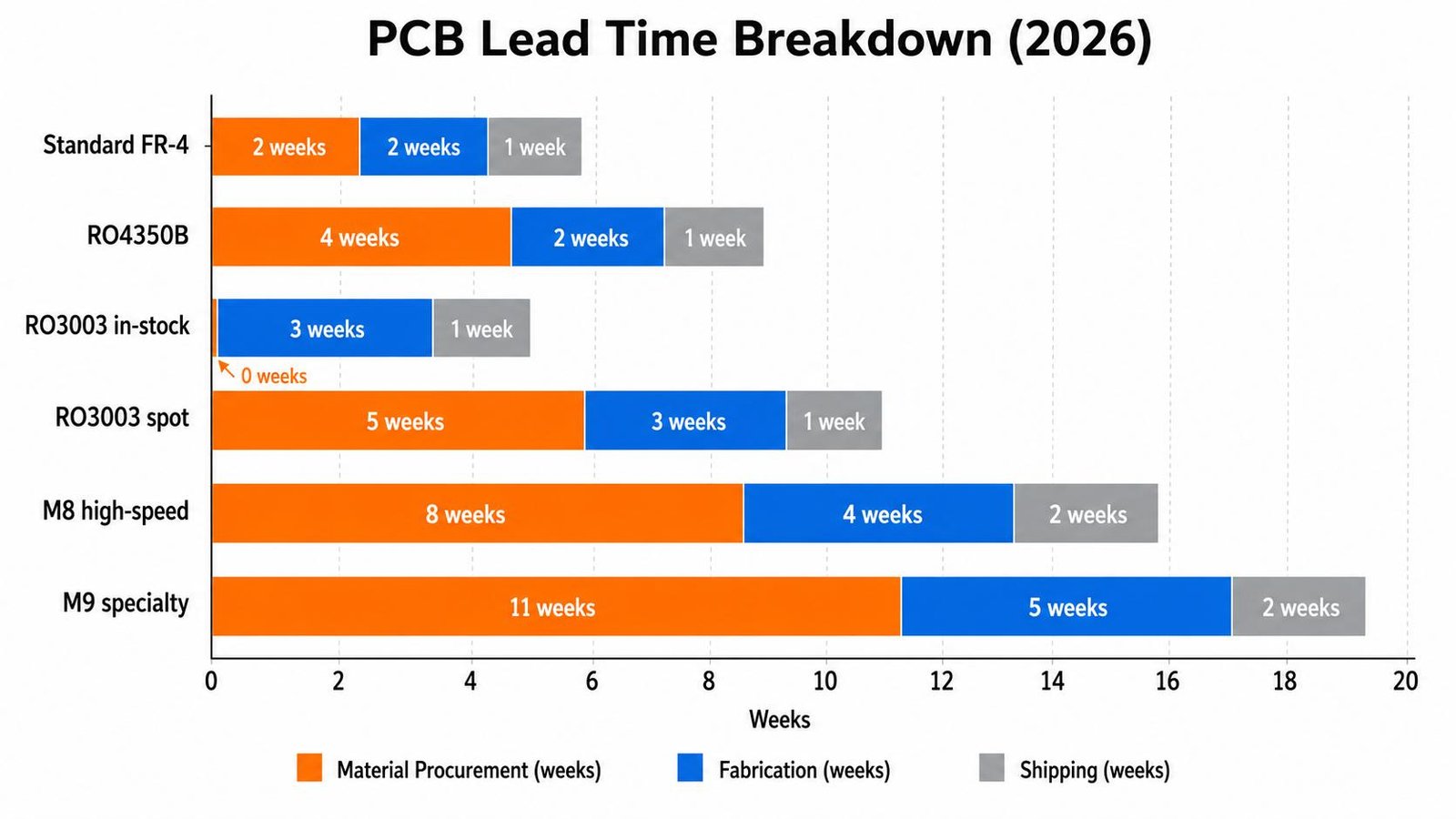
| Hidden Lead Time Component | How Much It Actually Adds |
|---|---|
| Material procurement (spot buying factory) | 3–8 weeks — not shown in quoted fabrication time |
| DFM review iteration | 1–5 days per round — rushed DFM = multiple rounds |
| Quote approval and PO processing (your side) | 1–2 weeks — internal procurement cycles matter |
| Shipping — economy vs express | Economy: 3–4 weeks. DHL Express: 3–5 days. Difference: 3 weeks |
| Incoming inspection and functional test | 1–3 days — often skipped, causing costly re-spins |
| SMT stencil lead time (if doing PCBA) | 3–7 days — usually quoted separately, often forgotten |
The fabrication time myth
Factory websites quote fabrication time — the time the board spends in the production line after material is on-hand and DFM is approved. For a standard 4-layer FR-4 board, fabrication is 5–7 working days. For a Rogers RO3003 multilayer, fabrication is 7–10 working days. These numbers have not changed much in 2026. What has changed is everything that happens before fabrication starts.
Material procurement — the real bottleneck
A factory that does not stock your specified material needs to procure it before fabrication can begin. In a normal market, this adds 1–2 weeks. In the 2026 PCB material shortage environment, procurement for constrained grades adds 4–16 weeks — and the procurement lead time is often not disclosed upfront in the factory’s quote. The quote says ’10 working days.’ The actual calendar time from order to delivery is 10 weeks.
DFM iteration — the avoidable delay
Every DFM revision round adds 1–5 days. A design submitted with incomplete stackup information, unspecified impedance targets or unclear drill tolerances will go through multiple DFM rounds before fabrication starts. A complete, well-prepared Gerber package with a clear stackup drawing eliminates this delay. The fastest orders are the ones where DFM passes in a single review.
By Material — What to Expect in 2026
Standard FR-4 — delayed but manageable
Standard FR-4 lead times have extended from 1–2 weeks to 3–5 weeks at most Chinese factories. The cause is CCL procurement pressure — copper foil at record prices and glass fiber cloth shortage have pushed FR-4 CCL lead times to 4–6 weeks at the supplier level. Factories with established allocation agreements and inventory buffers are less affected. If your factory quotes under 3 weeks for FR-4, they either have stock or are quoting fabrication time only.
Rogers RO4350B / RO4003C — stock-dependent
RO4350B and RO4003C lead times are now 5–8 weeks at factories that procure per-order. Factories that maintain Rogers inventory can still deliver in the 5–7 working day fabrication window. The key question to ask: ‘Is RO4350B on your shelf today, or will you order it for my job?’ The answer determines whether your lead time is 5 days or 5 weeks.
Rogers RO3003 and RT5880 — the in-stock advantage
This is where stock position creates the largest lead time difference. RO3003 and RT5880 procured from the spot market now takes 6–10 weeks — the materials are not freely available and pricing is volatile. Riching PCB maintains RO3003 (0.127mm, 0.254mm) and RT5880 in all six standard thicknesses as on-shelf inventory. For orders placed against this stock, fabrication starts at DFM approval — 7–10 working days total lead time, same as pre-2025. See Rogers RO3003 PCB manufacturer and Rogers RT5880 PCB manufacturer for current stock confirmation.
High-speed M6/M7/M8 — plan for 8–16 weeks
AI server demand has created genuine allocation constraints on M6–M9 grade CCL. These materials are on controlled release from manufacturers — buyers without long-term volume agreements are effectively in a queue. If your design requires M7 or M8, plan for 8–16 weeks minimum and lock your order as early as possible. Do not submit Gerbers and ask for a 2-week turnaround — it will not happen in 2026.
M9 specialty grades — treat as 3–6 months
M9 is in allocation mode. The largest factories with direct manufacturer relationships can sometimes source in 6–8 weeks, but for standard buyers, 3–6 months is the realistic expectation. If your design was specified on M9 and your program schedule cannot accommodate this, it is worth reviewing whether M8 or a hybrid stackup could meet your electrical requirements at a shorter lead time.
How to Plan Your PCB Program Schedule in 2026
| Timeline | What to Do | Why It Matters |
|---|---|---|
| 12+ weeks out | Lock material spec — no changes after this point | Every material change restarts your procurement queue |
| 8–10 weeks out | Place PCB order with confirmed material stock | Fabrication starts at DFM approval, not at material arrival |
| 6 weeks out | Confirm delivery date in writing with your factory | Catch allocation issues before they become schedule emergencies |
| 4 weeks out | Order SMT components if doing PCBA | Component lead times also extended in 2026 |
| 2 weeks out | Confirm shipping method — DHL vs economy freight | DHL Express 3–5 days vs economy 3–4 weeks |
| On receipt | Run TDR / electrical test before full assembly | Catch material or impedance issues at board level, not system level |
Five Things That Will Save Your Schedule
- Confirm material stock before placing the order — ask ‘Is this material on your shelf today?’ not ‘What is your lead time?’
- Submit a complete DFM package the first time — stackup drawing, impedance target, drill file, full Gerber set. Every missing document adds a DFM round.
- For Rogers and PTFE designs: use a factory with confirmed in-stock material. See high frequency PCB manufacturerfor current stock and lead times.
- Choose DHL Express for prototype delivery — the 3-week difference between economy freight and express shipping is the same as one full prototype iteration cycle. At prototype stage, speed is worth more than shipping cost savings.
- Request TDR report with delivery — catching an impedance issue at board receipt takes 1 day to resolve. Catching it after system assembly takes weeks.
PCB Lead Time 2026 — Q&A
Common questions about why PCB lead times are so long in 2026, what the actual numbers are by material, and how to protect your program schedule.
Why are PCB lead times so long in 2026?
The main cause is material procurement delay, not fabrication capacity. CCL lead times extended to 4–16 weeks due to AI server demand pulling T-glass and copper foil away from standard grades. Factories that buy material per-order pass this delay directly to customers. Fabrication time itself has not changed significantly.
What is the actual lead time for Rogers RO3003 PCB in 2026?
It depends on whether your factory stocks RO3003 or procures per-order. Factories with RO3003 in stock deliver in 7–10 working days. Factories that procure per-order are looking at 6–10 weeks in the 2026 market. Always ask 'Is RO3003 0.127mm on your shelf today?' before accepting a lead time quote.
How can I reduce my PCB lead time in 2026?
Five actions help: (1) Confirm material is in stock before ordering. (2) Submit a complete DFM package the first time. (3) Use DHL Express — 3–5 days vs 3–4 weeks economy. (4) Lock material specification early — changes restart procurement. (5) For Rogers and PTFE, use a factory with confirmed on-shelf inventory.
When a factory quotes lead time, does it include material procurement?
Usually not. Most quotes refer to fabrication time only — after material is on-hand and DFM is approved. In 2026, the gap between quoted fabrication time and actual calendar time can be 4–8 weeks for standard materials and longer for specialty grades.
How long is the lead time for M8 and M9 high-speed PCB in 2026?
M6/M7/M8 are running 8–16 weeks due to T-glass fiber shortage and PPE resin disruption. M9 is in allocation mode with 3–6 months for buyers without established agreements. If your schedule cannot accommodate this, review whether M8 or a hybrid stackup meets your electrical requirements at shorter lead time.
Rogers RO3003 and RT5880 In Stock — 7–10 Day Lead Time, No Material Wait
While most factories quote 6–10 weeks for PTFE materials, Riching PCB stocks RO3003 0.127mm, 0.254mm and RT5880 in all six standard thicknesses. Fabrication starts at DFM approval. DHL Express delivery. No MOQ.
Check Stock & Lead Time → WhatsAppRequest a PCB Quote
Upload your Gerber ZIP file and project requirements. Our engineering team will review your PCB material, stackup, impedance needs, surface finish, and production quantity before quoting.
Please prepare:
- Gerber files in ZIP format
- PCB material or stackup requirements
- Controlled impedance notes if available
- Prototype or batch production quantity