
Surface finish is an important part of RF PCB manufacturing and microwave PB manufacturing. It protects exposed copper, supports solderability, affects assembly quality, and may influence reliability in high frequency applications.
For standard PCB projects, surface finish is often selected mainly by cost and assembly requirements. But for high frequency PCB, antenna PCB, Rogers PCB materials, and PTFE PCB projects, the decision should also consider surface flatness, storage life, connector areas, bonding requirements, and RF-sensitive signal paths.
There is no single best surface finish for every RF or microwave PCB. The right option depends on the application, component type, assembly process, operating environment, and customer requirement.
Quick Summary
Common surface finish options for RF and microwave PCB include ENIG, immersion silver, OSP, HASL, lead-free HASL, immersion tin, hard gold, and other customer-specified finishes.
ENIG is commonly used because it provides a flat surface, good solderability, and stable assembly performance.
Immersion silver can be suitable for some high frequency applications, but storage, handling, and tarnishing risks should be controlled. IPC-4553A is a useful external reference because it sets requirements for immersion silver plating on printed boards.
OSP is cost-effective and flat, but it may not be ideal for every high reliability or repeated assembly process.
HASL is less common for precision RF and microwave PCB because surface flatness may be a concern.
For RF and microwave PCB projects, surface finish should be selected together with material, stackup, copper thickness, impedance requirement, assembly process, and reliability needs.
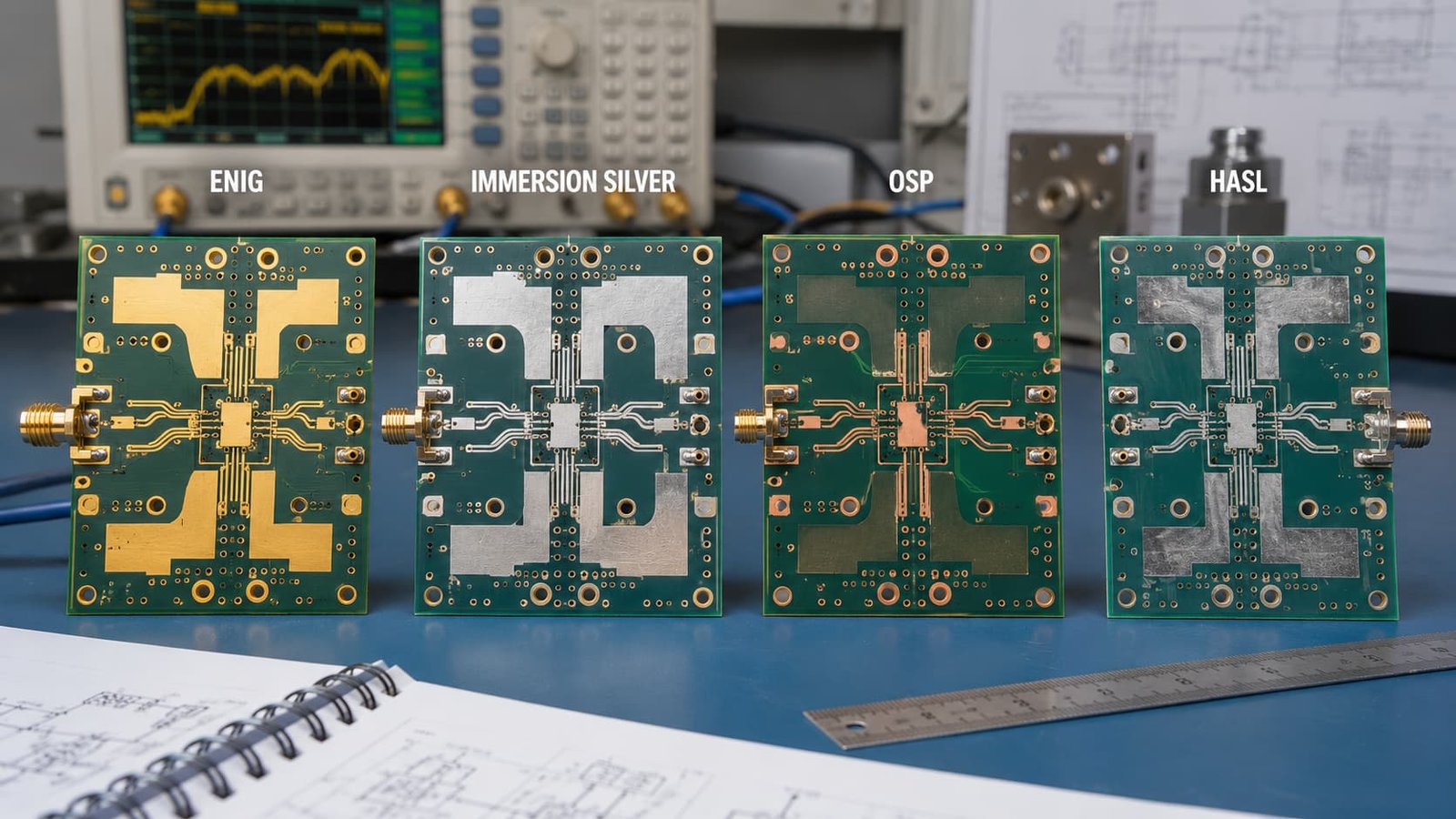
Why Surface Finish Matters in RF and Microwave PCB
The surface finish is applied to exposed copper after PCB fabrication. Its main purpose is to protect copper from oxidation and prepare the board for soldering, bonding, or assembly.
In RF and microwave PCB projects, surface finish may affect:
Solder joint reliability
Component assembly quality
Connector performance
Surface flatness
Copper protection
Storage life
RF pad quality
Customer specification compliance
For high frequency PCB applications, surface finish should not be selected only by price. It should match the final assembly process, PCB material, storage condition, and application environment.
For example, a Rogers PCB used in an RF module may require a different finish decision than a cost-sensitive FR4 control board. A PTFE PCB used in microwave circuits may also require more careful review because material processing and assembly reliability are more sensitive.
ENIG for RF and Microwave PCB
ENIG stands for electroless nickel immersion gold. It is one of the most commonly used surface finishes for RF PCB, microwave PCB, antenna PCB, Rogers PCB, and high frequency PCB projects.
ENIG provides a flat surface, good solderability, and reliable copper protection. It is widely accepted in B2B PCB manufacturing because it works well for many fine-pitch components and standard SMT assembly processes.
Common advantages of ENIG include:
Flat surface
Good solderability
Good storage performance
Suitable for fine-pitch components
Commonly accepted by many buyers
Stable assembly performance
However, ENIG includes a nickel layer. In some very sensitive RF designs, engineers may need to consider whether the finish structure affects exposed RF pads, antenna feed areas, or connector regions. For most general RF and microwave PCB applications, ENIG remains a practical and widely used option.
Immersion Silver
Immersion silver is another surface finish option for RF and microwave PCB.
It provides a flat surface and good electrical conductivity. For some high frequency designs, immersion silver may be considered when surface conductivity and RF signal areas are important.
The IPC-4553A specification sets requirements for immersion silver plating as a surface finish for printed boards. This makes IPC-4553A a useful technical reference when discussing immersion silver requirements for PCB manufacturing.
Advantages of immersion silver may include:
Flat surface
Good solderability
Good conductivity
No nickel layer
Suitable for some RF applications
However, immersion silver requires careful storage and handling. It can be more sensitive to tarnishing, contamination, and packaging conditions. If the board will be stored for a long time or shipped through uncontrolled environments, the finish should be reviewed carefully before selection.
Immersion silver can be a good option, but it should be matched with the assembly process, storage condition, and reliability requirement.
OSP Surface Finish
OSP stands for organic solderability preservative. It is a thin organic coating used to protect copper before soldering.
OSP is flat, simple, and cost-effective. It may be used in some PCB projects where surface flatness is important and the assembly process is well controlled.
Advantages of OSP include:
Very flat surface
Cost-effective
No nickel layer
Simple process
Suitable for some SMT assembly
However, OSP is usually less robust for long storage, repeated reflow, or harsh handling conditions. For RF and microwave PCB projects with higher reliability requirements, OSP should be reviewed carefully.
For high frequency PCB projects using Rogers, PTFE, Taconic, or F4B materials, OSP may be suitable in some cases, but the final decision should consider assembly timing, storage condition, and customer specification.
HASL and Lead-Free HASL
HASL means hot air solder leveling. It is a traditional surface finish used in many general PCB projects.
HASL can provide good solderability, but its surface is not as flat as ENIG, immersion silver, or OSP. For RF and microwave PCB projects with fine-pitch components, controlled impedance areas, antenna feed lines, or strict assembly requirements, this may be a limitation.
Lead-free HASL is more common when RHS compliance is required. However, for precision antenna PCB, microwave PCB, and high frequency circuit boards, HASL is usually not the first choice unless the project requirement allows it.
HASL may still be suitable for some less demanding PCB areas, but it should be reviewed before use in RF-sensitive designs.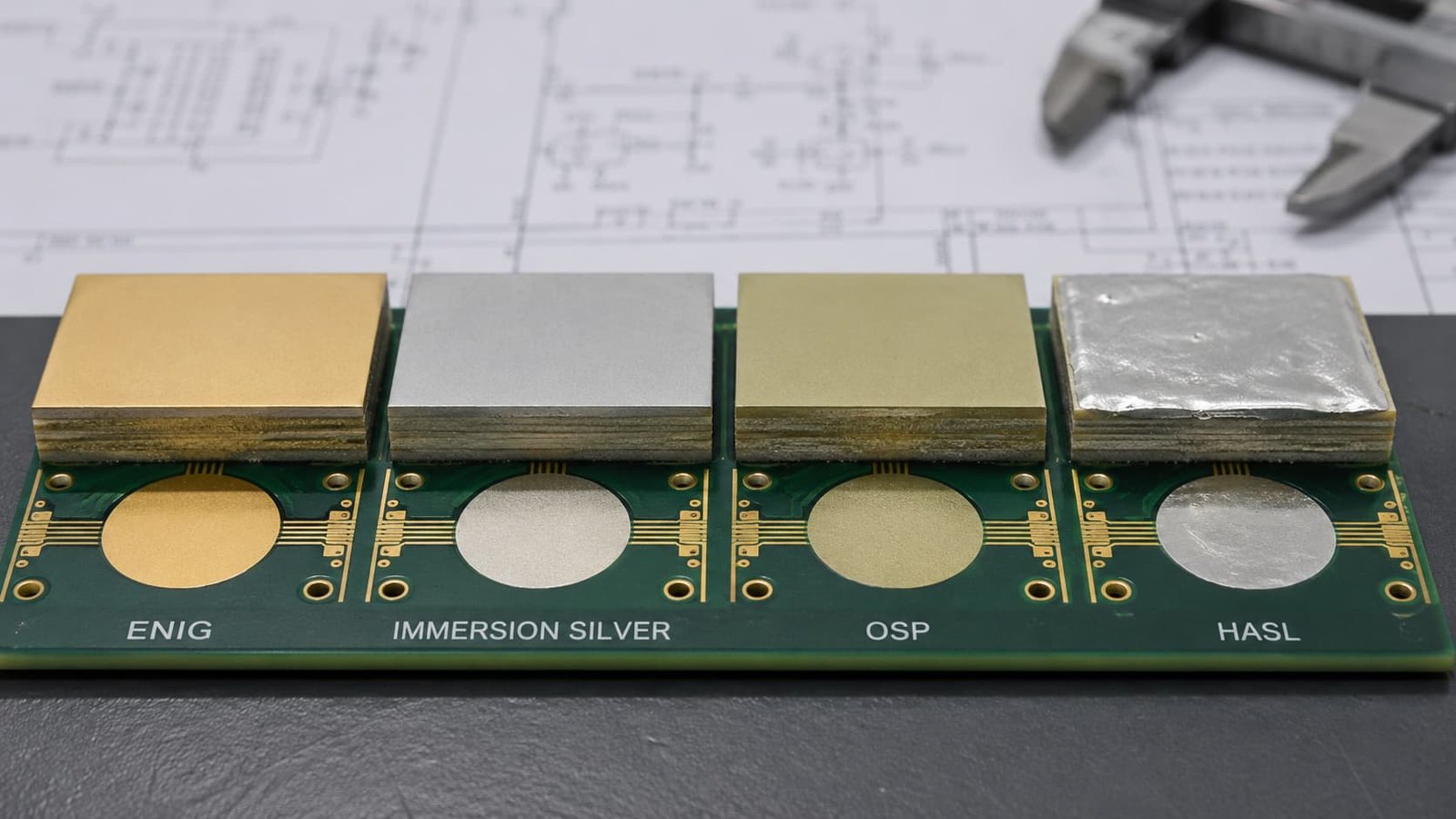
Immersion Tin and Other Finishes
Immersion tin is another surface finish option for printed circuit boards. IPC-4554 sets requirements for immersion tin as a surface finish for printed circuit boards, so it can be used as an external technical reference when customers specify immersion tin.
For RF and microwave PCB projects, immersion tin is not always the default choice, but it may be considered if required by the customer, assembly process, or product specification.
Hard gold is usually used for areas that need wear resistance, such as edge connectors, gold fingers, or repeated contact points. It is not normally selected for the entire RF PCB unless the design requires it.
Some RF or microwave PCB projects may require special finishes based on customer specifications, wire bonding, connector requirements, storage environment, or reliability standards.
When special finishes are required, they should be clearly stated in the quotation request.
Surface Finish and High Frequency Signal Loss
Surface finish can affect high frequency performance in certain RF and microwave designs, especially around exposed traces, RF pads, connector areas, and antenna feed regions.
For most controlled impedance PCB designs, the main factors are still material Dk, dielectric thickness, trace width, copper thickness, reference plane, solder mask, and manufacturing tolerance. However, finish selection may matter more at higher frequencies or in low-loss designs.
A technical article on the effects of surface finish on high frequency signal loss compared OSP, HASL, ENIG, and immersion silver across different substrate materials. This type of testing shows why surface finish should be considered as part of the whole RF design and manufacturing review, not only as a solderability choice.
For RF and microwave projects, the manufacturer should understand whether the finish is applied to RF-critical areas and whether the design has special loss or conductivity requirements.
Surface Finish for Rogers and PTFE PCB
Rogers PCB and PTFE PCB projects often require more careful process review than standard FR4 PCB.
For these boards, surface finish should be selected based on:
Material type
Assembly process
Component type
Storage requirement
RF performance sensitivity
Connector or bonding requirement
Customer specification
Final application environment
ENIG is commonly selected for many Rogers and PTFE PCB projects because it provides a flat and stable finish. Immersion silver may be considered for some RF applications, while OSP or HASL should be reviewed more carefully depending on the project.
For FR4 + Rogers hybrid PCB stackups, the finish should also be reviewed together with the stackup, lamination process, and assembly requirement.
How to Choose the Right Surface Finish
To choose the right surface finish for RF and microwave PCB, consider these questions:
What components will be assembled?
Is surface flatness important?
Is long storage required?
Are there fine-pitch components?
Is wire bonding required?
Are there edge connectors or contact points?
Is the board used in RF-critical areas?
Is the material Rogers, PTFE, Taconic, F4B, or hybrid?
Does the customer have a fixed specification?
For many B2B high frequency PCB projects, ENIG is a practical default option. But for certain RF-sensitive, cost-sensitive, or special assembly projects, immersion silver, OSP, hard gold, immersion tin, or other finishes may be reviewed.
What to Provide for Quotation
When requesting a quote, buyers should clearly provide the required surface finish.
If you are not sure which finish to choose, provide the project application and assembly requirement so the manufacturer can suggest suitable options.
Useful details include:
Gerber files
PCB stackup
Material requirement
Surface finish requirement
Component assembly method
Storage requirement
Connector or bonding requirement
Working frequency
Controlled impedance requirement
Quantity
Application background
For related quotation preparation, you can also review your article on what files are needed for a high frequency PCB quotation.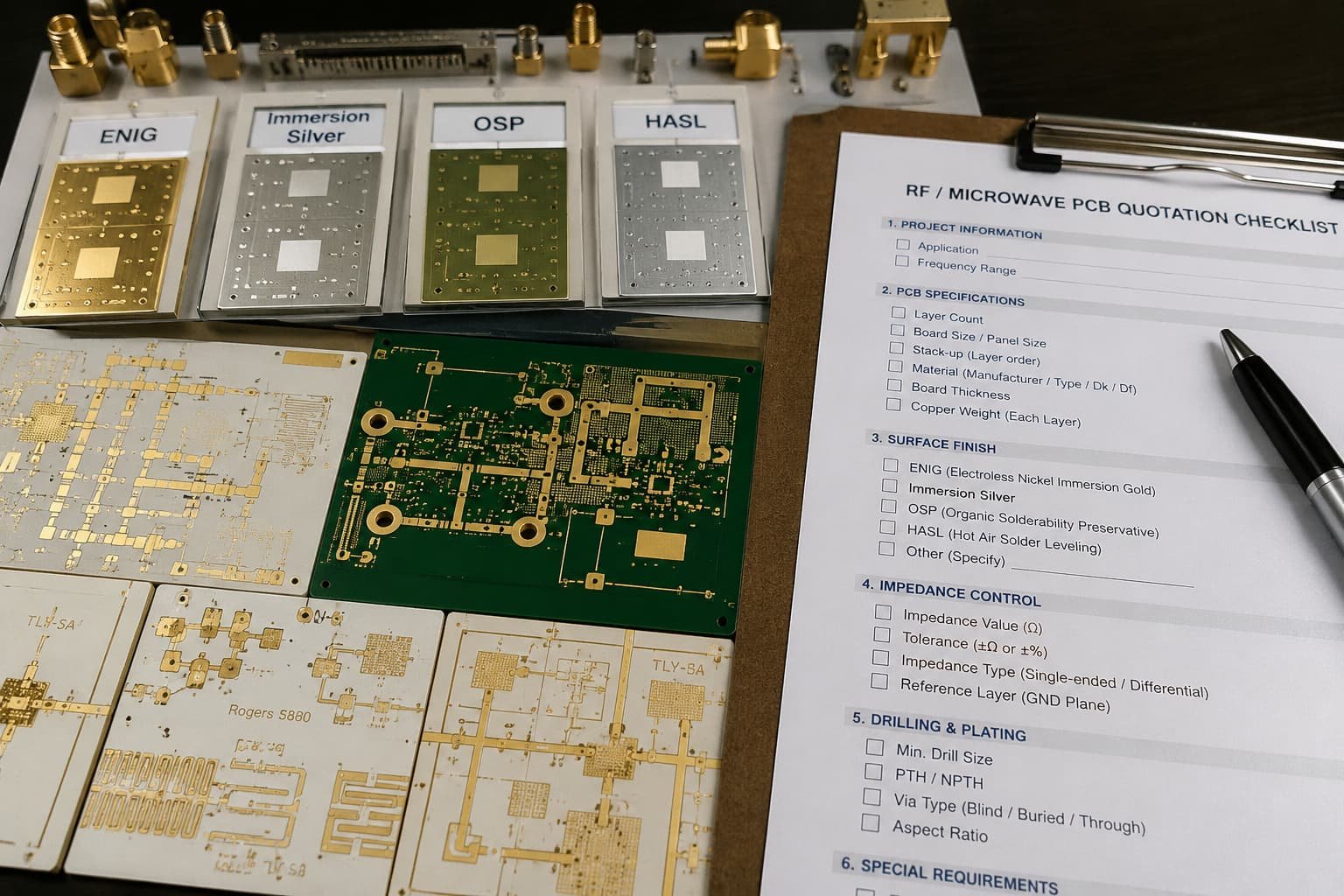
Conclusion
Surface finish is an important choice in RF and microwave PCB manufacturing. It affects copper protection, solderability, assembly quality, surface flatness, storage life, connector areas, and sometimes RF-sensitive signal regions.
ENIG is widely used for many high frequency PCB projects because it provides a flat surface and reliable assembly performance. Immersion silver may be suitable for some RF applications, while OSP, HASL, immersion tin, hard gold, and other finishes should be selected based on assembly, storage, reliability, and customer requirements.
For RF PCB, microwave PCB, antenna PCB, Rogers PCB, PTFE PCB, and high frequency PCB projects, surface finish should be reviewed together with material, stackup, impedance, copper thickness, assembly method, and application requirements before production.