
Engineers specifying high frequency PCB materials frequently encounter both Isola and Rogers in their material options list. Both are established laminate brands with multiple grades covering the high frequency and high-speed digital PCB market. The choice between them is not always obvious — the right answer depends on the operating frequency, the application type, the temperature range, and whether the priority is RF loss minimization or signal integrity in digital circuits.
Isola and Rogers serve partially overlapping but fundamentally different primary markets. Rogers is built around microwave and RF performance — its materials are specifically designed for controlled impedance high frequency PCB at frequencies where dielectric loss and Dk stability are the dominant concerns. Isola’s strongest products — 370HR and Astra MT77 — are designed primarily for high-speed digital PCB, where loss tangent matters but Dk stability at microwave frequencies is not always the design driver.
As a direct high frequency PCB manufacturer with Rogers, Taconic, F4B, and PTFE production capability in our factory, we regularly help engineers decide between these materials based on their specific application requirements. This guide covers the key differences so you can make the right material choice before submitting files for production.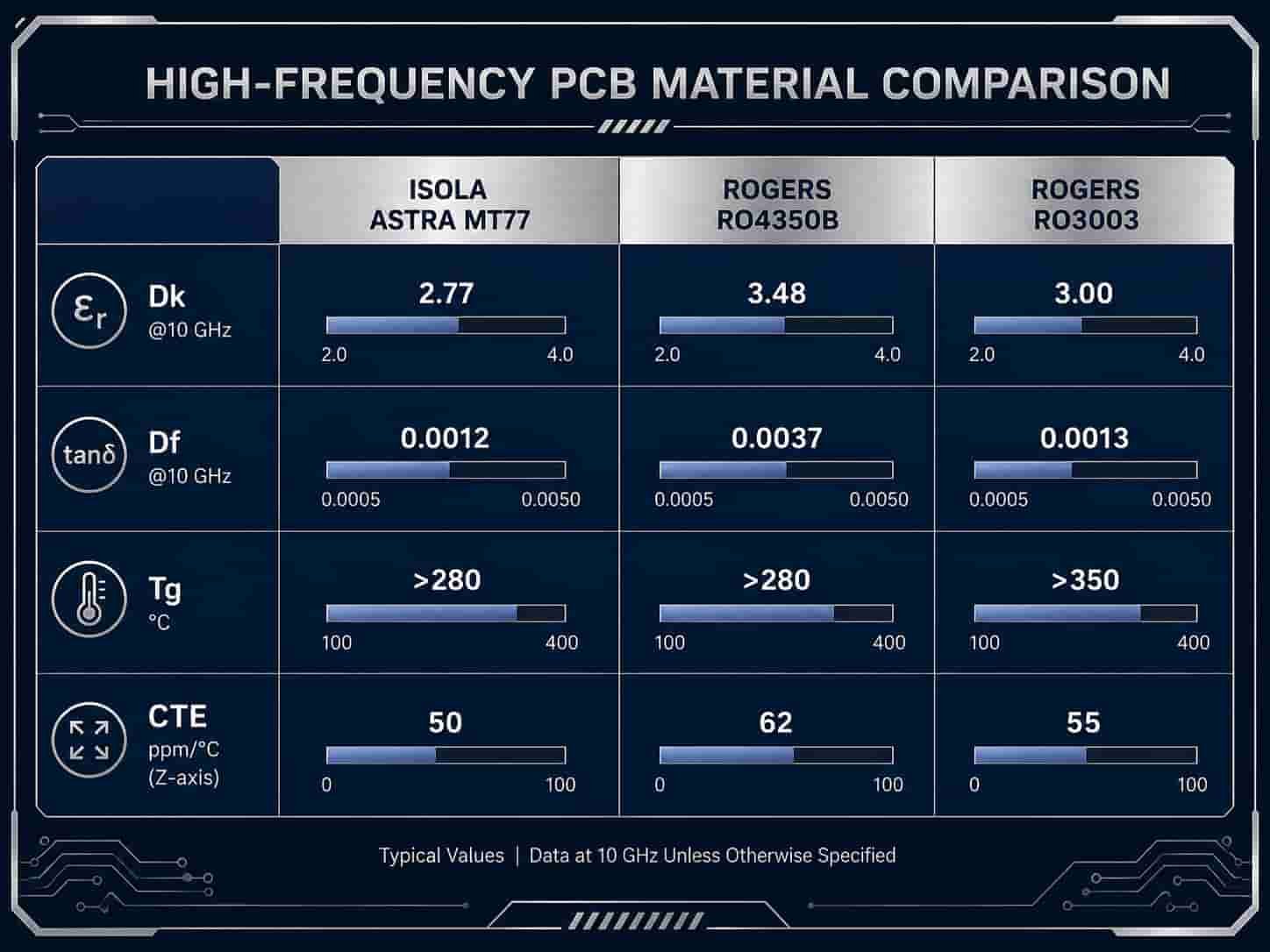
Quick Summary
Key point: Rogers RO4350B and RO3003 are designed for RF and microwave PCB where Dk stability and minimum Df across a wide frequency range are the primary requirements. Isola 370HR is designed for high-reliability high-speed digital PCB where thermal reliability (high Tg) and signal integrity in the 1–10 GHz range are the drivers. Isola Astra MT77 bridges the gap — lower Df than 370HR, suitable for some microwave applications up to approximately 20 GHz. For aerospace and defense RF PCB, Rogers is the standard — Isola is rarely specified for military radar or EW applications.
The most common mistake in material selection is choosing Isola for its lower cost without checking whether its Df at the actual operating frequency meets the insertion loss budget. At frequencies above 10 GHz, the difference in Df between Isola Astra MT77 and Rogers RO4350B becomes meaningful. Above 20 GHz, Rogers is the clear choice for RF applications.
What Isola and Rogers Make — Understanding the Product Lines
Isola — High-Speed Digital First, Microwave Second
Isola is primarily a high-speed digital laminate manufacturer. Its flagship products — IS370HR, IS415, and FR408HR — are designed for server PCB, networking equipment, and high-density interconnect boards where multilayer reliability, thermal stability, and signal integrity at 1–10 GHz are the dominant requirements. Isola Astra MT77 is its dedicated low-loss material for higher frequency applications, but it is still positioned for high-speed digital and some microwave applications rather than the full RF and microwave range that Rogers covers.
- IS370HR: Dk 3.97, Df 0.0130 at 2.5 GHz — high-speed digital, server, networking PCB
- IS415: Dk 3.45, Df 0.0040 at 10 GHz — lower loss than 370HR, some microwave applications
- Astra MT77: Dk 3.04, Df 0.0017 at 10 GHz — Isola’s lowest-loss standard product, targets microwave applications
- FR408HR: Dk 3.66, Df 0.0090 — high-Tg high-speed digital
Rogers — RF and Microwave First
Rogers Corporation’s material portfolio is built specifically for RF and microwave PCB. Every Rogers laminate grade is designed with Dk and Df performance at microwave frequencies as the primary specification. Rogers materials are the standard in aerospace radar, defense EW, satellite communication, and 5G millimeter-wave PCB — applications where Isola materials are rarely used.
- RO4350B: Dk 3.48, Df 0.0037 at 10 GHz — most widely used RF/microwave laminate globally
- RO4003C: Dk 3.38, Df 0.0027 at 10 GHz — lower loss than RO4350B for X-band and above
- RO3003: Dk 3.0, Df 0.0010 at 10 GHz — PTFE base, very low loss for Ka-band and defense
- RT5880: Dk 2.2, Df 0.0009 at 10 GHz — ultra-low loss for EW, W-band, and broadband systems
Isola vs Rogers: Material Property Comparison
The table below compares the key electrical and thermal properties of the most commonly used Isola and Rogers high frequency PCB materials. Understanding these differences is the foundation of the material selection decision.
 Dk and Df: The Most Important Comparison
For high frequency PCB, Dk and Df are the two most critical material properties. Dk determines the electrical wavelength on the board and the characteristic impedance of transmission lines. Df determines how much signal power is lost as heat in the dielectric as frequency increases.
Dk Comparison
The Dk values of Isola Astra MT77 (Dk 3.04 at 10 GHz) and Rogers RO3003 (Dk 3.0 at 10 GHz) are very similar at 10 GHz. The critical difference is Dk stability — how much Dk changes with frequency and with temperature.
- Astra MT77 Dk variation (1–20 GHz): Dk decreases from approximately 3.3 at 1 GHz to 3.0 at 10 GHz — approximately 9% variation across the decade
- Rogers RO4350B Dk variation (1–20 GHz): Dk decreases from approximately 3.6 at 1 GHz to 3.48 at 10 GHz — approximately 3% variation, more stable
- Rogers RO3003 Dk variation (1–40 GHz): less than 2% variation — most stable Dk of standard high frequency materials
- For broadband systems covering a wide frequency range, Dk stability matters as much as nominal Dk value
Df Comparison — Where the Real Difference Is
Df (loss tangent) is the most significant performance difference between Isola and Rogers for RF applications. At microwave frequencies, every 0.001 increase in Df adds approximately 0.05–0.1 dB/inch of additional insertion loss at 10 GHz, depending on the trace geometry.
- Isola 370HR Df at 10 GHz: 0.0130 — suitable for high-speed digital, not for microwave RF
- Isola Astra MT77 Df at 10 GHz: 0.0017 — lower loss, approaching Rogers RO4350B
- Rogers RO4350B Df at 10 GHz: 0.0037 — note this is higher than Astra MT77 at 10 GHz
- Rogers RO4003C Df at 10 GHz: 0.0027 — lower than RO4350B
- Rogers RO3003 Df at 10 GHz: 0.0010 — 1.7× lower than Astra MT77
- Rogers RT5880 Df at 10 GHz: 0.0009 — lowest standard RF laminate
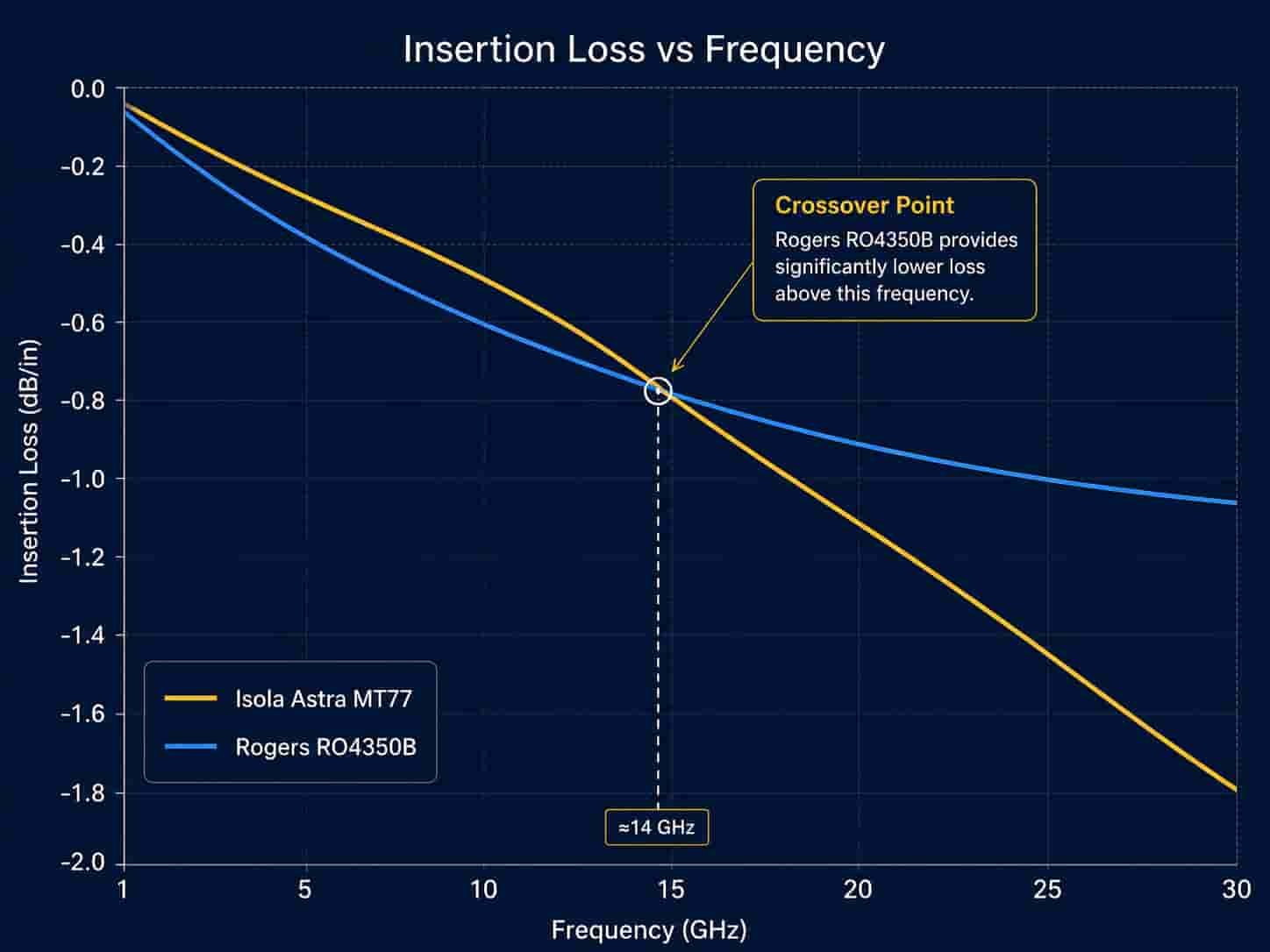
Important nuance: At 10 GHz, Isola Astra MT77 Df (0.0017) is actually lower than Rogers RO4350B Df (0.0037). This surprises many engineers. The reason Rogers RO4350B remains the dominant RF material is its superior Dk stability over temperature and frequency, its established qualification history in defense and aerospace, and the significantly wider Df gap at higher frequencies where Rogers materials maintain low Df while Astra MT77 increases.
Temperature Stability: Tg, CTE, and Dk Temperature Coefficient
Glass Transition Temperature (Tg)
Tg is the temperature above which the laminate resin softens and CTE increases dramatically. For aerospace and defense applications operating at -55°C to +125°C, Tg must be well above the operating range.
- Isola 370HR Tg: 180°C — the highest standard FR4 Tg, but still below the z-axis CTE concern threshold for demanding aerospace applications
- Isola Astra MT77 Tg: 190°C — adequate for most non-aerospace commercial applications
- Rogers RO4350B Tg: >280°C — significantly higher than any Isola product, no concern at aerospace operating temperatures
- Rogers RO3003 Tg: >500°C (PTFE base) — no glass transition in any practical PCB operating range
- For aerospace and defense operating at -55°C to +125°C: Rogers materials preferred — higher Tg provides greater margin
CTE and Thermal Cycling Reliability
- Isola 370HR z-axis CTE: 50–65 ppm/°C — typical for modified epoxy systems
- Isola Astra MT77 z-axis CTE: approximately 35–45 ppm/°C — better than 370HR but higher than Rogers
- Rogers RO4350B z-axis CTE: 32–46 ppm/°C — similar to Astra MT77 in z-axis
- Rogers RO3003 z-axis CTE: 24 ppm/°C — lower than all Isola products, better via fatigue life in thermal cycling
- For 1000+ thermal cycle qualification: Rogers RO3003 or RO4350B preferred over Isola for most aerospace applications
Dk Temperature Coefficient
- Isola Astra MT77 Dk temperature coefficient: approximately +100–120 ppm/°C — Dk increases with temperature
- Rogers RO4350B Dk temperature coefficient: +50 ppm/°C — more stable than Astra MT77 over temperature
- Rogers RO3003 Dk temperature coefficient: +13 ppm/°C — 8–9× more stable than Astra MT77 over temperature
- For designs operating over wide temperature ranges where impedance stability matters: Rogers materials are significantly better
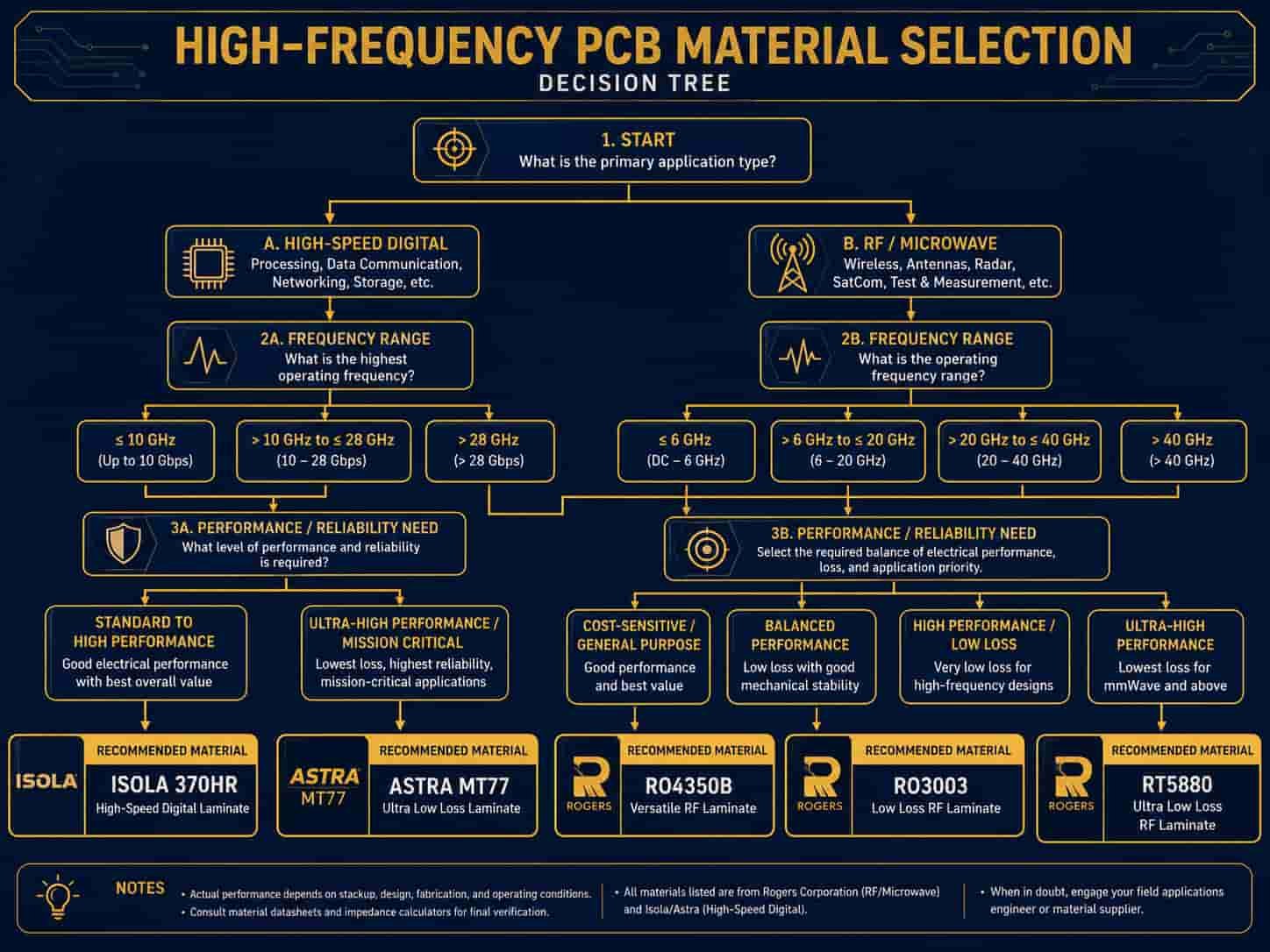
Application-Specific Selection Guidance: Isola vs Rogers
The right material choice depends on the specific application. The following guidance covers the most common application types encountered in high frequency PCB specification.
High-Speed Digital PCB (1–10 GHz, Server/Networking/5G Backhaul) → Isola
Isola 370HR and Astra MT77 were designed for this application. High-layer-count server and networking boards with many impedance-controlled differential pairs at 10–25 Gbps data rates are where Isola products are most competitive.
- Isola 370HR: standard choice for high-reliability server and networking PCB — high Tg, good process compatibility
- Isola Astra MT77: for applications above 10 Gbps where lower Df is needed — better signal integrity at 10–20 GHz
- Rogers RO4350B: can be used in this application but is typically more expensive than Isola for the same performance at data link frequencies
- Rogers advantage disappears below 10 GHz for digital applications — Isola products are optimized for this range
Commercial RF and Microwave PCB (2–20 GHz) → Rogers RO4350B or Astra MT77
In the 2–20 GHz range for commercial RF applications — VSAT terminals, 5G RF front-end, radar sensors — both Rogers RO4350B and Isola Astra MT77 are technically viable. The choice often comes down to manufacturing availability and cost.
- Rogers RO4350B: more widely stocked in high frequency PCB factories, established qualification history
- Isola Astra MT77: lower Df at 10 GHz than RO4350B — advantage for applications where insertion loss budget is tight at 10–15 GHz
- Above 20 GHz: Rogers RO4003C or RO3003 — Astra MT77 Df increases more rapidly above 20 GHz
- Factory note: we stock Rogers RO4350B and RO4003C in our factory. Astra MT77 is available by order with lead time confirmation
Aerospace and Defense RF PCB (All Frequencies) → Rogers
For aerospace and defense high frequency PCB — airborne radar, EW systems, satellite communication, avionics — Rogers materials are the standard. Isola is rarely specified in defense programs for several reasons:
- IPC Class 3 defense programs typically specify Rogers by grade — Astra MT77 substitution requires customer written approval
- Rogers has established defense qualification history with documented performance data across temperature and frequency
- Rogers Dk temperature coefficient is 4–8× more stable than Isola over the -55°C to +125°C aerospace operating range
- Rogers Tg > 280°C provides far more margin than Isola Astra MT77 Tg of 190°C for aerospace thermal cycling qualification
- MIL-PRF-31032 qualified PCB programs: Rogers materials are the established option — Isola qualification is uncommon
For aerospace and defense PCB material requirements, see High Frequency PCB for Aerospace and Defense: Material, Reliability and Manufacturing Requirements.
Ka-Band and Above (26.5 GHz+) → Rogers RO3003 or RT5880
Above Ka-band, Isola Astra MT77 is not a practical choice for RF applications. Its Df increases significantly above 20 GHz and its Dk stability at millimeter-wave frequencies is less well characterized than Rogers PTFE materials.
- Ka-band (26.5–40 GHz): Rogers RO3003 — standard material, well-characterized at Ka-band
- W-band (75–110 GHz): Rogers RT5880 — only viable standard material at W-band
- Isola Astra MT77: not recommended above 20 GHz for RF applications
Manufacturing Process Differences: What Your Factory Needs to Handle
Material selection affects not just electrical performance but also manufacturing process requirements. Understanding these differences helps when evaluating whether your PCB factory can produce the specified material reliably.
Isola Processing
Isola 370HR and Astra MT77 are epoxy-based or modified epoxy/hydrocarbon laminates that process similarly to standard FR4. Most FR4-capable PCB factories can process Isola materials without specialized equipment.
- Lamination: standard FR4 press cycle compatible — widely available
- Drilling: standard FR4 drill parameters acceptable
- Desmear: standard permanganate desmear process
- Bonding film: standard FR4 prepreg compatible for most Isola materials
- Maximum lamination cycles: same as FR4 — up to 3 cycles for most grades
- Factory availability: most FR4 factories can handle Isola — but not all have confirmed RF PCB capability
Rogers Hydrocarbon Ceramic (RO4350B, RO4003C) Processing
Rogers RO4350B and RO4003C are hydrocarbon ceramic materials designed to process similarly to FR4 while delivering RF performance significantly better than FR4. A factory with Rogers RO4350B capability needs to confirm the correct bonding film and lamination profile.
- Lamination: compatible with standard FR4 press cycle but requires Rogers-specified bonding film (RO4450F or RO4450T)
- Drilling: standard parameters acceptable — PTFE-specific parameters not required
- Desmear: standard permanganate process
- Maximum lamination cycles: up to 3 cycles — same as FR4
- Key requirement: Rogers RO4450F or RO4450T bondply must be in factory inventory — standard FR4 prepreg as bonding film causes impedance errors at the Rogers-FR4 interface
Rogers PTFE (RO3003, RT5880) Processing
Rogers PTFE materials require specialized processing that FR4-only factories do not have. This is where the difference between a genuine high frequency PCB factory and a factory that handles occasional Rogers orders becomes clear.
- Hole wall activation: sodium naphthalene or plasma etch required before copper plating — standard desmear is not sufficient for PTFE
- Drill parameters: PTFE-specific spindle speed and feed rate — standard FR4 parameters cause hole wall deformation
- Maximum lamination cycles: 2 cycles maximum — more than 2 cycles degrades PTFE properties
- Bonding film: Rogers 2929 or equivalent PTFE-compatible bonding film — not standard FR4 prepreg
- Factory note: our factory runs PTFE-specific drill parameters and hole wall activation for all RO3003 and RT5880 orders — not an occasional process
For PTFE manufacturing requirements, see PTFE PCB Manufacturing Challenges and Process Considerations. For mixed laminate processing, see Mixed Laminate High Frequency PCB: How FR4 and Rogers Are Combined in Production.
Cost Comparison: Isola vs Rogers
Material cost is often cited as the reason for considering Isola as a Rogers alternative. The cost relationship is more nuanced than it appears.
- Isola 370HR vs Rogers RO4350B: Isola 370HR is significantly less expensive — but they serve different markets and comparing them directly is like comparing standard FR4 to Rogers
- Isola Astra MT77 vs Rogers RO4350B: Astra MT77 is typically comparable to or slightly lower than RO4350B in material cost — not dramatically cheaper
- Isola Astra MT77 vs Rogers RO4003C: similar price range
- Processing cost: Isola processes like FR4 — slightly lower processing cost than Rogers for most factories
- Total PCB cost difference: typically 10–20% lower for Isola Astra MT77 vs Rogers RO4350B for the same board — not a dramatic saving
- For applications where either material is technically adequate, the cost difference may justify Isola
- For aerospace and defense: cost saving from Isola is irrelevant if the program specifies Rogers — substitution requires customer approval and re-qualification
Factory perspective: We regularly build Rogers RO4350B PCB for commercial customers who ask about Isola as a lower-cost alternative. For most applications below 15 GHz, Astra MT77 is technically viable. For applications above 15 GHz, for aerospace and defense programs, or for any design with Rogers specified on the fabrication drawing, we recommend staying with Rogers — the performance difference and qualification risk of substitution outweigh the modest cost saving.
Quick Decision Guide: Isola or Rogers?
Use the following guidance as a starting point for material selection. Always confirm with your PCB manufacturer before finalizing the design.
Choose Isola 370HR when:
- Application is high-speed digital PCB — server, networking, switching equipment
- Operating frequency is below 5 GHz with digital data rates up to 25 Gbps
- High Tg (180°C) is needed for thermal reliability in industrial or high-temperature environments
- Cost is a primary concern and RF performance at microwave frequencies is not the driver
Choose Isola Astra MT77 when:
- Application is high-speed digital with some RF sections operating at 10–15 GHz
- Lower Df than 370HR is needed but Rogers price or availability is a concern
- Application is commercial RF below 20 GHz and Rogers is not specified on the fabrication drawing
- Customer has specifically approved Astra MT77 as an alternative to Rogers
Choose Rogers RO4350B when:
- Application is RF or microwave PCB at L-band through X-band (1–12 GHz)
- Aerospace, defense, or IPC Class 3 program — Rogers specified or required
- Wide temperature range operation (-40°C to +85°C) with Dk stability requirement
- Hybrid FR4 + Rogers stackup — RO4350B is the most compatible Rogers material for hybrid
- Program requires Rogers-certified material documentation with lot traceability
Choose Rogers RO3003 or RT5880 when:
- Application is Ka-band, W-band, or any frequency above 20 GHz
- Electronic warfare, SIGINT, or broadband receiver covering 2–18 GHz or wider
- Defense or aerospace program requiring minimum insertion loss at Ka-band or above
- IPC Class 3 with wide temperature range (-55°C to +125°C) and maximum Dk stability
For detailed Rogers material selection guidance, see Rogers PCB Material Selection Guide for RF and Microwave Applications. For PTFE and low-loss material options, see PTFE PCB Manufacturing Challenges and Process Considerations.
What We Can Build: Our High Frequency Material Capability
As a direct high frequency PCB manufacturer, we produce both Rogers and Isola high frequency PCB in our own factory. The following materials are available for production:
Rogers Materials (In Production)
- RO4350B, RO4003C — hydrocarbon ceramic, standard RF and microwave applications
- RO3003, RO3003G2 — PTFE, Ka-band, defense radar, EW
- RT5880, RT5870 — PTFE ultra-low loss, W-band, EW receivers
- RO3006, RO3010, RO6010 — high Dk specialty applications
Isola Materials (Available by Order)
- Isola 370HR — high-speed digital, networking, server PCB
- Isola Astra MT77 — lower-loss microwave applications, hybrid with FR4
- Lead time for Isola orders: confirm material availability before design finalization
Our Manufacturing Capability for Both
- Controlled impedance: ±10% standard, ±8% advanced — verified by TDR on every lot
- IPC Class 3: 25 µm average PTH copper plating, in-house microsection, 100% electrical test
- PTFE-specific process: sodium activation for RO3003 and RT5880 — not an occasional process
- Hybrid stackup: Rogers + FR4 or Isola + FR4 with appropriate bonding film
- Layer count: 2–32 layers standard, up to 50 layers advanced
Information Needed for Isola or Rogers High Frequency PCB Quotation
To review feasibility and provide an accurate quotation for your high frequency PCB regardless of material, the following information should be prepared:
- Gerber files and NC drill files
- Material specification — Rogers grade, Isola grade, or both for comparison
- Complete stackup with layer sequence and dielectric thickness
- Operating frequency range
- Controlled impedance requirements — target value and tolerance
- Whether Rogers-certified material documentation is required (defense/aerospace programs)
- IPC Class requirement — Class 2 for commercial, Class 3 for aerospace/defense
- Layer count and board thickness
- Surface finish
- Quantity and delivery requirement
For a complete file checklist, see What Files Are Needed for a High Frequency PCB Quotation?.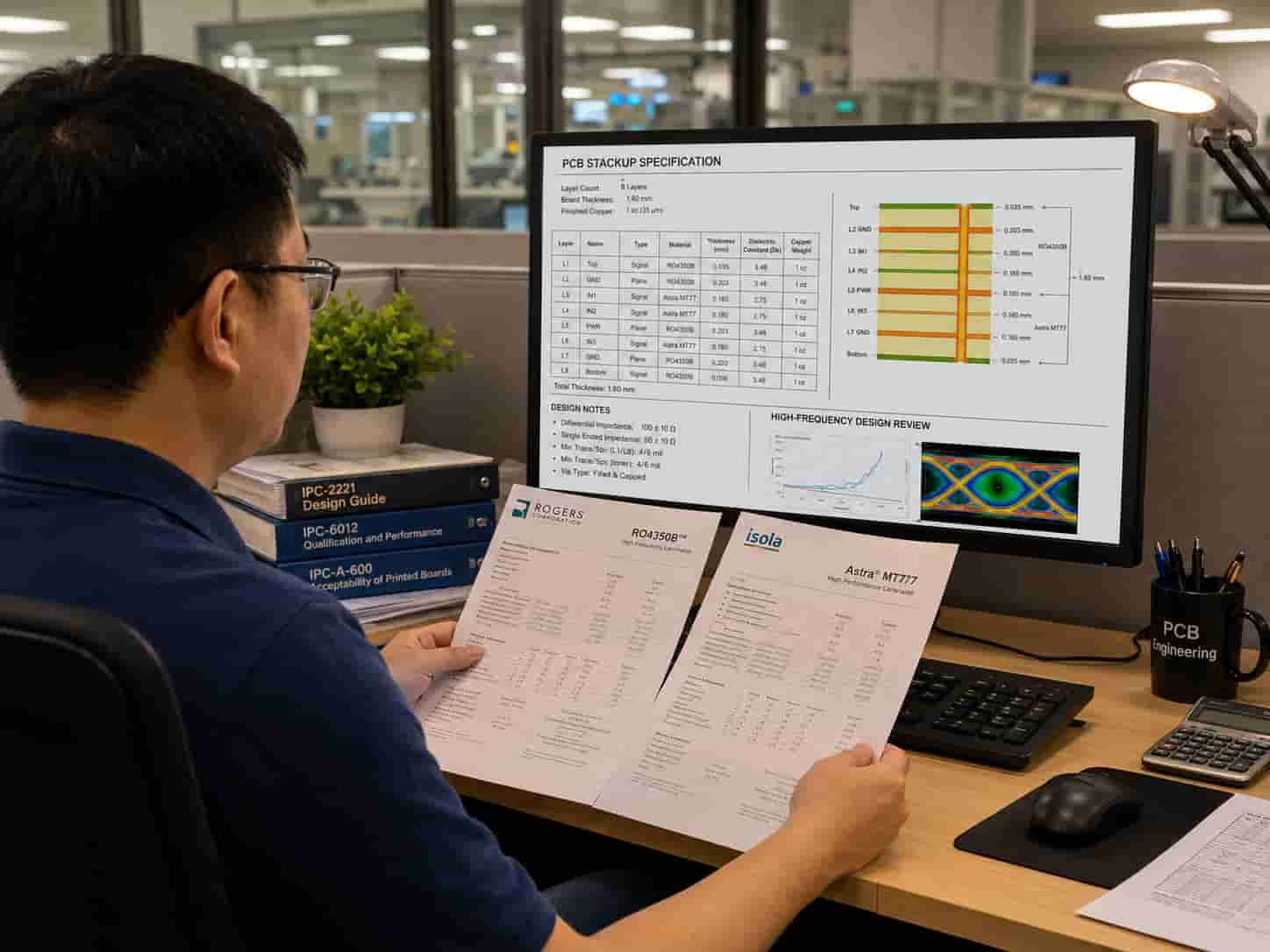
Conclusion
Isola and Rogers serve different primary markets and the best material choice depends on the application, frequency, temperature range, and program requirements. Isola 370HR and Astra MT77 are well-suited for high-speed digital applications and commercial RF PCB operating below 20 GHz where Rogers-certified documentation is not required. Rogers RO4350B, RO4003C, RO3003, and RT5880 are the standard for RF and microwave PCB at any frequency, and the only practical choice for aerospace, defense, Ka-band, and millimeter-wave applications.
As a direct manufacturer with Rogers, Isola, and PTFE production capability in our own factory, we can help you evaluate the right material for your specific high frequency PCB project — including honest guidance on when Isola is a viable option and when Rogers is the correct specification. Submit your stackup and Gerber files for engineering review and we will confirm material suitability, impedance feasibility, and production capability before quotation.