
PCB Material Price Increase 2026: 6 Rounds of Hikes, Root Causes and What to Do Now
PCB material prices rose through six consecutive rounds of hikes between December 2025 and April 2026 — the most sustained price escalation the industry has seen since records began. Copper-clad laminate (CCL) is up 45% versus prior periods. Copper foil has risen 30%+. High-end laminate grades for AI server and high-speed applications are up 20–40%, with some grades in allocation mode at lead times extending to six months. This article documents what happened, why it happened, and what RF and high-frequency PCB buyers should do now.
Home » PCB Material Price Increase 2026: 6 Rounds of Hikes, Root Causes and What to Do Now
Table of Contents
| Round | Timing | Who Raised | What Increased |
|---|---|---|---|
| Round 1 | December 2025 | Kingboard (建滔), Nanya | FR-4 CCL and prepreg +10–20% in a single week |
| Round 2 | January 2026 | Chinese glass fiber cloth makers | Glass fiber cloth cumulative +50% from Oct 2025 baseline |
| Round 3 | February 2026 | Chinese glass fiber makers (2nd notice) | Further glass cloth increases — 4 successive hikes Oct/Dec/Jan/Feb |
| Round 4 | March 1, 2026 | Resonac (Japan) | All specialty CCL grades +30% |
| Round 5 | April 1, 2026 | Mitsubishi Gas Chemical (Japan) | All resin-coated foil grades +30% |
| Round 6 | April 25–28, 2026 | Iteq, TUC, Elite Material, Kingboard | High-end CCL +20–40%; Kingboard FR-4 +10% (4th hike of 2026) |
The six rounds were not independent events. They were a cascade triggered by a single structural shift: AI server hardware requires PCBs with fundamentally higher material intensity than conventional server boards. The average AI server PCB layer count rose from approximately 18 layers in 2023 to around 32 layers in 2025. Each layer requires CCL. As AI server production volumes grew at 28%+ annually, CCL demand grew faster than capacity — and the shortage cascaded from high-end specialty grades down to standard FR-4.
The Three Root Causes
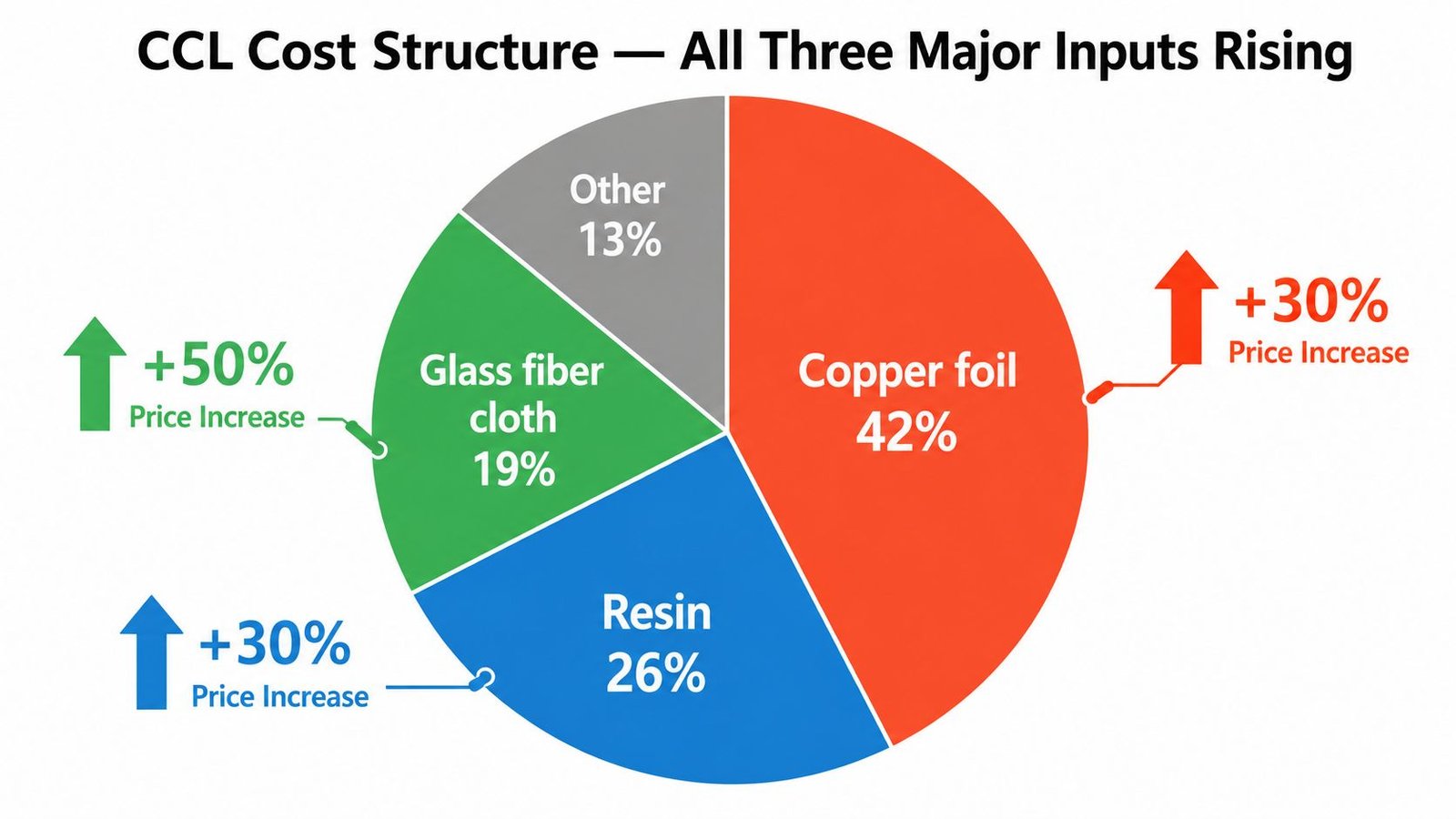
1. Copper foil — LME copper at record highs
Copper foil accounts for approximately 42% of CCL cost. LME copper prices reached $14,527/tonne in January 2026 — a record high. MicroThin foil (used in high-density PCBs) rose 12% in April 2026 from Mitsui Kinzoku. Premium specialty foils (HVLP, HVLP4 — used in RF and high-speed designs for low surface roughness) rose further because their production capacity is independently constrained.
2. Glass fiber cloth — Nittobo monopoly and T-glass shortage
Glass fiber cloth accounts for 19% of CCL cost — a smaller share, but the structural chokepoint of the entire supply chain. Nittobo holds approximately 90% of global T-glass supply (the specialty glass cloth used in high-frequency and high-speed CCL). Nittobo raised prices 20% in August 2025 and another 20–30% in April 2026. T-glass has surged to approximately $100/kg with orders backlogged into 2027. Chinese glass fabric makers issued four successive price increase notices between October 2025 and February 2026, with cumulative increases above 50%.
3. Resin — PPE disruption and AI-grade resin shortage
Resin accounts for 26% of CCL cost. PPE (polyphenylene ether) resin — the backbone of high-performance laminates including Panasonic Megtron — experienced a production disruption at the largest single global supplier in April 2026. Mitsubishi Gas Chemical raised all resin-coated foil grades by 30% effective April 1. With no alternative producer at comparable scale, recovery is projected at 6–9 months.
Impact by PCB Material Category
| Material Category | Price Change | Lead Time Change | Most Affected PCBs |
|---|---|---|---|
| Standard FR-4 CCL | ↑ 10–15% | 2–4 weeks → 5–8 weeks | All FR-4 multilayer |
| High-Tg FR-4 | ↑ 15–25% | 4–6 weeks | Server, automotive, industrial |
| High-speed laminate (M6/M7/M8) | ↑ 25–40% | 8–16 weeks | AI server, high-speed digital |
| M9 / T-glass specialty | ↑ 40%+, allocation | Up to 6 months | AI GPU/switch boards |
| Rogers RO4350B / RO4003C | ↑ 10–20% | 5–8 weeks | RF, radar, SATCOM |
| Rogers RO3003 / RT5880 (PTFE) | ↑ 15–25% market | 7–10 days (in stock at Riching) | Ka-band, 77GHz, EW |
| Copper foil (all grades) | ↑ 30%+ | Embedded in CCL price | All copper-based PCBs |
Why Rogers RO3003 and RT5880 are different
Rogers PTFE materials (RO3003, RT5880) have also seen upstream cost pressure — but their supply situation differs from AI-driven grades in one important way: these materials are not competing with AI server demand. The AI supply crunch is concentrated in high-speed digital laminates (M6–M9, T-glass based). Rogers RO3003 and RT5880 are PTFE ceramic composites — a completely different material chemistry and supply chain. Riching PCB maintains RO3003 0.127mm, 0.254mm and RT5880 in all six standard thicknesses as regular inventory. See Rogers RO3003 PCB manufacturer and Rogers RT5880 PCB manufacturer for current stock and lead times.
Will Prices Keep Rising?
The structural drivers are not temporary. Three signals point to sustained elevated prices through at least end-2026:
- Nittobo’s T-glass capacity expansion (3× by 2028) does not produce material output until late 2026 — no supply relief before then
- PPE resin recovery projected at 6–9 months from April 2026 disruption — meaning Q4 2026 at earliest
- NVIDIA Rubin GPU production — expected to begin in Q4 2026 — uses M9 CCL, adding another demand wave on top of current AI server build-out
- Vexos CMS internal procurement tracking shows CCL indexed at 153.2 in March 2026, with Q2 2026 forecast of 246.8 — a projected +61% from the March baseline
For standard FR-4 and Rogers RO4350B, the pressure is real but more moderate — primarily driven by copper foil cost pass-through rather than allocation constraints. For high-speed digital laminates, the situation is more severe and less predictable.
What RF and High-Frequency PCB Buyers Should Do Now
| Action | Why It Matters Now |
|---|---|
| Lock material specs early | Late design changes that alter layer count or laminate reset your material queue — potentially months of delay |
| Share 3–6 month demand forecast | Suppliers are managing allocation. Buyers with visible demand get priority over spot buyers |
| Ask about in-stock material before ordering | For Rogers RO3003 and RT5880, in-stock factories eliminate procurement lead time — 7–10 days vs 3–4 months elsewhere |
| Review whether your design truly needs premium grades | Many designs over-specify — standard FR-4 or RO4350B may meet requirements where M8/M9 was specified by default |
| Consider hybrid stackup for cost control | Rogers only on RF layers, FR-4 elsewhere — 30–50% cost saving vs all-Rogers, same RF performance |
| Request a DFM review before committing to material | A 4–8 hour DFM review can identify material substitution options before procurement is locked |
The hybrid stackup option
For designs using Rogers or PTFE on all layers, a hybrid FR-4 + Rogers stackup can reduce material cost 30–50% while maintaining RF performance on critical layers. Rogers or PTFE on RF signal layers only; FR-4 on digital, power and ground layers. This approach insulates the design from FR-4 price increases on Rogers layers and from Rogers price increases on FR-4 layers — each material is used only where it is technically necessary.
In-stock material vs procurement lead time
In the current environment, the difference between a factory that stocks Rogers RO3003 and one that procures per-job is not just 3–4 weeks of lead time — it is cost certainty. When a factory procures per-job, the price quoted today is based on today’s CCL cost. When the factory procures for your order, it may pay a higher price if another hike lands between quote and purchase. In-stock material means the price you are quoted is the price the factory has already paid. Riching PCB maintains Rogers and PTFE inventory as standard stock — see high frequency PCB manufacturer for available materials and current lead times.
PCB Material Price Increase 2026 — Q&A
Common questions about the 2026 PCB material price surge, which materials are most affected, and what buyers can do to manage cost and lead time risk.
Why did PCB material prices increase so much in early 2026?
Three inputs — copper foil (42% of CCL cost), glass fiber cloth (19%), and resin (26%) — all rose simultaneously. The underlying driver is AI server demand: AI PCBs require far more CCL per unit than conventional boards, and industry capacity was not built for this demand profile. The cascade ran from high-end specialty grades down to standard FR-4, producing six rounds of price hikes between December 2025 and April 2026.
How much did CCL prices rise in 2026?
Standard FR-4 CCL rose approximately 10–15%. High-speed laminates (M6/M7/M8) rose 25–40%. M9 specialty grades rose 40%+ and moved into allocation with lead times up to 6 months. South Korea's CCL import prices reached $20,728/tonne in March 2026 — a 74.5% year-over-year increase and the first time the $20,000 threshold was crossed since records began in 2000.
Are Rogers RO3003 and RT5880 affected by the 2026 price increase?
Rogers PTFE materials have seen some cost pressure, but their supply situation differs from AI-driven grades. The 2026 crunch is concentrated in high-speed digital laminates (M6–M9). Rogers RO3003 and RT5880 are PTFE ceramic composites — a different material chemistry and supply chain. Factories that stock these materials offer both price certainty and 7–10 day lead times.
Will PCB material prices keep rising in 2026?
The structural drivers are not temporary. Nittobo's T-glass capacity expansion does not produce output until late 2026. PPE resin recovery is projected at 6–9 months from April 2026. NVIDIA Rubin GPU production in Q4 2026 will add another wave of M9 demand. Industry forecasts show CCL prices continuing to rise through 2026.
What can I do to reduce exposure to PCB material price increases?
Lock material specifications early. Share 3–6 month demand forecasts with your PCB supplier to secure allocation. Use hybrid FR-4 + Rogers stackups to reduce Rogers material consumption 30–50%. Ask about in-stock material — factories with Rogers in stock offer price certainty because the cost is already locked. Request a DFM review to identify substitution options before procurement is committed.
Rogers RO3003 and RT5880 In Stock — No Material Wait, Price Certainty
While most factories are quoting 3–4 months for PTFE materials, Riching PCB maintains RO3003 0.127mm and RT5880 in all 6 thicknesses as standard inventory. The price you are quoted is the price we have already paid — no procurement surcharge risk. 7–10 day prototype, no MOQ.
Check Material Stock → WhatsAppRequest a PCB Quote
Upload your Gerber ZIP file and project requirements. Our engineering team will review your PCB material, stackup, impedance needs, surface finish, and production quantity before quoting.
Please prepare:
- Gerber files in ZIP format
- PCB material or stackup requirements
- Controlled impedance notes if available
- Prototype or batch production quantity