
77 GHz Radar PCB: Material Selection and Manufacturing Guide
Home » 77 GHz Radar PCB: Material Selection and Manufacturing Guide
Table of Contents
Key point: Most factories quote 3–4 weeks waiting for RO3003 / RT5880 material procurement. Riching PCB maintains these materials in stock — no material wait.77 GHz radar PCB requires PTFE substrate — Rogers RO3003 (Dk 3.0, Df 0.0010) or RT5880 (Dk 2.20, Df 0.0009). Standard RO4350B (Df 0.0037) is not suitable above 24 GHz. All PTFE orders require in-house plasma hole wall activation before copper plating, low-profile copper foil, and TDR-verified impedance control to ±5%. Maximum 2 lamination press cycles for PTFE. Riching PCB stocks RO3003 and RT5880 with in-house plasma activation. No MOQ. Prototype lead time 5–7 working days.
77 GHz automotive radar PCB is one of the most demanding PCB manufacturing challenges in commercial electronics. The millimeter-wave frequency requires ultra-low-loss PTFE substrate, tight impedance control, in-house plasma activation, and TDR verification on every production lot. A wrong material choice or a single process shortcut will cause the radar to fail range or angular resolution specifications — failures that cannot be corrected after fabrication.
This guide covers material selection, design rules, manufacturing requirements, and what to verify with your PCB fabricator before placing an order.
Why 77 GHz Requires PTFE Substrate
At 77 GHz, signal wavelength in the substrate is approximately 1.5–2 mm. A Df of 0.020 (standard FR4) produces insertion loss exceeding 10 dB/cm at this frequency — the signal is completely absorbed before reaching the antenna. PTFE substrates with Df of 0.0009–0.0010 reduce insertion loss to under 1 dB/cm, preserving signal integrity across the board.
Dk stability is equally critical. At 77 GHz, a ±0.05 variation in Dk shifts the antenna resonance frequency by hundreds of MHz — moving the radar out of the 76–77 GHz band. Rogers RO3003 and RT5880 maintain Dk within ±0.05 across the operating temperature range of automotive applications (–40°C to +85°C).
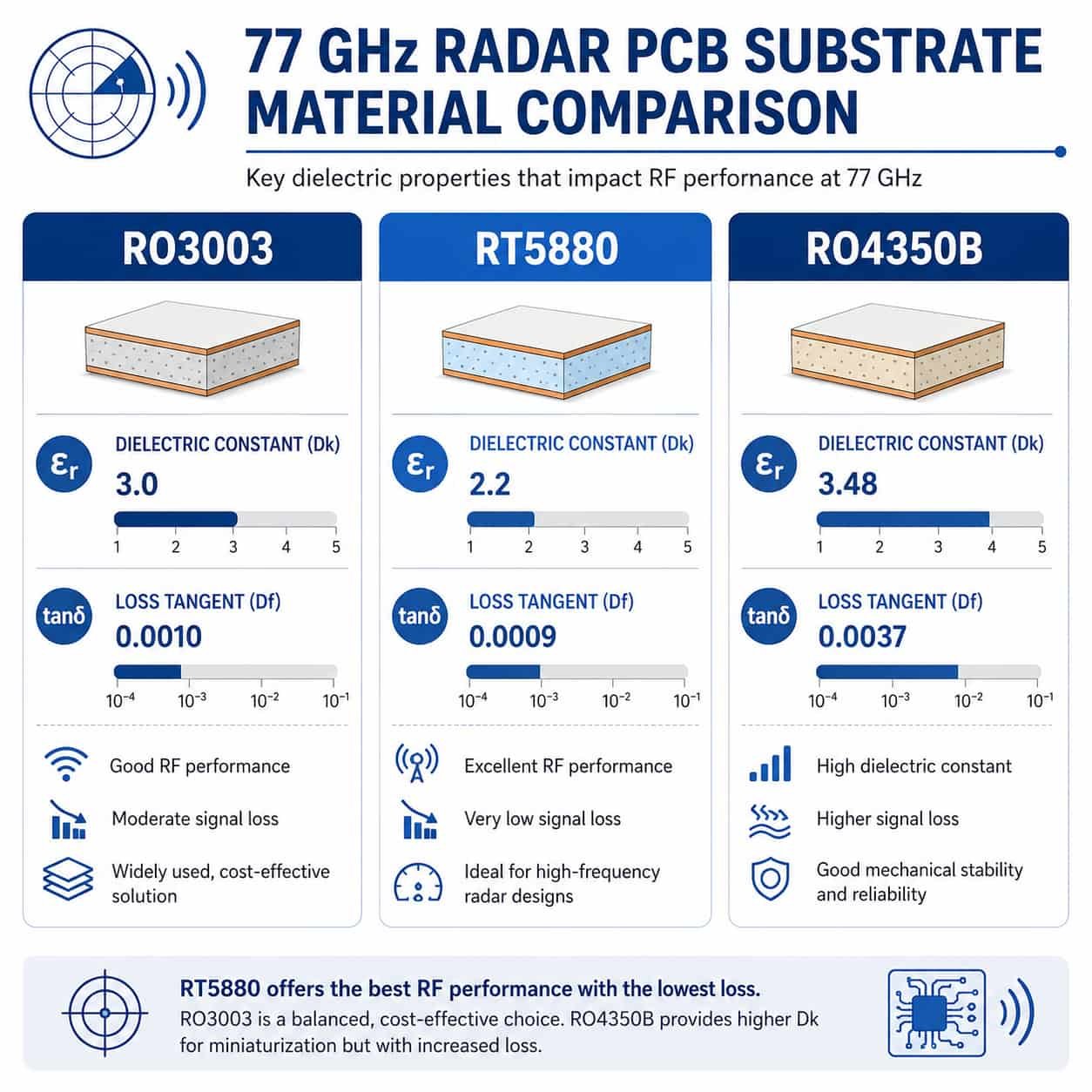
| Material | Dk | Df | Type | Suitability for 77 GHz |
|---|---|---|---|---|
| RO3003 | 3.0 | 0.0010 | PTFE ceramic | ✅ Recommended — stable Dk, plasma activation required |
| RT5880 | 2.20 | 0.0009 | PTFE glass | ✅ Recommended — lowest loss, wideband, plasma activation required |
| RO4350B | 3.48 | 0.0037 | Hydrocarbon | ⚠️ Not suitable — loss too high at 77 GHz |
| Taconic TLY-5 | 2.17 | 0.0009 | PTFE glass | ✅ Suitable — similar to RT5880 |
| F4BM220 | 2.20 | 0.0010 | PTFE | ✅ Cost-effective alternative — confirm Dk stability at 77 GHz |
| Standard FR4 | ~4.5 | ~0.020 | Epoxy glass | ❌ Not suitable — excessive insertion loss above 3 GHz |
Material Selection for 77 GHz Radar PCB
The two standard materials for 77 GHz radar PCB are Rogers RO3003 and RT5880. Both are PTFE-based and require in-house plasma hole wall activation before copper plating.
Rogers RO3003 (Dk 3.0, Df 0.0010)
RO3003 is the most widely used material for 77 GHz automotive radar PCB. Its Dk of 3.0 gives a good balance between trace width (wider than RT5880, easier to manufacture) and insertion loss. Available in 0.127 mm and 0.254 mm dielectric thickness — 0.127 mm is standard for most 77 GHz antenna array designs.
Rogers RT5880 (Dk 2.20, Df 0.0009)
RT5880 offers the lowest Df of any standard Rogers material (0.0009) and is used where maximum range or minimum insertion loss is required. Lower Dk means wider traces for the same impedance — slightly easier to manufacture — but lower Dk also means a larger antenna element size. See Rogers materials overview for full thickness options.
Why RO4350B Is Not Suitable for 77 GHz
RO4350B (Df 0.0037) is the standard material for RF applications below 12 GHz but is not suitable for 77 GHz radar. Its Df is 4× higher than RO3003, producing unacceptable insertion loss at millimeter-wave frequencies. For applications below 24 GHz, RO4350B remains a cost-effective choice — see RO4350B PCB guide for details.
77 GHz Radar PCB Design Rules
| Parameter | Typical Value | Notes |
|---|---|---|
| Operating frequency | 76–77 GHz (FMCW) | Some designs span 76–81 GHz |
| Substrate | RO3003 or RT5880 | PTFE required — plasma activation mandatory |
| Dielectric thickness | 0.127–0.254 mm | Thinner core = narrower trace for 50Ω |
| Trace width (50Ω microstrip) | 0.28–0.35 mm on 0.127 mm RO3003 | Confirm with fabricator TDR |
| Impedance tolerance | ±5% or better | TDR verification on every lot |
| Copper foil | Low-profile or reverse-treated | Standard ED copper adds insertion loss at 77 GHz |
| Surface finish | ENIG | Flat surface critical — HASL not acceptable |
| Min. line width | 2.5 mil | Verify with fabricator for PTFE process |
| Via drill diameter | 0.1–0.2 mm | Laser drill preferred for small vias |
| Board thickness | 0.2–0.5 mm typical | Thin boards common for mmWave antenna arrays |
Manufacturing Requirements
Plasma Hole Wall Activation
All PTFE materials (RO3003, RT5880) require plasma or sodium naphthalene hole wall activation before copper plating. Without this step, copper deposits on the PTFE hole wall with no adhesion — the board passes initial electrical testing and fails under thermal cycling. This is the most common failure mode in PTFE PCB from factories that outsource the process. Riching PCB performs in-house plasma activation on every PTFE order. See PTFE PCB manufacturing challenges for full process detail.
Impedance Control and TDR Verification
77 GHz radar PCB requires impedance tolerance of ±5% or better. Standard ±10% tolerance produces antenna mismatches that degrade beam pattern and range accuracy. TDR (Time Domain Reflectometry) verification must be performed on every production lot — not just on test coupons from the first article.
Copper Foil Selection
At 77 GHz, the skin effect concentrates current in the top 0.3–0.5 µm of the copper surface. Standard electrodeposited (ED) copper foil has surface roughness of 1–2 µm RMS, which significantly increases the effective signal path length and insertion loss. Low-profile (LP) or reverse-treated (RTF) copper foil with roughness below 0.5 µm RMS is required for 77 GHz designs.
Surface Finish
ENIG (immersion gold) is the only acceptable surface finish for 77 GHz radar PCB. The nickel layer (120–300 µin) and gold flash (1–5 µin) provide a flat, solderable surface without the surface topology variation of HASL. Immersion silver is acceptable for prototype evaluation but not recommended for production due to tarnish sensitivity.
PTFE Lamination Limit
PTFE materials are limited to a maximum of 2 lamination press cycles. Exceeding this limit causes PTFE deformation and Dk variation across the board. For multi-layer 77 GHz designs requiring more than 2 press cycles, consult your fabricator on hybrid stackup options. See PTFE PCB manufacturing guide for full lamination constraints.
Applications
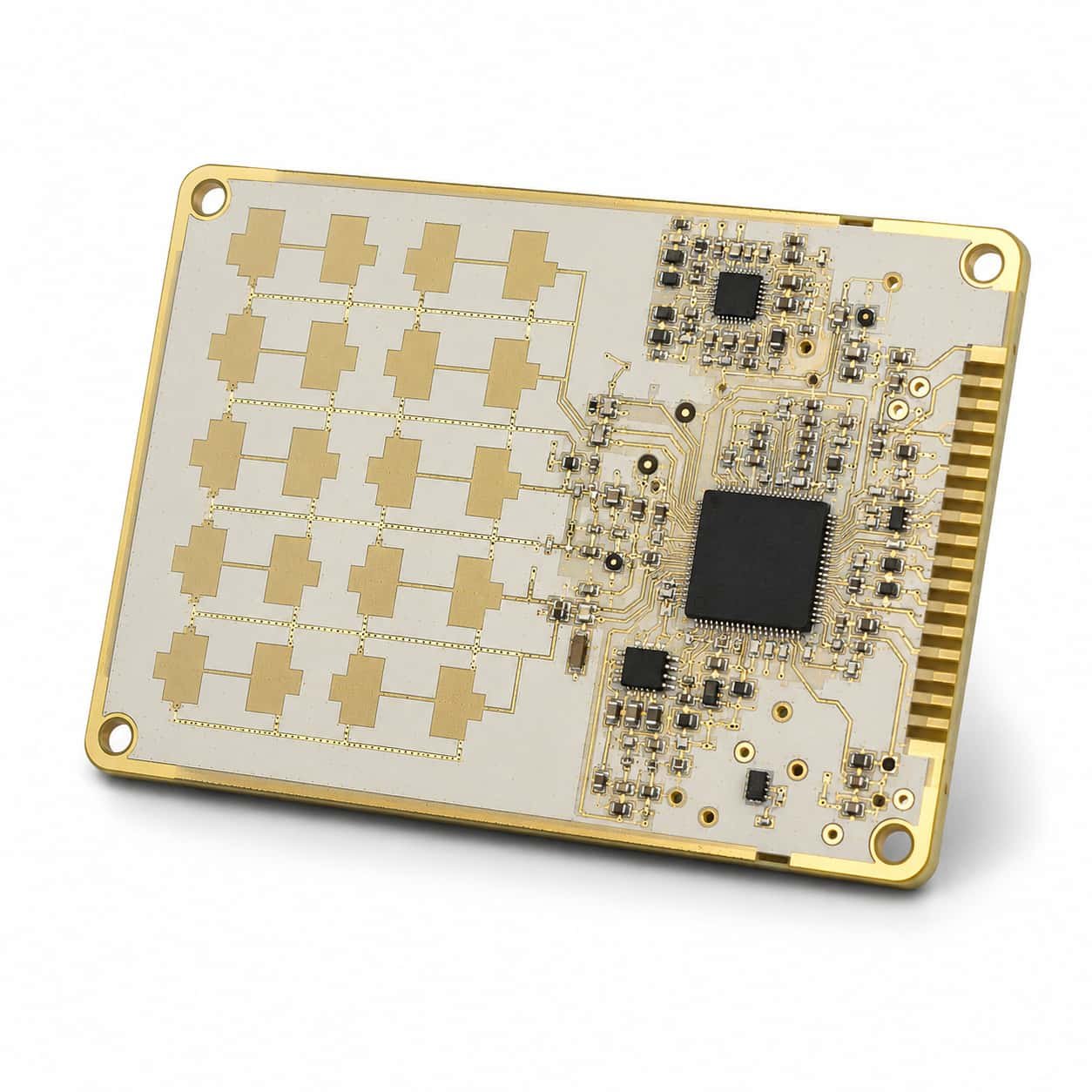
- Automotive ADAS front radar (76–77 GHz FMCW) — adaptive cruise control, automatic emergency braking
- Corner radar modules (77–81 GHz) — blind spot detection, lane change assist
- Industrial level measurement radar (76–77 GHz)
- Security and perimeter surveillance radar
- Traffic monitoring radar systems
- Drone detection and counter-UAS radar
Checklist: What to Confirm with Your Fabricator
- PTFE plasma activation performed in-house (not outsourced)
- RO3003 or RT5880 material in stock at specified thickness (0.127 mm or 0.254 mm)
- Low-profile or reverse-treated copper foil available
- Impedance control to ±5% with TDR verification on every lot
- Maximum 2 lamination press cycles for PTFE layers
- ENIG surface finish standard
- IPC Class 2 or Class 3 capability confirmed
Conclusion
77 GHz radar PCB requires PTFE substrate, in-house plasma activation, low-profile copper foil, and TDR-verified impedance control on every production lot. Rogers RO3003 is the standard material for most automotive radar designs; RT5880 is used where maximum range performance is required. Riching PCB manufactures 77 GHz radar PCB with in-house plasma activation, RO3003 and RT5880 in stock, TDR verification available, and prototype lead time of 5–7 working days. See high frequency PCB capabilities for full factory specifications.
Get a Quote for Your 77 GHz Radar PCB
Riching PCB stocks RO3003 and RT5880 with in-house plasma activation. Send the following for DFM review:
- Gerber files + NC drill file
- Material grade (RO3003 or RT5880) and dielectric thickness
- Copper foil type — standard ED or low-profile
- Controlled impedance target and tolerance
- IPC Class and quantity
WhatsApp +86 13760473650 — DFM review within 24 hours
77 GHz Radar PCB Q&A
Common questions about 77 GHz radar PCB including material selection, PTFE plasma activation, impedance requirements, and prototype lead times.
Can RO4350B be used for 77 GHz radar PCB?
No. RO4350B Df 0.0037 produces unacceptable insertion loss at 77 GHz. Rogers RO3003 (Df 0.0010, PTFE ceramic) or RT5880 (Df 0.0009, PTFE glass) are required. RO4350B is suitable for RF applications below 12 GHz including 5G sub-6GHz, WiFi 6, and antenna PCB.
What is the difference between RO3003 and RT5880 for 77 GHz?
RO3003: Dk 3.0, Df 0.0010. RT5880: Dk 2.20, Df 0.0009. RT5880 offers slightly lower insertion loss but lower Dk means larger antenna element size. RO3003 is the more common choice for automotive radar. Both are PTFE — plasma hole wall activation required before copper plating.
Why does 77 GHz radar PCB require plasma activation?
77 GHz radar PCB uses PTFE substrate. PTFE is chemically inert — copper cannot bond to it without surface treatment. Plasma activation creates micro-roughness on the hole wall for copper adhesion. Without it, the board passes initial testing and fails under thermal cycling. Must be performed in-house — outsourcing introduces process control risk.
What impedance tolerance is required for 77 GHz radar PCB?
±5% or better. Standard ±10% produces antenna pattern degradation and range accuracy loss at millimeter-wave frequencies. TDR verification must be performed on every production lot — not only on first article samples or test coupons.
What is the lead time for 77 GHz radar PCB prototype?
No minimum order quantity — prototype from 1 board. RO3003 and RT5880 prototype lead time: 7–10 working days. PTFE plasma activation adds ~1–2 days vs standard RO4350B orders. DFM review before every order. WhatsApp: +86 13760473650.
Request a PCB Quote
Upload your Gerber ZIP file and project requirements. Our engineering team will review your PCB material, stackup, impedance needs, surface finish, and production quantity before quoting.
Please prepare:
- Gerber files in ZIP format
- PCB material or stackup requirements
- Controlled impedance notes if available
- Prototype or batch production quantity
