
Rogers PCB Cost Reduction: 6 Strategies That Work Without Compromising RF Performance
Practical cost reduction strategies for Rogers RF PCB — hybrid stackup, material grade selection, quantity optimization, alternative materials and direct factory sourcing. With estimated savings for each strategy.
Home » F4B Rogers alternative » Rogers PCB Cost Reduction: 6 Strategies That Work Without Compromising RF Performance
Table of Contents
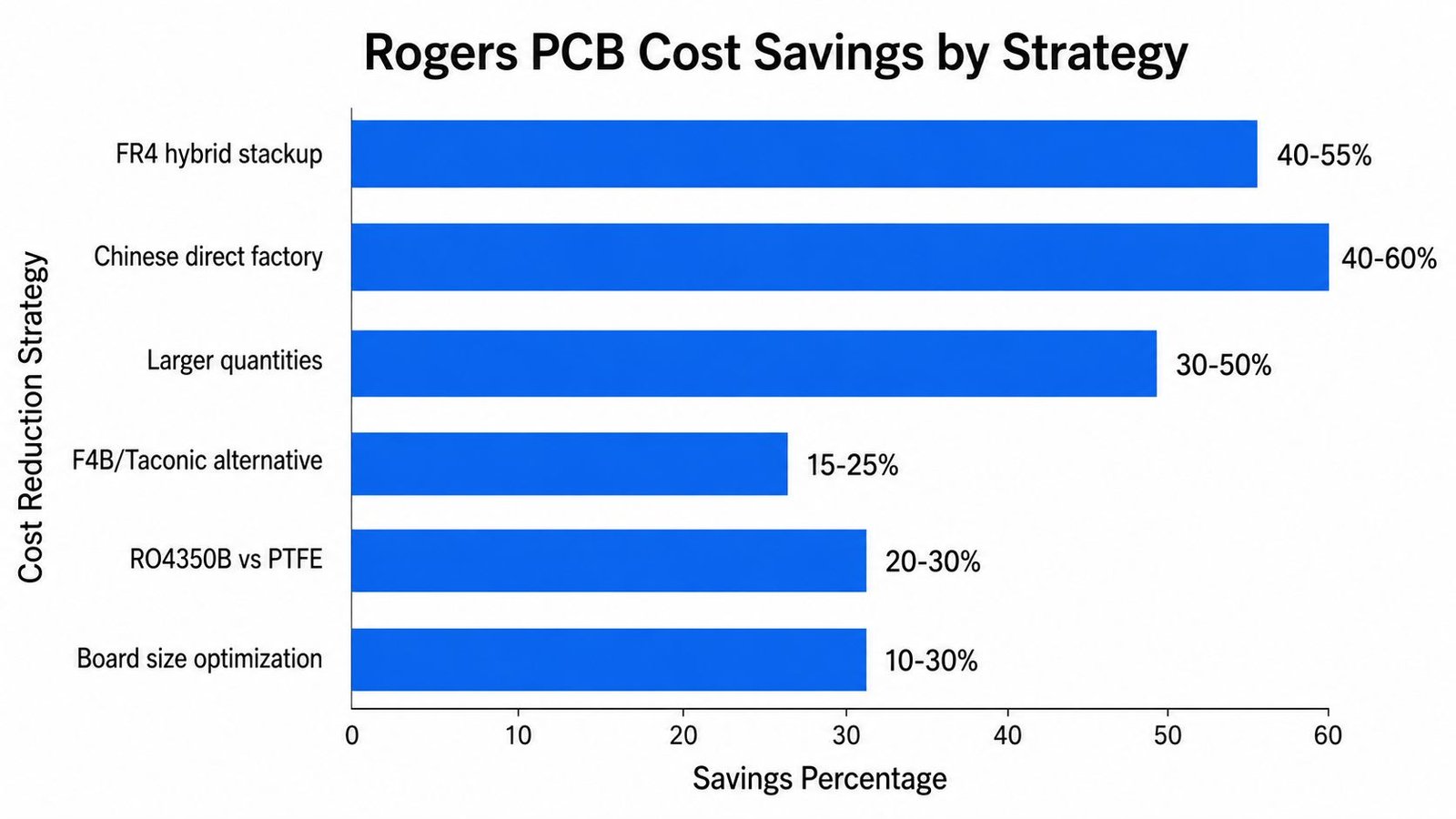
Key point: The three highest-impact Rogers PCB cost reduction strategies: (1) FR4 + Rogers hybrid stackup — 40–55% saving for 4-layer designs where RF is only on outer layers. (2) Chinese direct factory sourcing — 40–60% vs Western fabricators, same materials and IPC standards. (3) Larger order quantities — 30–50% per-board reduction by improving Rogers panel utilization.
Riching PCB manufactures all Rogers grades, F4B and Taconic alternatives in stock. No MOQ — prototype from 1 board. DFM review before every order.
Rogers PCB costs 3–8× more than equivalent FR4 PCB. For most RF designs, this premium is unavoidable at some level — the electrical performance requirements genuinely need better substrate materials. But many designs pay more Rogers premium than they need to, either by using PTFE materials where RO4350B would suffice, using all-Rogers stackups where hybrid would work, or sourcing from Western fabricators where capable Chinese factories offer equivalent quality at 40–60% lower cost.
This guide covers six practical Rogers PCB cost reduction strategies with estimated savings for each, and explains when each strategy is applicable without compromising RF performance.
Summary: 6 Strategies and Expected Savings
| Strategy | Typical Saving | Condition |
|---|---|---|
| 1. FR4 + Rogers hybrid stackup | 40–55% vs all-Rogers 4-layer | RF only on outer layers |
| 2. RO4350B instead of PTFE | 20–30% vs RO3003/RT5880 | Operating frequency below 12 GHz |
| 3. F4B or Taconic alternatives | 15–35% vs Rogers PTFE | Same Dk/Df class; verify Dk uniformity for arrays |
| 4. Larger order quantities | 30–50% per board (10→50 boards) | More boards from same Rogers panel |
| 5. Chinese direct factory | 40–60% vs Western fabricator | Same materials and IPC standards |
| 6. Board size optimization | 10–30% | Maximize boards per Rogers panel |
 Strategy 1: FR4 + Rogers Hybrid Stackup
The largest single cost reduction opportunity for multi-layer Rogers PCB. If RF signals are only on outer layers and inner layers carry DC power and ground planes, replace the inner Rogers layers with FR4. A 4-layer hybrid RO4350B + FR4 stackup costs 40–55% less than a 4-layer all-Rogers board with negligible RF performance difference for most applications below 12 GHz.
Design constraint: PTFE materials (RO3003, RT5880) are limited to 2 press cycles — hybrid stackup uses both cycles. RO4350B hybrid has no press cycle limit. See PTFE PCB lamination guide for bondply selection and stackup design rules.
Estimated saving: 40–55% vs all-Rogers 4-layer board. Applicable when RF traces are on outer layers only.
Strategy 2: Use RO4350B Instead of PTFE Where Performance Allows
Rogers RO4350B (Df 0.0037) is FR4-compatible — no plasma activation, same lead time as FR4. Rogers RO3003 and RT5880 (PTFE) add 15–25% process cost and 2–3 days lead time for plasma activation. If your design operates below 12 GHz and the link budget tolerates Df 0.0037, RO4350B eliminates the PTFE process premium entirely. Estimated saving: 20–30% vs equivalent PTFE grade.
Strategy 3: Use F4B or Taconic as Lower-Cost PTFE Alternatives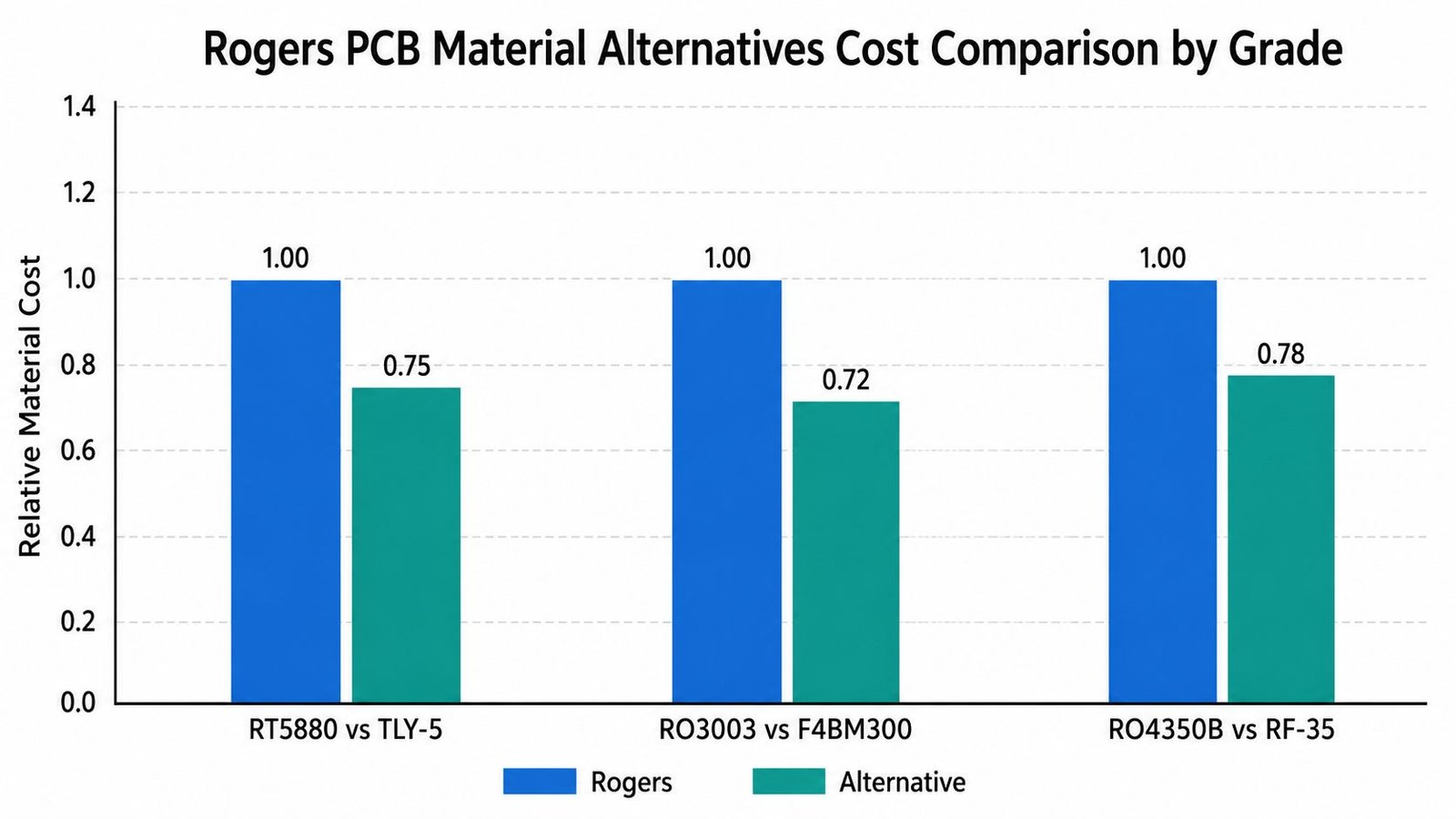
| Rogers Grade | Alternative | Cost vs Rogers | Notes |
|---|---|---|---|
| RT5880 | Taconic TLY-5 / TLP-5 | ~15–20% lower | Dk 2.17–2.20, Df 0.0009 — equivalent performance |
| RT5880 | F4BM220 | ~25–35% lower | Dk 2.20, Df 0.0010 — verify Dk uniformity for arrays |
| RO3003 | F4BM300 / ZYF300CA | ~20–30% lower | Dk 3.0, Df 0.0017–0.0018 — slightly higher Df |
| RO4350B | Taconic RF-35 | ~10% lower | Df 0.0018 vs 0.0037 — lower loss but PTFE process |
| RO4350B | ZYF350CA | ~15% lower | Dk 3.5, Df 0.0031 — close to RO4350B |
Chinese domestic PTFE materials (F4B series from Wangling, ZY series from ZhongYing) and Taconic materials offer equivalent Dk and Df to Rogers PTFE at 15–35% lower material cost. F4BM220 (Dk 2.20, Df 0.0010) is a direct equivalent to Rogers RT5880 (Dk 2.20, Df 0.0009) at approximately 25–35% lower material cost. See F4B vs Rogers PCB guide for a detailed technical comparison.
Important: all PTFE alternatives require the same in-house plasma activation as Rogers PTFE. The process cost savings are in material only, not process. Verify panel Dk uniformity for phased array applications — Rogers material has tighter Dk tolerance specification than some domestic alternatives.
Strategy 4: Order in Larger Quantities
Rogers material is sold in standard panel sizes. The panel cost is fixed regardless of how many boards are cut from it. For small boards (100×100 mm or smaller), most of a Rogers panel goes unused when ordering 5 boards — the unused panel cost is divided across only 5 boards. Ordering 20–50 boards from the same panel reduces per-board material waste cost by 50–70%.
Practical application: when transitioning from prototype to early production, order 20–30 boards instead of 5 for the first production run. The per-board cost reduction on Rogers material often justifies the larger initial inventory investment.
Strategy 5: Source from Chinese Direct Factory
A capable Chinese Rogers PCB factory offers 40–60% lower unit cost than equivalent Western fabricators — using the same Rogers materials, same IPC standards, same TDR verification. The key is verifying the factory has in-house plasma activation for PTFE materials. See how to verify China PTFE PCB manufacturer capability for the verification checklist. Door-to-door to Europe or North America via DHL Express: 10–15 working days — often comparable to Western fabricator lead time alone.
Strategy 6: Optimize Board Size
Rogers material is sold in fixed panel sizes. A board that is 110×110 mm costs as much as a 100×100 mm board in material — but only 8 boards fit per Rogers panel vs 9 boards for the smaller size. Minimizing board dimensions to maximize panelization efficiency reduces the per-board Rogers material cost by 10–30% for designs where size optimization is feasible.
Practical check: ask the fabricator how many of your boards fit per Rogers panel. If the answer is not a round number (e.g. 8.5), there is unused panel area you are paying for. Adjust board dimensions to maximize utilization.
What NOT to Do: False Economy
- Using FR4 where Rogers is required — boards fail RF performance testing; re-spin cost exceeds savings
- Using RO4350B above 20 GHz — Df 0.0037 produces unacceptable insertion loss at Ka-band; PTFE is mandatory
- Skipping TDR verification to save cost — boards ship out of spec; field returns cost more than TDR
- Ordering from a factory without in-house plasma activation — boards fail under thermal cycling; savings eliminated by rework cost
Conclusion
The most impactful Rogers PCB cost reduction strategies are: FR4 + Rogers hybrid stackup (40–55% savings for 4-layer designs), sourcing from a capable Chinese direct factory (40–60% vs Western fabricators), and ordering in larger quantities (30–50% per-board reduction). For PTFE material costs, Taconic and F4B equivalents offer 15–35% material savings. Riching PCB manufactures all Rogers grades, F4B and Taconic materials — in stock, no material wait, no MOQ. See Rogers PCB price guide for reference price ranges by board spec.
Get a Cost-Optimized Rogers PCB Quote
Rogers, F4B, Taconic in stock. DFM review identifies cost reduction opportunities before fabrication.
- Gerber files + stackup drawing
- Current material spec and target material if different
- Operating frequency range
- Quantity (prototype and production volume if known)
- Budget target if relevant
WhatsApp +86 13760473650— quotation within 4–8 hours
Rogers PCB Cost Reduction Q&A
Common questions about the most effective Rogers PCB cost strategies, F4B and Taconic alternatives, and Chinese factory quality.
What is the most effective way to reduce Rogers PCB cost?
Two highest-impact: (1) FR4 + Rogers hybrid stackup — 40–55% on 4-layer designs where RF is on outer layers only. (2) Chinese direct factory — 40–60% vs Western fabricators, same Rogers materials and IPC standards. Combined: 60–75% cost reduction vs all-Rogers from Western fabricator.
Can I use F4B or Taconic instead of Rogers PTFE?
Yes for most applications. Taconic TLY-5 is RT5880 equivalent at 15–20% lower cost. F4BM220 is 25–35% lower than RT5880. All require same in-house plasma activation. For phased arrays: verify Dk uniformity specification before substituting.
Is Rogers RO4350B always necessary or can I use FR4?
Below 500 MHz short traces: FR4 adequate. Above 1 GHz for longer traces or tight loss budget: RO4350B needed. Above 20 GHz: PTFE mandatory. Paying Rogers premium where FR4 works is the most common unnecessary cost.
How much does ordering more boards reduce Rogers PCB cost?
For 100×100mm boards: ordering 5 vs 20–30 boards reduces per-board cost 30–50% by improving Rogers panel utilization. Ask fabricator how many boards fit per panel to calculate exact efficiency.
Does using a Chinese Rogers PCB factory compromise quality?
No, for a factory with in-house plasma activation, same Rogers materials, TDR on every lot. Fastest check: RO3003 prototype lead time should be 7–10 days — same as FR4 speed means no genuine PTFE capability.
Request a PCB Quote
Upload your Gerber ZIP file and project requirements. Our engineering team will review your PCB material, stackup, impedance needs, surface finish, and production quantity before quoting.
Please prepare:
- Gerber files in ZIP format
- PCB material or stackup requirements
- Controlled impedance notes if available
- Prototype or batch production quantity