
IATF16949 PCB Manufacturing — What It Means for Automotive Suppliers
If you are sourcing PCBs for automotive electronics — 77GHz radar, ADAS, EV power modules, body control systems or any other automotive application — your supply chain will eventually require IATF16949 certification from your PCB manufacturer. This article explains what IATF16949 covers, how it differs from ISO9001, and what questions to ask before qualifying a PCB supplier for automotive programs.
Home » automotive PCB quality » IATF16949 PCB Manufacturing — What It Means for Automotive Suppliers
Table of Contents
What Is IATF16949?
IATF16949 is the International Automotive Task Force quality management system standard, developed jointly by the major automotive OEMs (BMW, Ford, General Motors, Stellantis, Renault and others) and their associations. It is the mandatory quality management certification for suppliers in the automotive supply chain — Tier 1 and Tier 2 suppliers typically require IATF16949 from their sub-suppliers, including PCB manufacturers.
IATF16949 is built on top of ISO9001 — it includes all ISO9001 requirements plus automotive-specific additions focused on defect prevention, variation reduction and continuous improvement in the automotive supply chain.
IATF16949 vs ISO9001 — Key Differences for PCB Manufacturing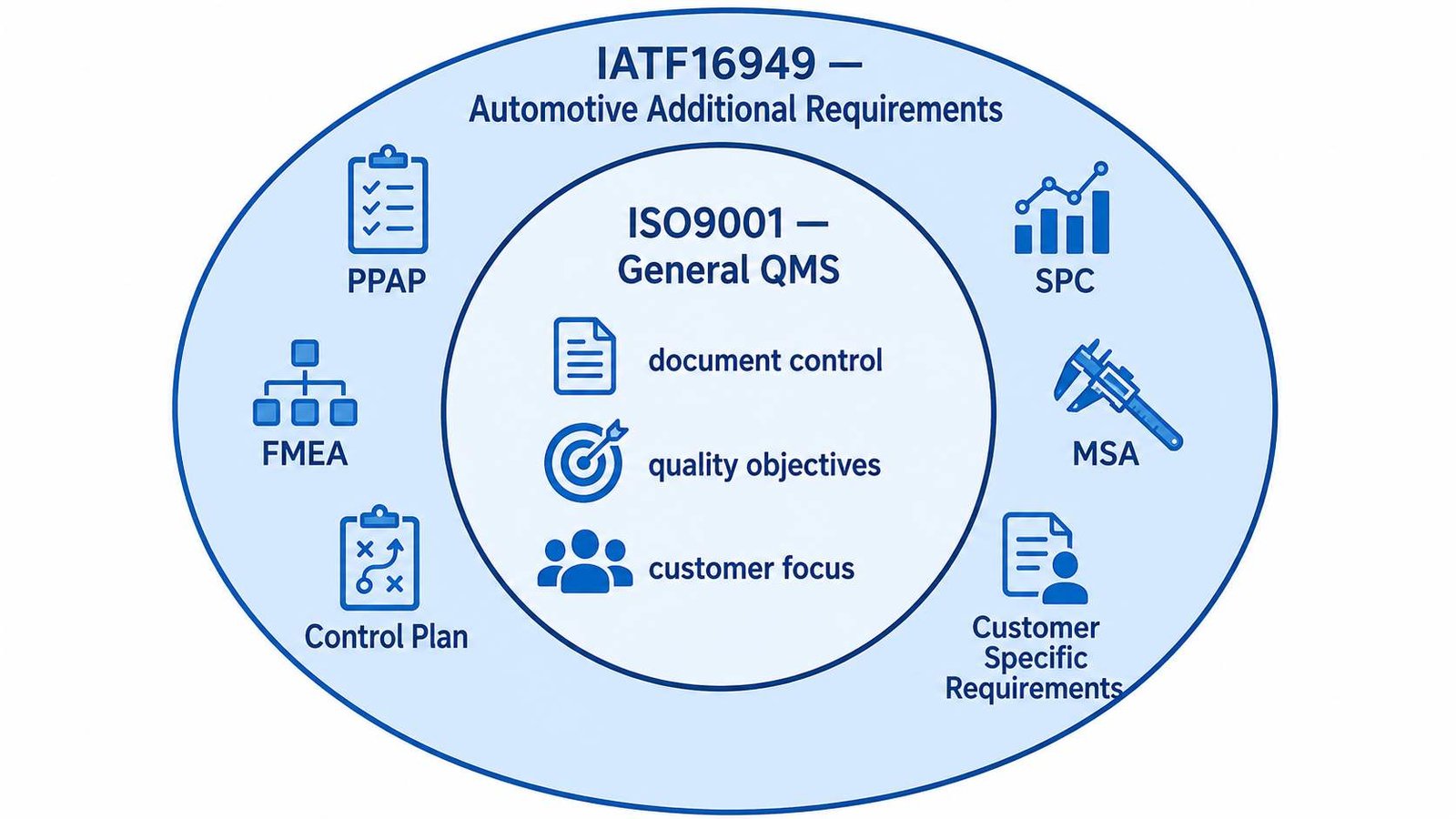
| Requirement | ISO9001 | IATF16949 |
|---|---|---|
| Scope | General industry | Automotive sector specific |
| Risk management | Basic | FMEA required — Design FMEA and Process FMEA |
| Production Part Approval | Not required | PPAP required for new parts and changes |
| Control plan | Not specified | Mandatory — covers all process steps |
| Measurement system analysis | Not required | MSA required — Gauge R&R studies |
| Statistical process control | Not required | SPC required for key process characteristics |
| Traceability | Basic material records | Full lot traceability — material to finished board |
| Customer-specific requirements | Not covered | CSR must be addressed per customer |
What IATF16949 Means in Practice for a PCB Manufacturer
PPAP — Production Part Approval Process
PPAP is the formal process by which a PCB manufacturer demonstrates to the automotive customer that its manufacturing process is capable of producing the part to the design specification. For a new PCB design or a significant process change, PPAP documentation typically includes: dimensional report, material certifications, process flow diagram, control plan, PFMEA, measurement system analysis, and initial process capability study (Cpk). Not all automotive programs require full PPAP Level 3 — confirm the level required with your customer before quoting.
Control Plan
A control plan documents every step in the PCB manufacturing process — incoming material inspection, drilling, plating, etching, impedance testing, final inspection — and specifies the control method, measurement frequency, reaction plan and who is responsible for each step. IATF16949 requires a control plan that is actively used and updated when processes change.
PFMEA — Process Failure Mode and Effects Analysis
PFMEA identifies potential failure modes at each manufacturing step, rates their severity, occurrence and detectability, and assigns corrective actions for high-risk modes. For automotive PCB manufacturing, PFMEA covers failures such as: impedance out of specification, copper plating below minimum thickness, drill position error, delamination, and solderability failures.
Statistical Process Control (SPC)
Key process characteristics — copper plating thickness, hole diameter, impedance — must be monitored using SPC, with control charts and Cpk/Ppk data available to customers. IATF16949 does not specify minimum Cpk values, but automotive customers typically require Cpk ≥ 1.67 for special characteristics.
Automotive PCB Applications and Quality Requirements
- 77GHz radar PCB — see 77GHz radar PCB manufacturer— IATF16949, IPC Class 3, RO3003 material traceability
- ADAS camera / LiDAR interface — IATF16949, halogen-free, controlled impedance
- EV power inverter — IATF16949, IPC Class 3, aluminum PCB thermal management
- Body control module — IATF16949, high layer count, blind/buried via
- V2X communication module — IATF16949, controlled impedance, RF + digital mixed
7 Questions to Ask Your Automotive PCB Supplier
| Question to Ask | Why It Matters |
|---|---|
| Is your IATF16949 certificate current and scope-relevant? | Certificate must cover PCB manufacturing, not just a holding company |
| Can you provide PPAP documentation for new part numbers? | Required by most Tier 1 automotive suppliers before production release |
| Do you maintain control plans for key process steps? | Soldering, lamination, plating thickness — must be documented and monitored |
| What SPC data do you collect on key characteristics? | Impedance, plating thickness — key characteristics should have Cpk data |
| Can you provide MSA / Gauge R&R studies for inspection tools? | TDR calibration, AOI measurement system — required for IATF16949 compliance |
| What is your PFMEA for the automotive PCB process? | Process FMEA identifies failure modes before they reach the customer |
| How is full material traceability maintained? | Lot records must link finished board to material certificates and process records |
Summary
IATF16949 certification is the baseline quality requirement for automotive PCB suppliers. Beyond the certificate itself, the practical requirements — PPAP capability, control plans, PFMEA, SPC data and full material traceability — determine whether a supplier can actually support automotive program launch and production. For automotive PCB manufacturing with IATF16949 certification, see automotive PCB manufacturer.
Frequently Asked Questions — IATF16949 PCB Manufacturing
What is IATF16949 for PCB manufacturing?
Is IATF16949 required for automotive PCB suppliers?
What is PPAP for PCB manufacturing?
Does IATF16949 require IPC Class 3 for automotive PCBs?
Need an IATF16949 Certified Automotive PCB Manufacturer?
Riching PCB holds IATF16949, ISO9001 and ISO13485 certification. RO3003 0.127mm in stock for 77GHz radar. IPC Class 3 on request. PPAP documentation available.
Automotive PCB Manufacturer → WhatsAppRequest a PCB Quote
Upload your Gerber ZIP file and project requirements. Our engineering team will review your PCB material, stackup, impedance needs, surface finish, and production quantity before quoting.
Please prepare:
- Gerber files in ZIP format
- PCB material or stackup requirements
- Controlled impedance notes if available
- Prototype or batch production quantity