
Microstrip vs Stripline PCB: When to Use Each for RF and Microwave Design

A practical comparison of microstrip, stripline and coplanar waveguide transmission line structures — insertion loss, isolation, dispersion, trace width and application selection guide.

Table of Contents

Key point: Microstrip — trace on outer surface, one ground below. Lower isolation, higher dispersion, easier to probe. Standard for most RF PCB. Stripline — trace buried between two ground planes. Better isolation (10–20 dB), lower dispersion, no probe access, higher layer count and cost. GCPW — outer surface trace with coplanar grounds plus bottom ground plane. Standard for mmWave above 30 GHz.

Riching PCB manufactures microstrip, stripline and GCPW on Rogers RO4350B, RO3003 and RT5880. In stock, no MOQ. Prototype 5–14 days depending on layer count.

Choosing between microstrip and stripline is one of the first decisions in RF PCB layout. Both structures achieve 50Ω controlled impedance transmission lines, but they have fundamentally different electrical behavior, manufacturing complexity, and application suitability. The wrong choice adds board layers, increases cost, or degrades RF performance.

This guide covers the structural difference between microstrip and stripline, key performance trade-offs, coplanar waveguide (CPW) as a third option, and an application selection guide.

Structure OverviewRF PCB transmission line structures comparison showing microstrip stripline and grounded coplanar waveguide cross-sections
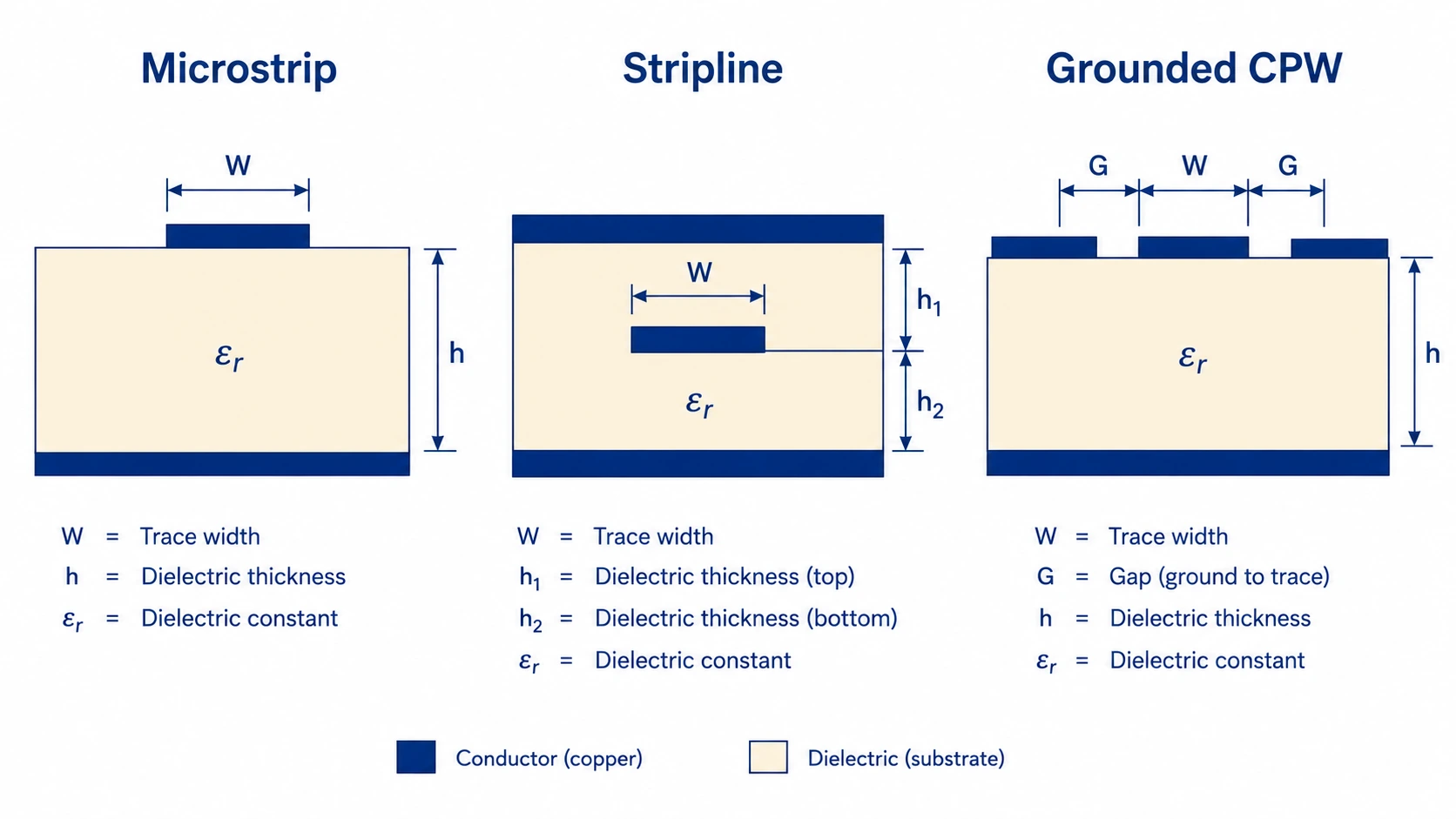
Microstrip

Microstrip is the simplest RF transmission line structure: a signal trace on the outer surface of a PCB above a ground plane reference layer. The electromagnetic field exists partly in the dielectric substrate and partly in the air above the trace. Microstrip requires only 2 PCB layers minimum — signal layer and ground layer. It is the most common structure for single and double-layer RF PCB and for RF circuits on outer layers of multilayer PCB.

Stripline

Stripline buries the signal trace between two ground planes with dielectric above and below. The electromagnetic field is entirely within the dielectric — there is no air interface. Stripline requires a minimum of 4 PCB layers (ground-signal-dielectric-ground). It provides better isolation and lower dispersion than microstrip at the cost of higher layer count, higher manufacturing complexity, and loss of probe access to the buried trace.

Grounded Coplanar Waveguide (GCPW)

GCPW places the signal trace on the outer surface with coplanar ground conductors on the same layer on both sides of the trace, plus a ground plane below. The coplanar grounds provide additional shielding compared to standard microstrip while keeping the trace accessible on the outer surface. GCPW is the standard structure for mmWave PCB above 30 GHz where via transitions in stripline become too lossy.

Microstrip vs Stripline: Detailed Comparison

PropertyMicrostripStripline
LocationOuter layer — trace on surfaceInner layer — buried between ground planes
Reference planesOne ground plane belowTwo ground planes (above and below)
Insertion lossLower — partial air reduces dielectric lossHigher — fully in dielectric
IsolationLower — radiates into airHigher — shielded between ground planes
DispersionHigher — air/dielectric boundaryLower — homogeneous dielectric
Probe accessYes — surface accessibleNo — buried layer
Min. layer count2 layers4 layers
ManufacturingLower complexityHigher — more layers, tighter registration
CostLowerHigher
Solder mask effectYes — affects impedanceNot applicable (buried)

Insertion Loss

Counterintuitively, microstrip has higher insertion loss than stripline for the same material and frequency. This is because the electromagnetic field in microstrip is split between the dielectric (lossy) and air (lossless). For a given trace length, more field in the dielectric means more dielectric loss. Stripline is fully immersed in dielectric — 100% of the field experiences the substrate Df.

The practical implication: for the same Rogers substrate, a stripline trace has higher insertion loss per unit length than microstrip. Stripline’s isolation advantage comes at an insertion loss penalty. For high-loss materials like FR4, stripline is noticeably worse than microstrip. For low-loss materials like RO3003 (Df 0.0010), the difference is smaller.

Isolation

Stripline provides significantly better isolation between adjacent transmission lines than microstrip. In microstrip, the field extends into the air above the trace and can couple to adjacent structures. In stripline, the ground planes above and below contain the field and prevent radiation coupling. For multi-channel RF modules — receiver front-ends, filter banks, phased array feed networks — stripline reduces cross-coupling between channels by 10–20 dB compared to microstrip.

Dispersion

Microstrip has frequency-dependent phase velocity due to the air/dielectric boundary — the effective Dk changes with frequency. This dispersion causes different frequency components of a wideband signal to travel at different speeds, distorting wideband signals. Stripline, being entirely within a homogeneous dielectric, has much lower dispersion. For wideband EW receivers covering 2–18 GHz, dispersion in microstrip is generally manageable with careful design; for multi-octave signals above 18 GHz, stripline or GCPW is preferred.

Coplanar Waveguide (CPW) and GCPW

CPW places ground conductors on the same layer as the signal trace, with controlled gaps between signal and ground. Grounded CPW (GCPW) adds a ground plane below — combining coplanar isolation with microstrip-like ground reference.

GCPW is the preferred structure for mmWave designs above 30 GHz because:

  • Via transitions from the outer layer to inner ground planes introduce inductance that becomes significant above 20 GHz — GCPW reduces via transition requirements
  • Coplanar grounds suppress surface wave modes that become significant at Ka-band and above
  • Probe pads for on-wafer GSG (Ground-Signal-Ground) probing are naturally compatible with GCPW topology
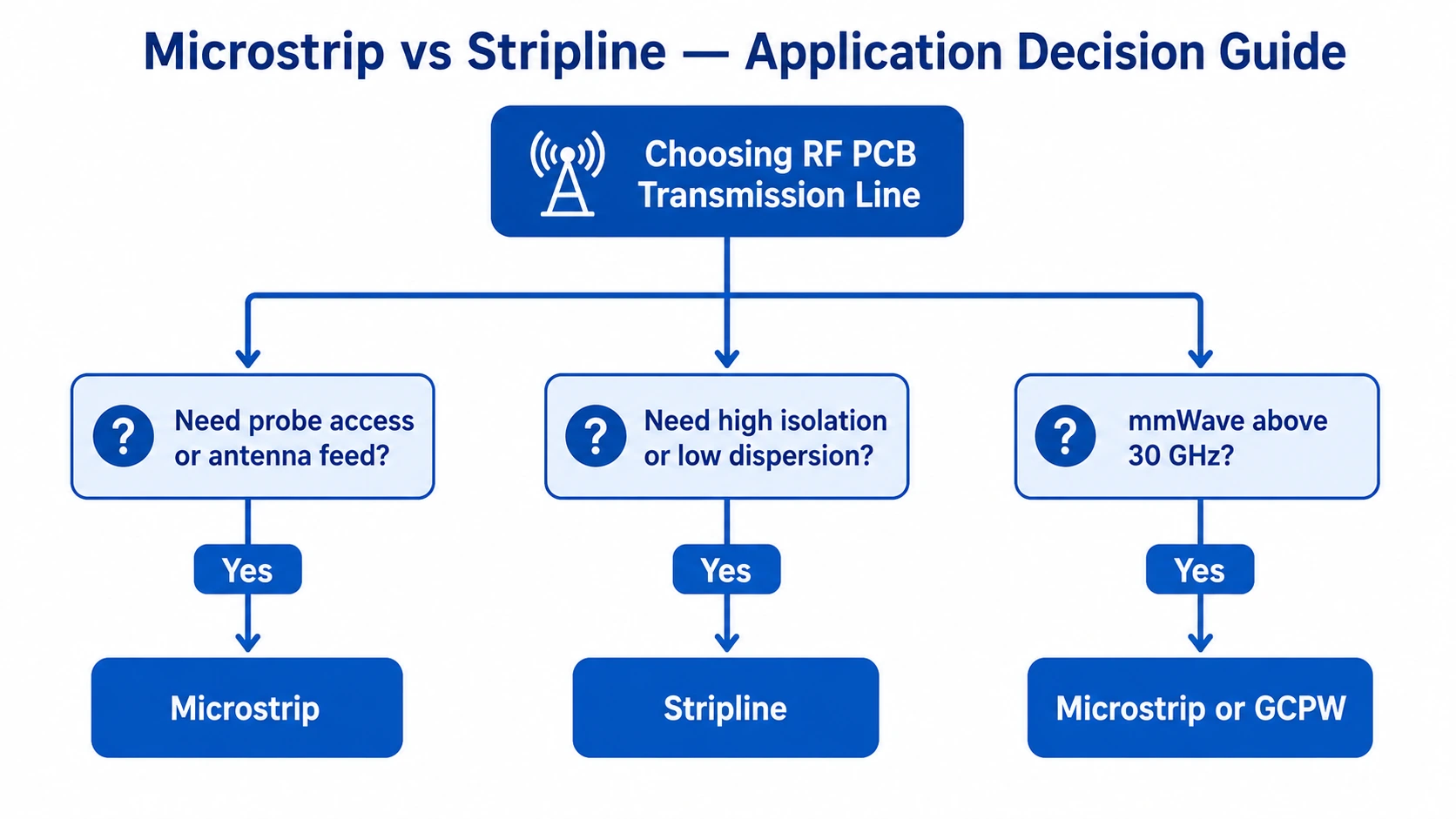
When to Use Microstrip vs StriplineApplication decision map showing when to use microstrip vs stripline for RF PCB design

Application / RequirementRecommendedReason
Antenna feed networkMicrostripDirect access to antenna elements on outer layer
High isolation between channelsStriplineShielded — no cross-coupling between lines
Wideband EW 2–18 GHzMicrostrip (RT5880)Lower insertion loss; microstrip simpler for wideband
mmWave above 30 GHzMicrostrip or GCPWStripline via transitions too lossy at mmWave
High-density mixed-signal PCBStripline for RF layersIsolation from digital noise on outer layers
Probe-accessible test boardMicrostripSurface traces accessible with GSG probes
Filter in multi-layer moduleStriplineBetter isolation, tighter coupling control

Manufacturing Implications

Microstrip on a 2-layer Rogers PCB is the simplest and lowest-cost RF PCB — single Rogers core, ground plane on bottom, RF traces on top. Stripline on a 4-layer hybrid Rogers/FR4 PCB adds bondply, inner Rogers or FR4 layers, and tighter registration requirements. Each additional layer adds cost and complexity.

For hybrid PTFE + FR4 stripline designs, see the PTFE PCB lamination guide for bondply selection and 2-cycle limit constraints. For controlled impedance specifications, see controlled impedance RF PCB guide.

Conclusion

Microstrip is the standard for most RF PCB designs: simpler, lower cost, probe-accessible, and adequate isolation for most applications. Stripline is chosen when isolation requirements are demanding or dispersion must be minimized for wideband signals. GCPW is the choice for mmWave above 30 GHz where via transitions become lossy. All three structures are available on Rogers RO4350B, RO3003 and RT5880 substrates. Riching PCB manufactures 2-layer microstrip, 4+ layer stripline, and GCPW PCB — RO4350B, RO3003, RT5880 in stock, no MOQ, 5–14 day prototype depending on layer count. See high frequency PCB capabilities for full specifications.

Get a Quote — Microstrip, Stripline or GCPW RF PCB

RO4350B, RO3003, RT5880 in stock. All transmission line structures supported. No MOQ.

  • Gerber files + NC drill file
  • Transmission line structure: microstrip / stripline / GCPW
  • Material grade and stackup
  • Impedance target and tolerance
  • Layer count and quantity

WhatsApp +86 13760473650— DFM review within 4–8 hours

Q&A

Microstrip vs Stripline PCB Q&A

Common questions about microstrip vs stripline differences, insertion loss, when to use each, GCPW and Rogers PTFE substrate compatibility.

What is the difference between microstrip and stripline?

Microstrip: trace on outer surface, one ground below, field partly in air. 2+ layers. Simpler, lower cost, probe-accessible. Stripline: trace buried between two ground planes, field entirely in dielectric. 4+ layers. Better isolation, lower dispersion, no probe access.

Does microstrip or stripline have lower insertion loss?

Microstrip — part of field is in air (lossless), so effective loss is lower than stripline where 100% of field is in lossy dielectric. Difference is smaller for low-loss PTFE (RO3003, RT5880) than FR4.

When should I use stripline instead of microstrip?

When isolation is critical (10–20 dB better than microstrip), for tight-coupling filters, or in mixed-signal PCBs where RF needs shielding from digital noise. Avoid for mmWave above 30 GHz — via transitions too lossy.

What is grounded coplanar waveguide (GCPW)?

Outer surface trace with coplanar ground conductors on both sides + ground plane below. Combines microstrip probe accessibility with better isolation. Standard for mmWave above 30 GHz — reduces lossy via transitions needed in stripline.

Can I use microstrip on Rogers PTFE substrate?

Yes — microstrip is the most common structure on RO3003, RT5880 and other PTFE substrates. A 2-layer PCB with RF traces on L1 and ground on L2 is standard for Ka-band, 77 GHz and wideband EW designs.

PCB Project Review

Request a PCB Quote

Upload your Gerber ZIP file and project requirements. Our engineering team will review your PCB material, stackup, impedance needs, surface finish, and production quantity before quoting.

Please prepare:

  • Gerber files in ZIP format
  • PCB material or stackup requirements
  • Controlled impedance notes if available
  • Prototype or batch production quantity
ZIP format only. Please compress all Gerber and drill files into one ZIP package before uploading.