
Arlon High Frequency PCB: Why Lead Time Kills Prototypes (And In-Stock Alternatives)
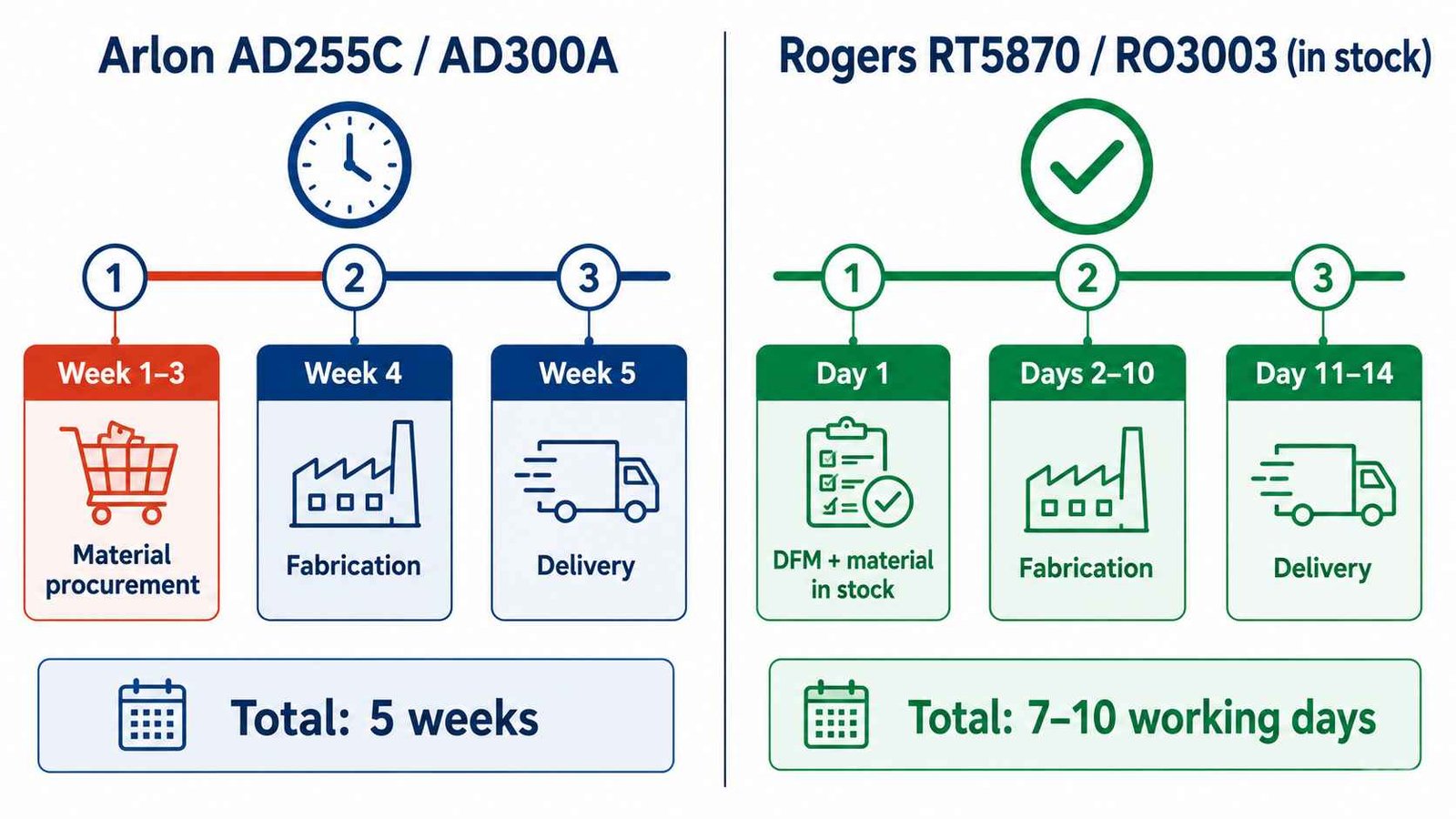
Arlon high frequency laminates — AD255C, AD300A, CLTE-XT, AD350A — are technically competent materials used in EW, SATCOM and defense radar PCBs. The problem is not performance, it is procurement: Arlon materials are specialty items that most Chinese PCB factories do not stock. When you specify Arlon, your factory quotes 3–4 weeks material procurement before fabrication even begins. For prototype iterations where you need a board in 10 days, this is a project-killing delay. This article covers Arlon's material grades, where they perform well, and which in-stock Rogers and Taconic materials provide equivalent Dk/Df specifications with 7–10 day prototype lead time.
Home » AD250C PCB » Arlon High Frequency PCB Materials: AD Series, CLTE Series and Defense Applications
Table of Contents
Arlon High Frequency Material Grades
| Grade | Dk | Df | Tg | Primary Application |
|---|---|---|---|---|
| AD255C | 2.55 | 0.0015 | — | Wideband EW, SATCOM Rx feeds |
| AD300A | 3.0 | 0.0020 | — | Ka-band, microwave filter |
| CLTE-XT | 2.94 | 0.0009 | — | mmWave, lowest loss Arlon PTFE |
| AD350A | 3.5 | 0.0025 | — | X/Ku band, phase shifter |
| 85N (polyimide) | — | 0.015 | 250°C | ⚠️ High-temp aerospace — NOT an RF substrate |
| AR1000 | 10.2 | 0.0035 | — | Patch antenna miniaturization |
Note: Arlon 85N is a polyimide material used for high-temperature mechanical applications — it is not a low-loss RF substrate (Df ~0.015) and should not be specified for RF signal layers. It is included here because it appears in Arlon’s catalog and is sometimes incorrectly specified for RF applications.
The Lead Time Problem
Arlon materials are manufactured in the US and distributed through a limited number of authorized channels. In China, they are not commodity stock items — most factories that claim Arlon capability are ordering per-job from a distributor, which adds 3–4 weeks to every prototype cycle. The problem compounds on second and third prototype iterations: each iteration adds another 3–4 week material wait, turning a 6-week prototype program into a 4-month ordeal.
Rogers and Taconic materials are stocked by more Chinese factories because they are specified more frequently. At Riching PCB, Rogers RO3003 (0.127mm, 0.254mm), RT5880 (6 thicknesses), RO4350B, RO4003C and Taconic TLY-5 and RF-35 are maintained as standard inventory — your prototype lead time is fabrication time only, not fabrication plus procurement.
In-Stock Alternatives to Arlon
| Arlon Grade | Dk | Df | In-Stock Alternative | Lead Time Difference |
|---|---|---|---|---|
| AD255C | 2.55 | 0.0015 | Rogers RT5870 (Dk 2.33, Df 0.0012) | Arlon: 3–4 weeks → Rogers in stock: 7–10 days |
| AD300A | 3.0 | 0.0020 | Rogers RO3003 (Dk 3.0, Df 0.0010) | Arlon: 3–4 weeks → Rogers in stock: 7–10 days |
| CLTE-XT | 2.94 | 0.0009 | Rogers RT5880 (Dk 2.20, Df 0.0009) | Arlon: 3–4 weeks → Rogers in stock: 7–10 days |
| AD350A | 3.5 | 0.0025 | Taconic RF-35 (Dk 3.5, Df 0.0018) | Arlon: 3–4 weeks → Taconic in stock: 7–10 days |
| AR1000 | 10.2 | 0.0035 | Rogers RO3010 (Dk 10.2, Df 0.0022) | Confirm RO3010 stock before specifying |
AD255C → Rogers RT5870
Arlon AD255C (Dk 2.55, Df 0.0015) is used for wideband low-loss applications. Rogers RT5870 (Dk 2.33, Df 0.0012) has slightly lower Dk and lower Df — better electrical performance, in stock, 7–10 day prototype. Trace width will be approximately 8% wider for the same impedance target — confirm in simulation before substituting on a design that is not yet fabricated.
AD300A → Rogers RO3003
Arlon AD300A (Dk 3.0, Df 0.0020) and Rogers RO3003 (Dk 3.0, Df 0.0010) have identical Dk. RO3003 has half the Df of AD300A — lower insertion loss. If your design was specified on AD300A, RO3003 is a direct pin-compatible substitute with better electrical performance. Rogers RO3003 PCB manufacturer — 0.127mm and 0.254mm in stock.
CLTE-XT → Rogers RT5880
Arlon CLTE-XT (Dk 2.94, Df 0.0009) is Arlon’s lowest-loss PTFE grade. Rogers RT5880 (Dk 2.20, Df 0.0009) has identical Df and lower Dk — wider trace width for same impedance. If your CLTE-XT design can tolerate slightly wider traces (or was not yet fabricated), RT5880 is the in-stock equivalent. Rogers RT5880 PCB manufacturer — 6 thicknesses in stock.
AD350A → Taconic RF-35
Arlon AD350A (Dk 3.5, Df 0.0025) and Taconic RF-35 (Dk 3.5, Df 0.0018) have identical Dk. RF-35 has lower Df. For X/Ku band filter and antenna designs specified on AD350A, RF-35 is a direct equivalent with better loss and in-stock availability.
When Arlon Is the Only Option
There are specific cases where Arlon materials have no direct equivalent:
- Arlon 85N for high-temperature polyimide applications (Tg 250°C) — Rogers does not make a direct equivalent for this thermal profile
- Arlon AR1000 (Dk 10.2) for miniaturized patch antenna designs — Rogers RO3010 (Dk 10.2) is the closest equivalent but confirm availability before designing in
- Designs already in production on Arlon where changing material requires re-qualification — if your customer has approved Arlon on the BOM, substitution requires their approval
For new designs or prototype iterations where Arlon is specified but not yet approved by a customer, switching to an in-stock Rogers or Taconic equivalent is almost always the right engineering decision — same or better electrical performance, 3–4 weeks faster.
How to Substitute Arlon on an Existing Design
- Confirm Dk is the same or within ±5% — trace width change will be small enough to ignore for most designs
- Confirm Df is equal or lower — substituting to a lower-Df material never degrades performance
- Re-run impedance calculation if Dk changes by more than 2% — trace width adjustment may be needed
- For designs already in production: substitution requires customer approval and may require re-testing
- For prototype iterations: no approval needed — just note the material change in your test report
Arlon High Frequency PCB Q&A
Common questions about Arlon PCB material grades, in-stock Rogers and Taconic alternatives, lead time issues and material substitution rules.
What is Arlon AD255C used for?
Arlon AD255C (Dk 2.55, Df 0.0015) is used for wideband low-loss RF applications including EW receivers, SATCOM feed networks and X-band radar front-ends. The closest in-stock alternative is Rogers RT5870 (Dk 2.33, Df 0.0012) — lower Dk and lower Df, slightly wider trace width but better insertion loss.
What is the Rogers equivalent of Arlon AD300A?
Rogers RO3003 (Dk 3.0, Df 0.0010) is a direct equivalent to Arlon AD300A (Dk 3.0, Df 0.0020). Both have identical Dk 3.0, but RO3003 has half the Df — better insertion loss. RO3003 0.127mm and 0.254mm are in stock at Riching PCB with 7–10 day prototype lead time, vs 3–4 weeks for AD300A.
Why is Arlon PCB lead time so long?
Arlon materials are manufactured in the US and distributed through limited channels in China. Most Chinese PCB factories do not stock Arlon — they order per-job from a distributor, adding 3–4 weeks procurement before fabrication begins. Rogers and Taconic materials are stocked more widely because they are specified more frequently.
Is Arlon 85N a good RF PCB material?
No. Arlon 85N is a polyimide for high-temperature mechanical applications (Tg 250°C) with Df ~0.015 — about 15× higher than Rogers RO3003. This produces very high insertion loss at RF frequencies. Arlon 85N should never be specified for RF signal layers. It is used for structural and thermal management in aerospace assemblies.
Can I substitute Rogers for Arlon on an existing design?
For prototypes and new designs: yes, if the Rogers equivalent has the same or lower Dk (±5%) and same or lower Df. Re-run impedance calculations if Dk changes by more than 2%. For designs already in production with Arlon approved on the customer BOM: substitution requires customer approval and may require re-testing.
Rogers & Taconic Arlon Equivalents — In Stock, 7–10 Day Prototype
RO3003 (AD300A equivalent), RT5880 (CLTE-XT equivalent), RT5870 (AD255C equivalent) and Taconic RF-35 (AD350A equivalent) all in stock. No procurement delay. No MOQ.
Rogers PCB In Stock → WhatsAppRequest a PCB Quote
Upload your Gerber ZIP file and project requirements. Our engineering team will review your PCB material, stackup, impedance needs, surface finish, and production quantity before quoting.
Please prepare:
- Gerber files in ZIP format
- PCB material or stackup requirements
- Controlled impedance notes if available
- Prototype or batch production quantity
Arlon AD255 High Frequency PCB: Specifications and Processing Notes
Arlon AD255 is a woven-glass reinforced PTFE laminate with micro-dispersed ceramic fillers, specified at a dielectric constant (Dk) of 2.55 and a dissipation factor (Df) of 0.0018 at 10 GHz. It sits in Arlon's AD series of low-loss microwave laminates and is most often specified for base-station antennas and antenna feed networks.
Arlon AD255 published laminate data
| Property | Arlon AD255 | Condition |
|---|---|---|
| Dielectric constant (Dk) | 2.55 (+/-0.04) | 10 GHz |
| Dissipation factor (Df) | 0.0018 | 10 GHz |
| Reinforcement / resin system | Woven glass + PTFE, ceramic-filled | — |
| Density | 2.40 g/cm3 | — |
| Water absorption | 0.070 % | — |
| CTE (x / y / z) | 12 / 15 / 95 µm/m·°C | — |
| Thermal conductivity | 0.235 W/m·K | — |
| Temperature coefficient of Dk | −110 ppm/°C | — |
| Flammability | UL94 V-0 | — |
Figures above are published laminate datasheet values and are given for stackup planning only. Your stackup drawing and impedance targets govern the final build.
What matters when you source an Arlon AD255 high-frequency PCB
If you are evaluating an Arlon AD255 high-frequency PCB manufacturer, three checks separate a working build from a rejected one: the laminate lot and datasheet revision actually used, Dk tolerance control on the impedance-controlled layers, and drill and lamination parameters proven out on ceramic-filled PTFE rather than carried over from FR-4. Ceramic-filled PTFE is softer and more abrasive than standard FR-4, so bit wear, hole wall quality and desmear behave differently.
RF PCB manufacturing capabilities | Controlled impedance verification | Material parameter comparison
What is Arlon AD255 used for?
Arlon AD255 is a woven-glass reinforced PTFE laminate with ceramic fillers, specified at Dk 2.55 and Df 0.0018 at 10 GHz. It is commonly specified for base-station antennas and antenna feed networks, where stable Dk across temperature and low passive intermodulation matter.
What are the key specifications of Arlon AD255?
Published laminate data: Dk 2.55 (+/-0.04) and Df 0.0018 at 10 GHz, density 2.40 g/cm3, water absorption 0.070 %, CTE 12 / 15 / 95 um/m-degC in x / y / z, thermal conductivity 0.235 W/m-K, temperature coefficient of Dk -110 ppm/degC, UL94 V-0. For impedance-controlled layers, Dk tolerance and copper type are the two variables that move trace width most.
How do I verify an Arlon AD255 PCB supplier?
Ask for the laminate lot and datasheet revision, the stackup drawing that shows which layers use AD255, and the impedance report for the controlled-impedance layers. Ceramic-filled PTFE also drills and plates differently from standard FR-4, so request the drill and lamination parameters used for your stackup.
Need a stackup review or a quote?
Send Gerber files, material and stackup requirements, and controlled-impedance notes. Prototypes typically ship in 7-10 days.