
PCB Material Shortage 2026: Why Factories Are Closing Despite Full Order Books
Something unusual is happening in the PCB industry in 2026. Small and mid-size factories — factories with full order books and paying customers waiting — are shutting down production lines. Not because demand dried up. Because they cannot get materials.
Home » PCB Material Shortage 2026: Why Factories Are Closing Despite Full Order Books
Table of Contents
Something unusual is happening in the PCB industry in 2026. Small and mid-size factories — factories with full order books and paying customers waiting — are shutting down production lines. Not because demand dried up. Because they cannot get materials.
The conventional PCB factory failure mode is a demand collapse: orders stop coming, revenue falls, the factory closes. What is happening in 2026 is the opposite: orders are there, the customers are ready, but the copper-clad laminate is not. Factories that built their business on spot purchasing — buying material per order rather than maintaining inventory — are discovering that the spot market no longer reliably delivers. When a competitor factory calls to borrow prepreg, you know the shortage has become acute.
This article is a companion to our analysis of the 2026 PCB price increases. If you have not read that piece, see: PCB Material Price Increase 2026 — 6 Rounds of Hikes Explained.
The Shortage Is Not About Demand Collapsing — It Is About Allocation
The word ‘shortage’ implies that supply has fallen. In 2026, the more precise description is allocation: CCL producers have more orders than capacity, and they are prioritizing their highest-value customers. A CCL manufacturer that can sell M9 T-glass at 15–20× the price of standard FR-4 has strong financial incentive to shift capacity toward M9. The result is that capacity for standard FR-4 shrinks — not because FR-4 demand fell, but because the same factory equipment can make more money producing advanced grades.
For a PCB factory that buys FR-4 on the spot market with no long-term supply agreement, this means they go to the back of the queue. The CCL supplier serves its allocated customers first — the large factories with volume commitments — and standard-grade spot buyers get whatever is left. In a tight market, sometimes nothing is left.
How the Shortage Cascades Through the Supply Chain
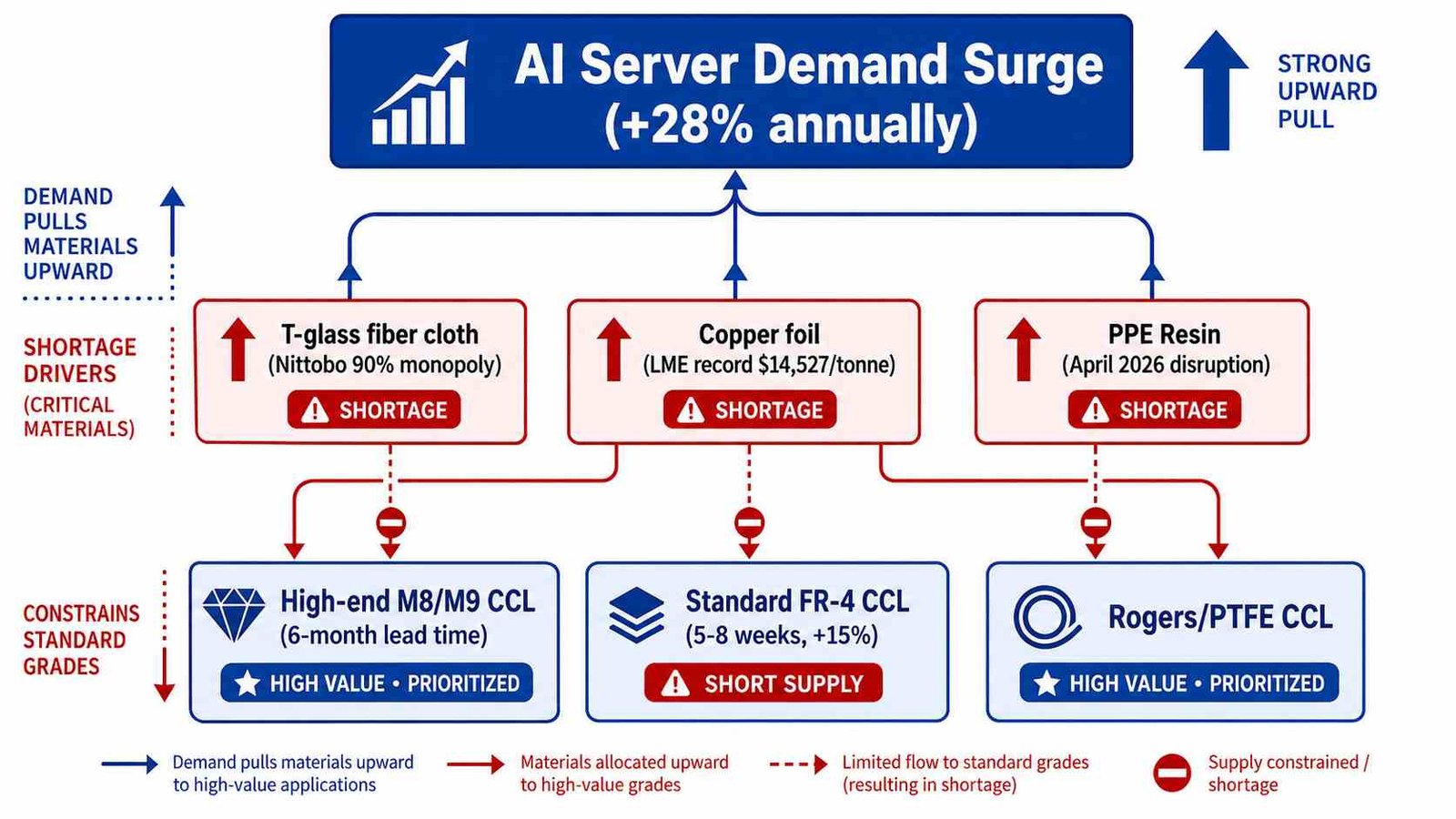
The cascade starts at the raw material level and flows down:
- AI server demand surge → CCL manufacturers shift capacity to M8/M9 high-end grades → standard FR-4 capacity contracts
- T-glass shortage (Nittobo ~90% global supply, prices up 40%+) → high-end CCL cannot be made fast enough → allocation mode for all advanced grades
- Copper foil at record prices → CCL cost rises across all grades → manufacturers raise minimum order quantities to protect margins
- Small factories lose allocation priority → cannot fulfill orders → borrow prepreg from competitors → eventually suspend production
- Medium factories absorb some of this demand → their lead times extend → their prices rise → your delivery date slips
What This Means for PCB Buyers
Lead time is now a function of your factory's supply chain position, not just their production capacity
A factory that quotes 2 weeks lead time but buys material per-order is not quoting 2 weeks lead time. They are quoting 2 weeks fabrication time plus however long it takes them to get material — which in 2026 can be 4–8 weeks for standard FR-4 and 3–4 months for specialty grades. The fabrication time is real. The material procurement time is hidden in the quote and only becomes visible when your order is delayed.
The factory that calls to borrow prepreg cannot reliably serve your program
When a factory needs to borrow prepreg from a competitor to fulfill an order, it means their inventory management has broken down and they are in reactive mode. A factory in this position cannot provide reliable lead times, cannot hold quoted prices, and cannot guarantee that your next order will be any more predictable than this one. This is not a judgment on the factory’s technical capability — their engineers and equipment may be excellent. It is a supply chain risk assessment.
Price certainty and lead time certainty are now the same thing as material certainty
In a stable material market, a PCB quote is valid because the factory knows what materials cost. In the 2026 market, a quote from a factory that buys spot is valid only as long as no further price hike lands between the quote date and when they actually purchase material for your order. In-stock material = price already paid = quote is real. See our piece on PCB material price increases in 2026 for the full timeline of 2026 hikes.
How to Assess Your PCB Factory's Material Risk
| Factory Type | Material Access | Risk Level for Your Orders |
|---|---|---|
| Large-volume factory (top 20 in China) | CCL supplier priority allocation | Low — but MOQ often high |
| Mid-size factory with stock program | Pre-purchased inventory buffer | Moderate — confirm stock depth |
| Small factory, spot purchasing | Buys per order — no allocation | High — closure risk |
| Factory claiming Rogers capability, no stock | Procures per job — 3–4 week wait | High — any further shortage extends your lead time |
| Factory with in-house PTFE + Rogers inventory | Decoupled from spot market for key materials | Low for PTFE/Rogers |
Questions to Ask Your PCB Supplier Right Now
| Question to Ask | What the Answer Tells You |
|---|---|
| Do you stock Rogers RO3003 and RT5880 as standard inventory? | Yes = decoupled from procurement delays. No = 3–4 week material risk on every PTFE order |
| What is your current FR-4 CCL lead time from your supplier? | <4 weeks = healthy stock. >6 weeks = allocation pressure, price may change between quote and order |
| Can you hold my price for 30 days after quoting? | Yes = material in hand. No = quoting spot price, not locked inventory |
| What CCL brands do you use for standard FR-4? | Named brands (Shengyi, Kingboard, Iteq) = legitimate supply chain. Vague = spot buying from brokers |
| Have you had any orders delayed in 2026 due to material availability? | Honest answer matters — a factory that acknowledges the market reality is more reliable than one that denies it |
The Rogers and PTFE Situation Is Different
For high-frequency PCB buyers, there is an important distinction: the 2026 shortage is concentrated in AI server grades (M6–M9, T-glass based CCL). Rogers RO3003, RT5880 and RO4350B are PTFE and hydrocarbon ceramic materials — a completely different supply chain from the glass-fiber-and-resin CCL that AI servers consume. They have seen cost pressure from copper prices, but they are not in the same allocation crisis as M8/M9 grades.
Riching PCB maintains Rogers RO3003 (0.127mm, 0.254mm) and RT5880 in all six standard thicknesses as standard inventory — purchased and on-shelf, not procured per order. This means your 77GHz radar PCB or Ka-band PCB prototype starts fabrication the day DFM is approved, not the day material arrives. 7–10 working days, no material wait.
What to Do If Your Current PCB Supplier Is Struggling
- Ask directly: ‘Have you had any material-related delays in the past 3 months?’ — a factory in trouble will either admit it or give a vague answer that signals the same thing
- Request a material certificate with your next order — if the factory struggles to provide one, they may be sourcing from brokers rather than primary manufacturers
- Qualify a second source now — not when your current supplier fails, but before. The time to qualify a backup is when your primary is still delivering
- For Rogers and PTFE programs: confirm in-stock availability before placing the order, not after — ask ‘Is RO3003 0.127mm on your shelf today?’
- Request a free DFM reviewfrom a factory with confirmed material stock — this costs nothing and tells you whether your design can be built on available material without substitution risk
PCB Material Shortage 2026 — Q&A
Common questions about why PCB factories are closing despite full order books, how to assess your supplier's material risk, and what to do to protect your supply chain.
Why are PCB factories closing in 2026 despite having orders?
The closures are driven by material shortage, not demand collapse. Factories that buy CCL on the spot market cannot get material reliably — CCL producers are prioritizing AI server grades and their largest customers. A factory with full orders but no material cannot produce boards.
How can I tell if my PCB factory has a material shortage problem?
Ask: Can you hold my quoted price for 30 days? (No = buying spot.) What is your FR-4 CCL lead time from your supplier? (More than 6 weeks = allocation pressure.) Do you stock Rogers RO3003 as standard inventory? (No = 3–4 week PTFE risk on every order.) What CCL brands do you use? (Vague answer = spot buying from brokers.)
Is the Rogers and PTFE supply chain affected by the 2026 shortage?
Rogers PTFE materials (RO3003, RT5880) are in a different supply chain from the AI-server grades that are most constrained. The 2026 crunch is concentrated in M6–M9 high-speed digital laminates using T-glass fiber. Rogers and PTFE have seen cost pressure from copper prices but are not in the same allocation crisis as M8/M9 grades.
What should I do if my current PCB supplier is struggling with material?
Qualify a second source before your primary fails. Request a material certificate with your next order. For Rogers and PTFE programs, confirm in-stock availability before placing the order. Ask directly whether your supplier has had material-related delays in 2026 — an honest answer tells you more than their website claims.
How long will the PCB material shortage last?
The structural drivers are not resolving quickly. Nittobo's T-glass capacity expansion does not produce output until late 2026. PPE resin recovery is projected at 6–9 months from April 2026. Industry forecasts suggest the shortage will persist through end-2026, with potential relief in 2027 as new capacity comes online.
Rogers RO3003 and RT5880 On Shelf — Not On Order
Riching PCB maintains Rogers and PTFE materials as standard on-shelf inventory. When you place an order, fabrication starts at DFM approval — not when material arrives. 7–10 day prototype, confirmed price, no MOQ.
Check Material Stock → WhatsAppRequest a PCB Quote
Upload your Gerber ZIP file and project requirements. Our engineering team will review your PCB material, stackup, impedance needs, surface finish, and production quantity before quoting.
Please prepare:
- Gerber files in ZIP format
- PCB material or stackup requirements
- Controlled impedance notes if available
- Prototype or batch production quantity