
Phased Array PCB: Material Selection, Design Rules and Manufacturing Guide

Substrate requirements, feed network design, Dk uniformity and manufacturing specifications for phased array antenna PCB — radar, satellite terminal and 5G mmWave applications.

Table of Contents

Key point: Key point: Most factories quote 3–4 weeks waiting for RO3003 / RT5880 material procurement. Riching PCB maintains these materials in stock — no material wait.

Rogers RO3003 is a PTFE ceramic substrate with Dk 3.0 and Df 0.0010 — standard for Ka-band (26.5–40 GHz), 77 GHz automotive radar and 5G mmWave 28 GHz phased arrays. At 30 GHz, RO3003 insertion loss is ~0.5 dB/cm vs ~1.8 dB/cm for RO4350B. 50Ω microstrip on 0.127 mm RO3003 with 0.5 oz copper: ~0.28 mm trace width. Available thicknesses: 0.127 / 0.254 / 0.508 / 0.762 / 1.524 mm. All RO3003 orders require in-house plasma hole wall activation and maximum 2 lamination press cycles. Riching PCB stocks RO3003 in 0.127 mm and 0.254 mm with in-house plasma activation. No MOQ. Prototype 7–10 working days.Phased array PCB requires PTFE substrate with Dk uniformity of ±0.05 across the panel — not just nominal Dk. Rogers RO3003 (Dk 3.0, Df 0.0010) is standard for Ka-band and 5G mmWave arrays; RT5880 (Dk 2.20, Df 0.0009) for wideband and lowest-loss designs; RO4350B for S-band and C-band passive arrays. Impedance tolerance ±5% must be TDR-verified at multiple panel locations. All PTFE materials require in-house plasma activation. Riching PCB stocks RO3003, RT5880 and RO4350B with in-house plasma activation, panel-level TDR available. No MOQ. Prototype 5–10 working days.

Phased array PCB is one of the most demanding PCB manufacturing challenges because it combines the requirements of a high-frequency RF substrate with the need for consistent electrical performance across a large panel area. A single patch antenna element is forgiving — a small Dk variation shifts its resonance but the system still functions. An array of 64, 256, or 1024 elements is not forgiving: Dk variation across the panel creates phase errors between elements, degrading the beam pattern, reducing gain, and raising sidelobe levels.

This guide covers the PCB material requirements specific to phased array design, feed network architecture, stackup options, and manufacturing specifications.

Why Phased Array PCB Has Unique Requirements

Standard RF PCB design requires consistent impedance along a single transmission line. Phased array PCB requires consistent impedance and phase across hundreds or thousands of parallel transmission lines distributed across the entire panel. Any systematic or random variation in Dk across the substrate translates directly into phase errors at the antenna elements:

  • At 28 GHz, a Dk variation of ±0.05 shifts patch antenna resonance by approximately 300–400 MHz
  • A phase error of 5° between adjacent elements degrades array gain by approximately 0.4 dB and raises sidelobe levels
  • For a 256-element array, even small systematic Dk gradients across the panel accumulate into beam pointing errors


This is why material Dk uniformity across the panel — not just nominal Dk value — is the critical specification for phased array PCB substrate.

Material Selection for Phased Array PCB

Material Dk Df Type Phased Array Suitability
RO3003 3.0 0.0010 PTFE ceramic ✅ Best for most arrays — tight Dk tolerance, good thermal conductivity
RT5880 2.20 0.0009 PTFE glass ✅ Lowest loss — larger element size, lower thermal conductivity
RO4350B 3.48 0.0037 Hydrocarbon ✅ S/C-band arrays — FR4-compatible, no plasma activation
Taconic TLY-5 2.17 0.0009 PTFE glass ✅ Suitable — similar to RT5880
F4BM220 2.20 0.0010 PTFE ✅ Cost-effective — confirm Dk uniformity across panel
Standard FR4 ~4.5 ~0.020 Epoxy glass ⚠️ L-band only — not suitable above 2 GHz for arrays

Rogers RO3003 — Standard for Ka-Band and 5G mmWave Arrays

RO3003 (Dk 3.0, Df 0.0010) is the most widely used substrate for Ka-band and 5G mmWave phased arrays. Its combination of tight Dk tolerance (±0.04 at 10 GHz), stable Dk over temperature (±0.05 from –40°C to +85°C), and higher thermal conductivity (0.50 W/m/K) compared to RT5880 makes it the preferred choice for high-power arrays where thermal management is a concern.

Rogers RT5880 — For Wideband and Lowest-Loss Arrays

RT5880 (Dk 2.20, Df 0.0009) offers the lowest insertion loss and is used where maximum array gain or wideband coverage is required. Lower Dk means larger antenna elements — for a fixed frequency, RT5880 elements are approximately 17% larger than RO3003 elements. Both RO3003 and RT5880 are available in multiple thicknesses from Riching PCB.

Rogers RO4350B — For S-Band and C-Band Arrays

For phased arrays operating below 8 GHz (S-band radar, C-band SATCOM), RO4350B (Df 0.0037) is acceptable — its higher Df is less significant at lower frequencies where absolute insertion loss per unit length is lower. RO4350B processes on FR4-compatible equipment with no plasma activation required. See RO4350B PCB guide for material properties.

Phased Array PCB Design Rules

Parameter Typical Value Notes
Element spacing λ/2 at center frequency ~5 mm at 28 GHz on RO3003, ~13 mm at 10 GHz
Substrate thickness 0.127–0.254 mm (Ka-band) Thinner = narrower trace for 50Ω
Impedance tolerance ±5% across panel TDR at multiple panel locations — not edge only
Dk uniformity ±0.05 across panel Critical for phase uniformity between elements
Copper foil Low-profile (Ka/Ku-band) Reduces insertion loss in feed network
Surface finish ENIG Flat surface critical for element dimensional accuracy
PTFE lamination Max 2 press cycles All PTFE materials — exceeding causes Dk shift
Via drill (Ka-band) 0.1–0.15 mm laser Through-hole via transition loss significant at 28 GHz
Min. line width 2.5 mil Verify with fabricator for PTFE process

Feed Network ArchitecturePhased array PCB corporate feed network showing Wilkinson power dividers and microstrip distribution
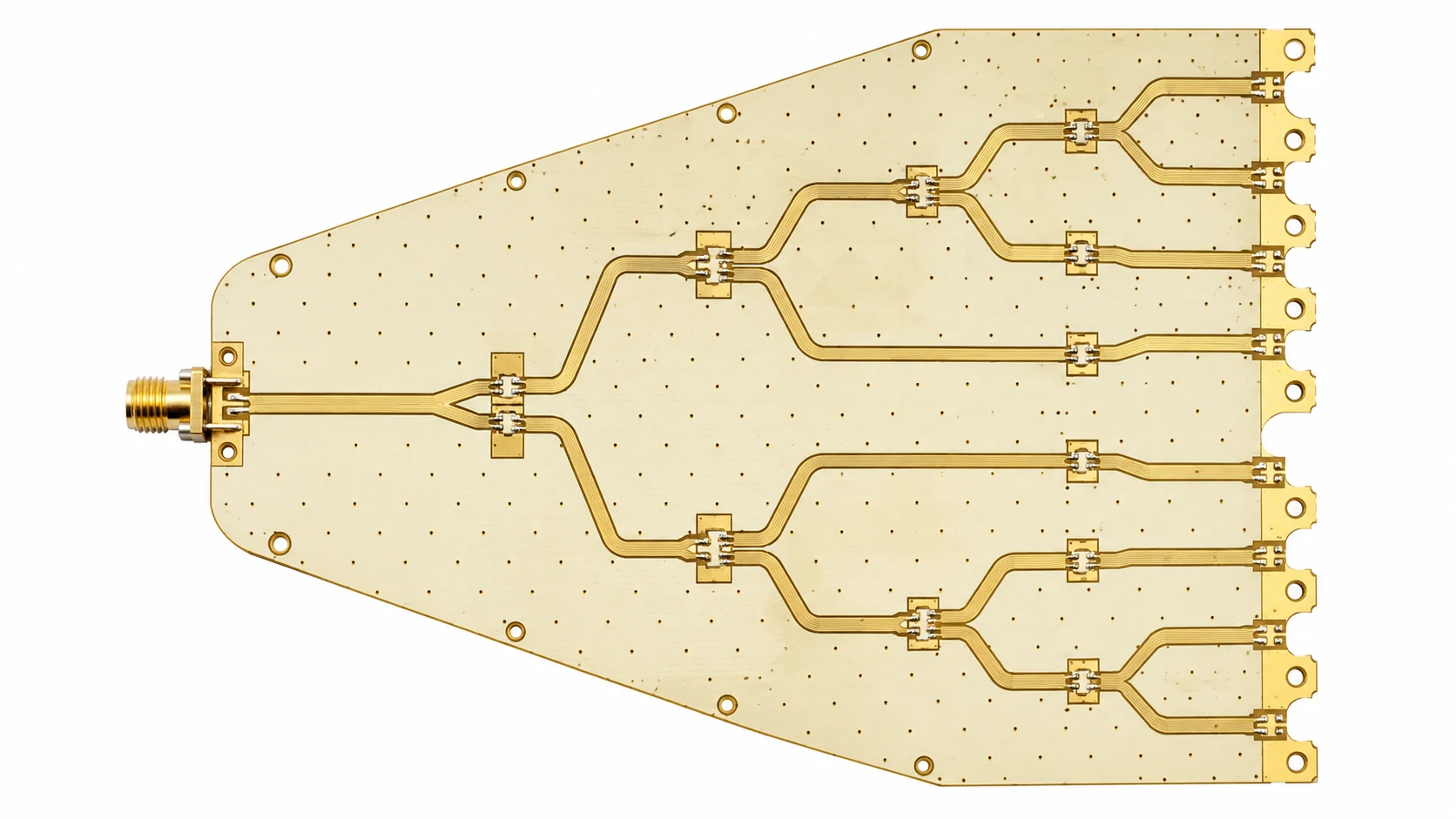
Corporate Feed Network

The most common feed architecture for phased arrays is the corporate (parallel) feed network — a binary tree of power dividers distributing RF signal from a single input to all antenna elements with equal path length. For Ka-band arrays, Wilkinson power dividers in microstrip are standard. Equal path length from input to each element ensures phase uniformity independent of substrate Dk variation — the path length error, not Dk, determines phase accuracy in a corporate feed.

Series Feed Network

Series feed networks route RF along a single transmission line with each element tapping off in sequence. Simpler to implement but frequency-sensitive — phase shift to each element changes with frequency, limiting instantaneous bandwidth. Used primarily for narrow-band arrays where bandwidth requirements are below 5%.

Active Phased Array (AESA)

Active phased arrays integrate T/R (transmit/receive) modules or beamforming ICs directly on the PCB, with individual phase and amplitude control per element. The PCB stackup must support both RF signal distribution and DC power delivery to hundreds of active devices. Multi-layer hybrid stackups with PTFE signal layers and FR4 power/ground layers are standard for AESA designs.

Stackup Design for Phased Array PCB

2-Layer (Simple patch array, passive)

  • Top copper: 0.5–1 oz — antenna elements and feed network
  • RO3003 core: 0.127 mm (Ka-band) or 0.254 mm (Ku-band)
  • Bottom copper: 1 oz — ground plane

4-Layer Hybrid (AESA with integrated beamforming)

  • L1 — RO3003 0.127 mm — antenna elements
  • L2 — Ground plane
  • FR4 prepreg — DC power distribution
  • L3 — Power plane
  • FR4 prepreg
  • L4 — RO3003 0.127 mm — RF feed network

See FR4 + Rogers hybrid PCB stackup guide for bondply selection and press cycle constraints for hybrid AESA stackups.

Manufacturing Requirements

Dk Uniformity Verification

For phased array PCB, request Dk uniformity verification across the panel — not just nominal Dk from the material certificate. Rogers RO3003 material specification guarantees Dk of 3.0 ±0.04 across a panel. Verify that your fabricator performs incoming material inspection and can provide Dk uniformity data for the specific material lot used in your order.

PTFE Plasma Activation

All PTFE phased array substrates (RO3003, RT5880, Taconic, F4B) require in-house plasma activation before copper plating. For phased array applications where the board operates in thermal cycling environments, the adhesion quality of copper on PTFE hole walls is critical — outsourced plasma activation introduces process control risk. See PTFE PCB manufacturing challenges for full process detail.

Impedance Control

Request ±5% impedance tolerance with TDR verification at multiple locations across the panel — minimum 5 measurement points for panels larger than 200 × 200 mm. This confirms Dk uniformity translates into impedance uniformity across all antenna elements. Standard single-point TDR on edge coupons is not sufficient for phased array applications. See controlled impedance RF PCB for full TDR specification guidance.

Dimensional Accuracy

Patch antenna element dimensions determine resonant frequency — for a Ka-band patch at 28 GHz, the element dimension is approximately 3.5 mm on RO3003. A dimensional error of ±0.05 mm shifts resonance by approximately 400 MHz. Specify dimensional tolerance on the fabrication drawing and confirm your fabricator’s etching accuracy at the required line width.

ApplicationsPhased array radar PCB for airborne active electronically scanned array AESA radar
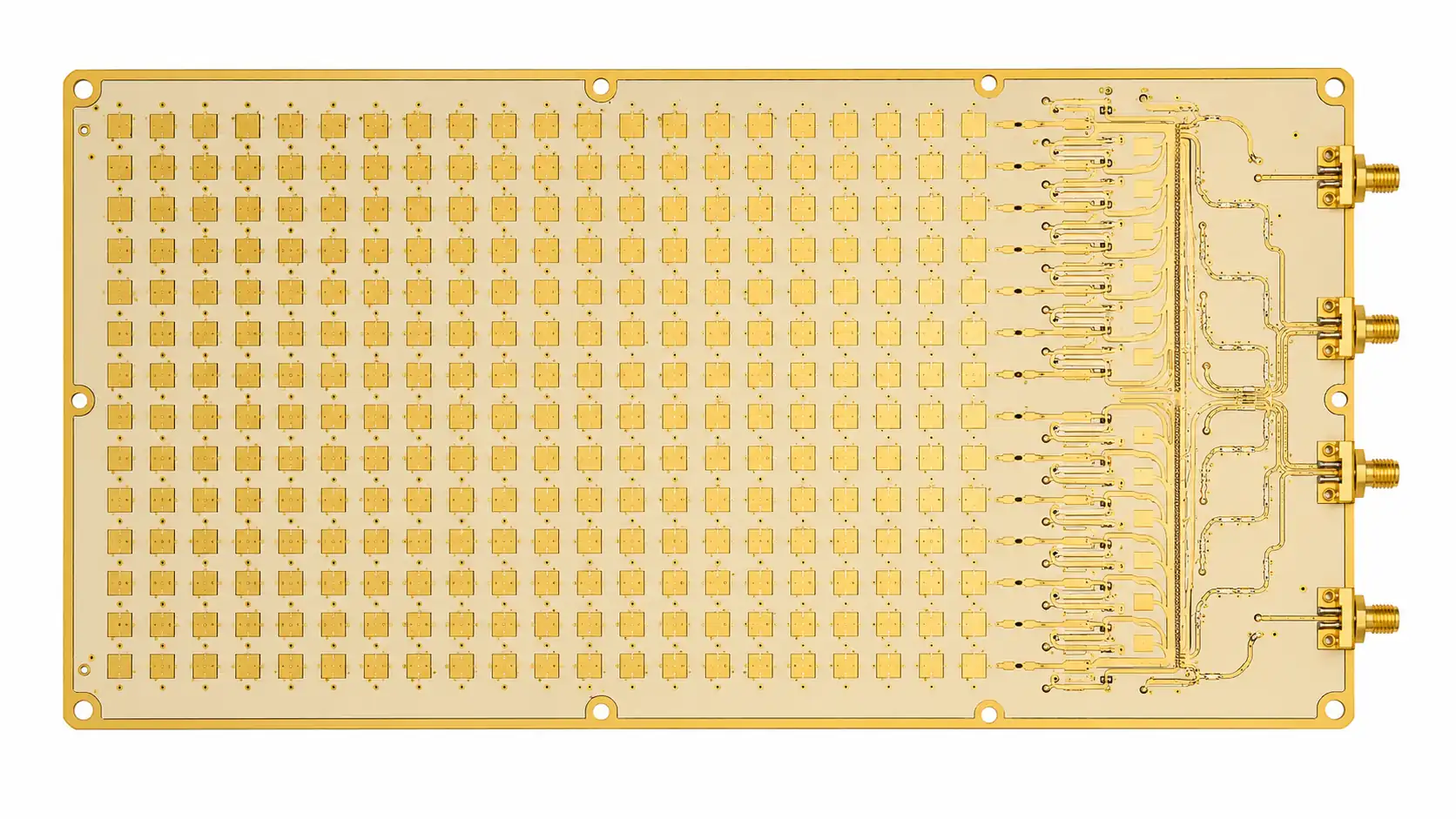
  • AESA radar — airborne fire control, ground-based air defense, naval radar
  • 5G mmWave massive MIMO base station antenna PCB — 64T64R arrays
  • LEO satellite user terminal — Starlink, OneWeb, Kuiper Ka-band phased array
  • Electronic warfare — wideband ESM phased array receiver
  • Automotive radar — 77 GHz MIMO radar front-end array
  • 5G FWA CPE — fixed wireless access customer premise equipment
  • Missile seeker — Ka-band active seeker phased array

Conclusion

Phased array PCB requires PTFE substrate with tight Dk uniformity across the panel (±0.05), ±5% impedance control verified at multiple panel locations, in-house plasma activation, and ENIG surface finish for dimensional accuracy. Rogers RO3003 is the standard for most Ka-band and 5G mmWave phased arrays; RT5880 for wideband and lowest-loss applications; RO4350B for S-band and C-band passive arrays. Riching PCB manufactures phased array PCB with RO3003, RT5880, and RO4350B in stock, in-house plasma activation, panel-level TDR verification available, no MOQ. See high frequency PCB capabilities for full factory specifications.

Get a Quote for Your Phased Array PCB

RO3003, RT5880 and RO4350B in stock. In-house plasma activation. Panel-level TDR available. Send the following for DFM review:

  • Gerber files + NC drill file
  • Array frequency and application type
  • Material grade and dielectric thickness
  • Stackup drawing — layer count and copper weight
  • Impedance tolerance required (±10% or ±5%)
  • Panel-level TDR verification required? (yes/no)
  • IPC Class and quantity

WhatsApp +86 13760473650 — DFM review within 24 hours

Q&A

Phased Array PCB Q&A

Common questions about phased array PCB including material selection, Dk uniformity requirements, impedance verification, lamination limits and prototype lead times.

What material is used for phased array PCB?

RO3003 (Dk 3.0, Df 0.0010) is standard for Ka-band and 5G mmWave arrays — tight Dk tolerance ±0.04, stable over temperature. RT5880 (Dk 2.20, Df 0.0009) for wideband and lowest-loss applications. RO4350B for S-band and C-band passive arrays below 8 GHz.

Why is Dk uniformity across the panel critical for phased array PCB?

Dk variation shifts resonant frequency and electrical path length of individual elements, creating phase errors between elements. At 28 GHz, ±0.05 Dk variation shifts patch resonance by 300–400 MHz and introduces beam steering errors. Dk uniformity across the panel — not just nominal Dk — is the critical specification.

What impedance verification is required for phased array PCB?

±5% impedance tolerance, TDR at multiple panel locations — minimum 5 points for panels over 200×200 mm. Single-point edge coupon TDR is not sufficient. Request panel-level TDR verification explicitly on the fabrication drawing.

What is the maximum lamination cycles for PTFE phased array PCB?

Maximum 2 press cycles for all PTFE materials (RO3003, RT5880, Taconic, F4B). Exceeding this causes PTFE deformation and Dk variation across the panel, directly degrading phased array beam performance. Multi-layer AESA designs use hybrid PTFE + FR4 stackups with Rogers bondply.

What is the prototype lead time for phased array PCB?

RO4350B S/C-band: 5–7 working days. RO3003 / RT5880 Ka-band PTFE: 7–10 working days. Panel-level TDR available on request. No MOQ — from 1 board. WhatsApp: +86 13760473650.

PCB Project Review

Request a PCB Quote

Upload your Gerber ZIP file and project requirements. Our engineering team will review your PCB material, stackup, impedance needs, surface finish, and production quantity before quoting.

Please prepare:

  • Gerber files in ZIP format
  • PCB material or stackup requirements
  • Controlled impedance notes if available
  • Prototype or batch production quantity
ZIP format only. Please compress all Gerber and drill files into one ZIP package before uploading.