
Rogers PCB Price: How Much More Than FR4 and What Drives the Cost

Real price ranges for RO4350B and RO3003 prototypes, the five cost drivers that separate Rogers from FR4, and practical ways to reduce cost without compromising RF performance.

Table of Contents

Key point: Rogers PCB costs 3–8× more than FR4. The largest cost driver is raw material — RO4350B laminate costs 10–15× more per m² than FR4; RO3003 and RT5880 PTFE cost 15–20× more. PTFE materials add a further 15–25% process premium due to plasma activation. The most effective cost reduction strategy is FR4 + Rogers hybrid stackup — placing Rogers only on outer RF signal layers reduces 4-layer board cost by 40–55% vs all-Rogers. Riching PCB: RO4350B prototype from USD 120, no MOQ, 5–7 day lead time.

Rogers PCB costs 3–8× more than equivalent FR4 PCB. The exact multiplier depends on material grade, layer count, board size, quantity, and whether PTFE materials are involved. Understanding what drives the cost difference helps you make better decisions — either to justify the premium when it’s necessary, or to reduce it when it isn’t.

This guide gives real price ranges for common Rogers PCB configurations from a Chinese direct factory, explains the five cost drivers behind the premium, and provides five practical strategies to reduce Rogers PCB cost without compromising RF performance.

Rogers PCB Price vs FR4 — Reference Price Table

The following prices are indicative ranges from Riching PCB for prototype and small-volume orders. All prices in USD, excluding shipping.

Board Spec FR4 (USD) RO4350B (USD) RO3003 PTFE (USD) Multiplier vs FR4
2L, 100×100mm, 10 boards 25–40 120–180 200–280 4–6×
2L, 200×200mm, 5 boards 40–60 180–260 300–420 5–7×
4L hybrid, 150×150mm, 5 boards 80–120 280–380 420–560 4–5×
2L, 100×100mm, 100 boards 120–180 500–700 800–1100 4–6×
4L all-Rogers, 100×100mm, 5 boards 350–500 500–700

Indicative price ranges from Riching PCB, USD, excluding shipping. Actual prices vary by thickness, copper weight and surface finish.

Note: RO3003 and RT5880 PTFE materials cost 20–40% more than RO4350B for equivalent boards, due to higher material cost and the additional plasma activation process step.

What Drives Rogers PCB CostRogers PCB cost breakdown chart showing material cost process cost and yield loss compared to FR4
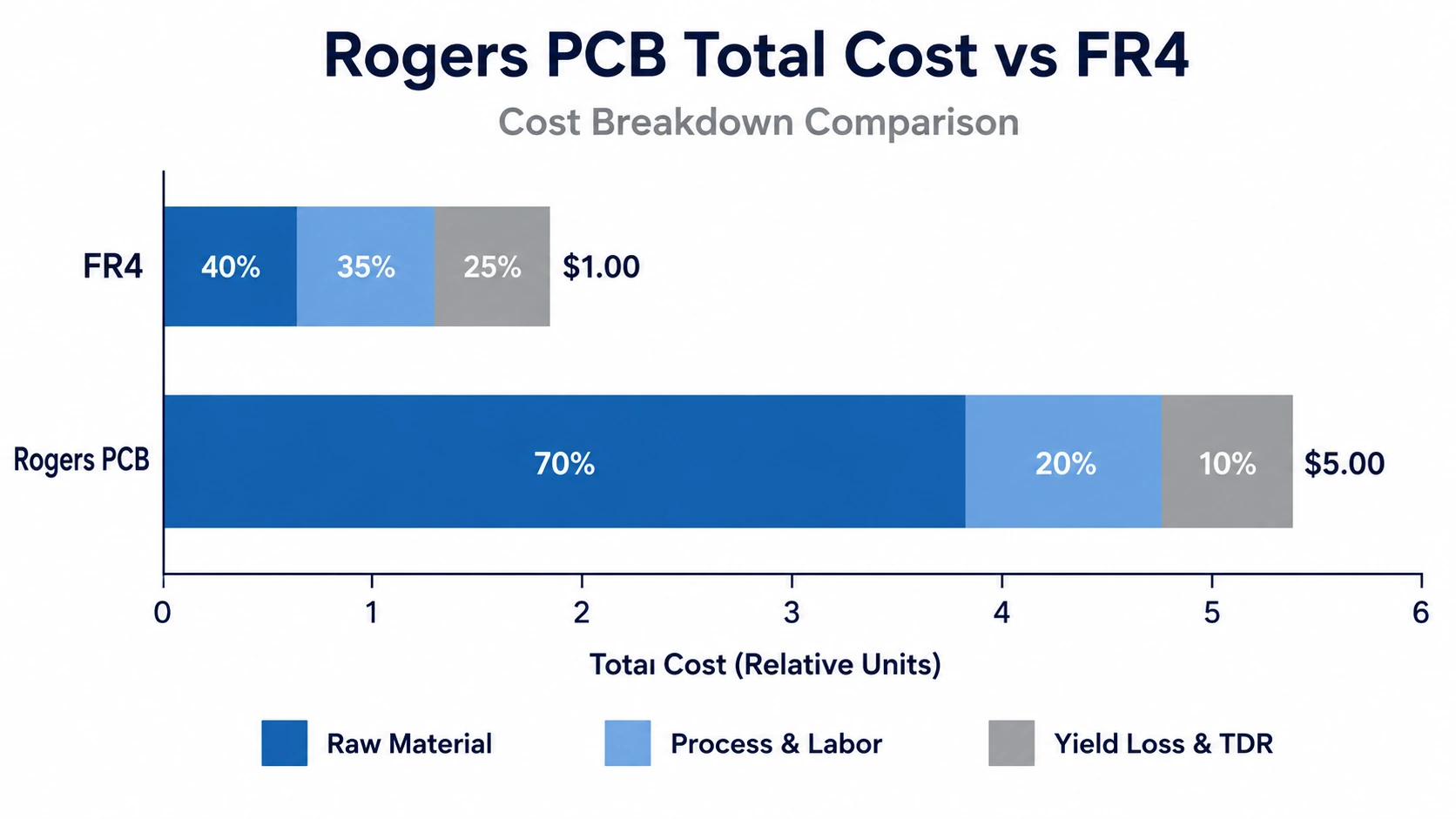
Cost Driver FR4 vs Rogers Delta Explanation
Raw material cost Rogers 8–15× higher per m² RO4350B ~USD 120–180/m² vs FR4 ~USD 8–15/m²
PTFE plasma activation +15–25% process cost PTFE only — equipment, labor, yield loss
Yield loss PTFE 5–15% vs FR4 1–3% PTFE harder to process — more scrap per lot
Minimum panel utilization Rogers sold in full panels Small boards or quantities waste more Rogers panel area
TDR verification +USD 30–80 per lot Required for impedance certification
Drill tooling wear PTFE wears tools faster Higher drill bit replacement cost for PTFE grades

1. Raw Material Cost

Rogers RO4350B costs approximately USD 120–180 per square meter of raw laminate. Standard FR4 costs USD 8–15 per square meter. This 10–15× material cost difference is the single largest driver of Rogers PCB price premium. Rogers RO3003 and RT5880 PTFE materials cost USD 180–280 per square meter — 15–20× higher than FR4.

2. Process Complexity for PTFE Materials

Rogers RO4350B (hydrocarbon ceramic) processes on standard FR4-compatible equipment — no plasma activation required. It adds cost only through material price. Rogers PTFE materials (RO3003, RT5880) require in-house plasma activation before copper plating, PTFE-specific drill parameters, and a maximum of 2 lamination press cycles. This adds 15–25% to process cost and 1–2 days to lead time compared to RO4350B.

3. Yield Loss

PTFE materials are harder to process than FR4 or RO4350B. Drill smear, hole wall adhesion failures, and lamination deformation produce higher scrap rates — typically 5–15% for PTFE vs 1–3% for FR4. Factories price this yield loss into the per-board cost.

4. Minimum Panel Utilization

Rogers material is sold in standard panel sizes. For small boards or small quantities, a significant portion of the Rogers panel may go unused — the cost of the entire panel is divided across fewer boards. FR4 is cheaper and easier to cut to any size, minimizing material waste.

5. TDR Verification

Rogers PCB requires TDR (Time Domain Reflectometry) impedance verification. This adds USD 30–80 per production lot for test coupon setup and measurement. On a 5-board prototype lot, this cost per board is significant.

5 Ways to Reduce Rogers PCB CostRogers FR4 hybrid PCB stackup cross-section showing cost saving by using FR4 for inner layers
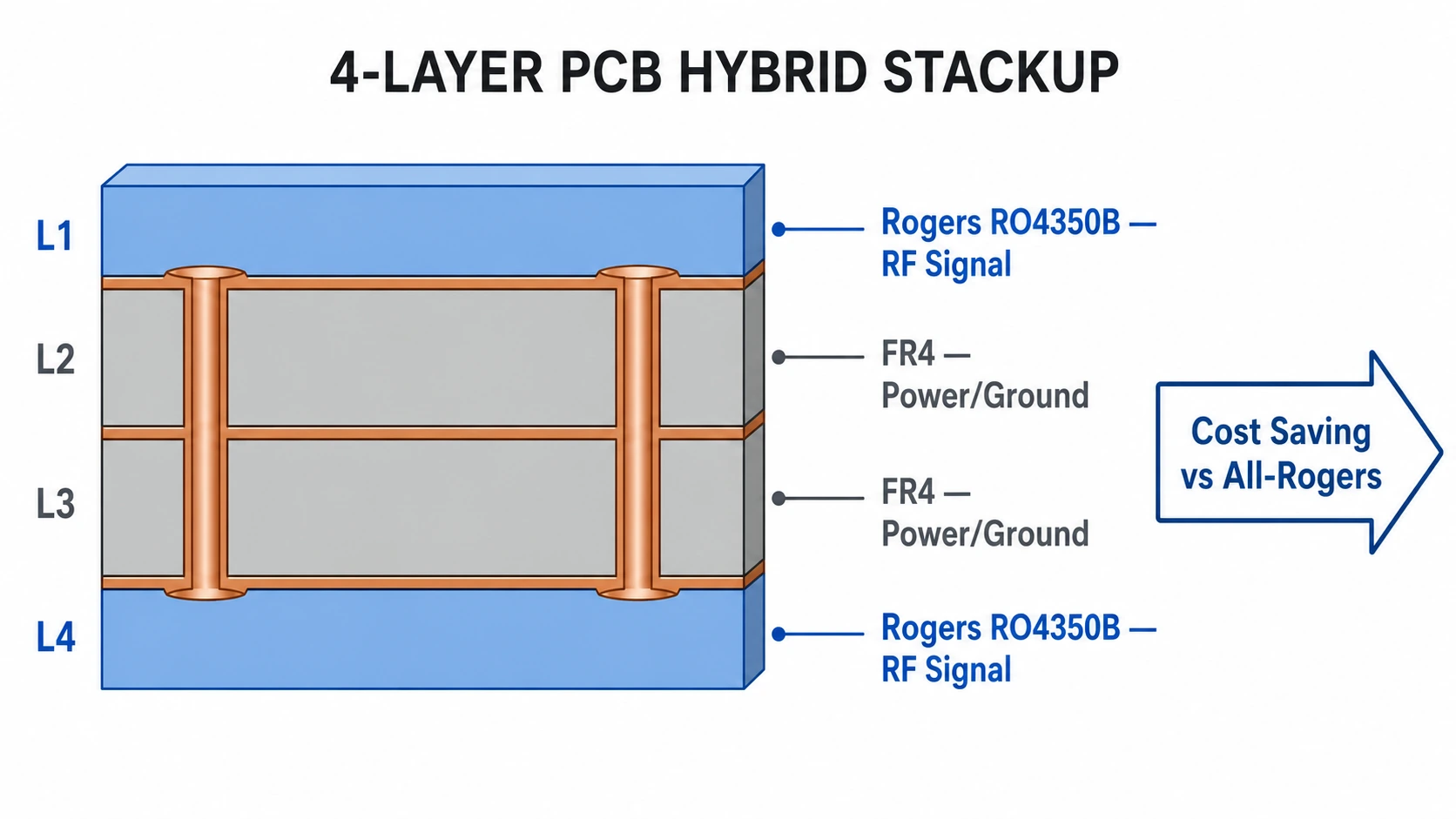
1. Use FR4 + Rogers Hybrid Stackup

For multi-layer RF PCB, place Rogers material only on the outer RF signal layers and use FR4 for inner power and ground planes. A 4-layer hybrid stackup with RO4350B outer layers and FR4 inner layers costs 40–55% less than an all-Rogers 4-layer board, with negligible RF performance difference for most applications below 12 GHz. See FR4 + Rogers hybrid stackup guide for design rules.

2. Use RO4350B Instead of PTFE Where Performance Allows

Rogers RO4350B (Df 0.0037) is suitable for most RF applications below 12 GHz and costs significantly less than PTFE materials (RO3003, RT5880) because it uses FR4-compatible manufacturing — no plasma activation required. If your design operates below 12 GHz and the link budget tolerates Df 0.0037, RO4350B is the most cost-effective Rogers option.

3. Consider Taconic RF-35 as RO4350B Alternative

Taconic RF-35 (Dk 3.5, Df 0.0018) offers 50% lower Df than RO4350B at similar Dk — at approximately the same material cost. If your design requires lower loss than RO4350B but doesn’t need PTFE performance, RF-35 can reduce insertion loss without the PTFE process premium. Note that RF-35 is PTFE-based and does require plasma activation. See Taconic RF PCB materials guide for comparison.

4. Order in Larger Quantities

The Rogers material panel cost is fixed regardless of how many boards are cut from it. Ordering 20 boards instead of 5 from the same panel reduces per-board material waste cost by 50–70%. For prototype-to-production transition, ordering a slightly larger prototype quantity (10–20 boards instead of 5) can reduce unit cost significantly.

5. Use Chinese Direct Factory vs Western Fabricator

A capable Chinese Rogers PCB factory offers 40–60% lower unit cost than equivalent Western fabricators for prototype and low-volume production — using the same Rogers materials, same IPC standards, same TDR verification. See Rogers PCB manufacturer China guide for verification checklist and capability comparison.

When the Rogers PCB Premium Is Justified

Rogers PCB premium is justified when the application actually requires it — and not all RF designs do. A few guidelines:

  • Below 500 MHz with short traces: standard FR4 is adequate. Rogers premium not justified.
  • 500 MHz to 3 GHz: FR4 works for short traces; Rogers RO4350B needed for long RF traces or tight insertion loss budget.
  • 3 GHz to 12 GHz: Rogers RO4350B standard. PTFE not required unless Df budget is very tight.
  • Above 20 GHz: PTFE (RO3003, RT5880) required. Premium is mandatory.
  • 77 GHz radar, Ka-band, wideband EW: PTFE mandatory, no substitution.

Conclusion

Rogers PCB costs 3–8× more than FR4 due to material cost, process complexity for PTFE grades, yield loss, and TDR verification. The largest cost reduction opportunity is hybrid FR4 + Rogers stackup, which reduces cost 40–55% vs all-Rogers for multi-layer designs. For single and double layer RF PCB, RO4350B from a capable Chinese direct factory offers the best cost-performance balance for applications below 12 GHz. Riching PCB manufactures Rogers PCB with no MOQ, 5–7 day prototype for RO4350B, and 7–10 days for PTFE. See Rogers materials page for available grades and thicknesses.

Get a Rogers PCB Quote — No MOQ

RO4350B from USD 120 for 10 boards. RO3003 PTFE from USD 200. Send the following for an exact quote:

  • Gerber files + NC drill file
  • Rogers material grade and dielectric thickness
  • Layer count and stackup (all-Rogers or hybrid)
  • Board size and quantity
  • Controlled impedance requirements

WhatsApp +86 13760473650 — quotation within 4–8 hours

Q&A

Rogers PCB Price Q&A

Common questions about Rogers PCB cost vs FR4, what drives the price premium, cost reduction strategies and minimum order quantity.

How much more does Rogers PCB cost compared to FR4?

3–8× more. A 2L RO4350B prototype (100×100mm, 10 boards): USD 120–180 vs USD 25–40 for FR4. RO3003 PTFE: USD 200–280 for same spec. Multiplier depends on board size, layer count, quantity and whether PTFE is involved.

Why is Rogers PCB so much more expensive than FR4?

Five drivers: (1) Raw material — RO4350B 10–15× more per m² than FR4. (2) PTFE plasma activation adds 15–25% process cost for RO3003/RT5880. (3) Higher yield loss — PTFE 5–15% vs FR4 1–3%. (4) Panel waste — Rogers sold in full panels. (5) TDR verification adds USD 30–80 per lot.

What is the most effective way to reduce Rogers PCB cost?

FR4 + Rogers hybrid stackup — Rogers on outer RF layers, FR4 on inner layers. Reduces 4-layer board cost 40–55% vs all-Rogers with negligible RF performance difference below 12 GHz. Using RO4350B instead of PTFE where performance allows also eliminates the plasma activation premium.

Is Rogers RO4350B always necessary for RF PCB?

No. Below 500 MHz short traces: FR4 adequate. 500 MHz–3 GHz: FR4 for short traces, RO4350B for long traces or tight loss budget. Above 3 GHz: RO4350B standard. Above 20 GHz: PTFE (RO3003, RT5880) required. Paying Rogers premium where FR4 works is the most common unnecessary cost in RF PCB design.

What is the minimum order for Rogers PCB from Riching PCB?

No MOQ — from 1 board. RO4350B 2L prototype (100×100mm, 10 boards) from ~USD 120. RO3003 PTFE from ~USD 200. Lead time: RO4350B 5–7 days, RO3003/RT5880 7–10 days. WhatsApp: +86 13760473650.

PCB Project Review

Request a PCB Quote

Upload your Gerber ZIP file and project requirements. Our engineering team will review your PCB material, stackup, impedance needs, surface finish, and production quantity before quoting.

Please prepare:

  • Gerber files in ZIP format
  • PCB material or stackup requirements
  • Controlled impedance notes if available
  • Prototype or batch production quantity
ZIP format only. Please compress all Gerber and drill files into one ZIP package before uploading.